
21
- Source:
- ukiyo-e.org
Description
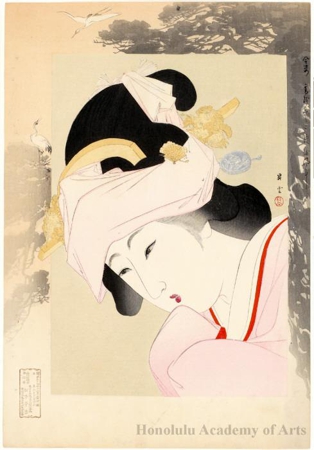
Plate 21 from Yamamoto Shoun's serial album Women in Their Pursuits extends the artist's patient survey of Meiji feminine life into one of the album's later compositions. By this point in the series, Shoun has confidently settled into the visual idiom that defines his contribution to Meiji bijin-ga: a single woman framed by generous white space, her form built from brushed outlines that recall Kano and Maruyama-Shijo painting, and her clothing rendered in a calibrated palette of indigo, persimmon, gray, and lacquered black. Shoun, born in 1870 in Kochi prefecture, trained in classical Japanese painting before turning to woodblock design and built a reputation in the 1890s and 1900s as one of the most subtly observant chroniclers of contemporary Japanese women, particularly through his long-running albums Women in Their Pursuits and Ima Sugata (Modern Figures). The two projects ran in parallel and reinforce each other, with the present series leaning more heavily into vocation and activity while Ima Sugata documented modes of dress and bearing. The print is preserved in the Japanese Art Open Database indexed by ukiyo-e.org, which has digitized the album as a complete sequence so that researchers and collectors can read plates against their neighbors. Plate 21 should be read in that context. It is a quiet image, but it gains weight when set among its siblings, contributing to an album-length portrait of late Meiji womanhood that is more sociological and more humane than most bijin-ga of the period. The sheet exemplifies why Shoun is now regarded as one of the most important bridge figures between the Edo ukiyo-e tradition and the early-twentieth-century shin hanga movement.
More Prints by Yamamoto Shoun


Featured in Collections
Curated cross-cuts that include this print.
Frequently Asked Questions
21 was created by Yamamoto Shoun (山本昇雲).