
22
- Source:
- ukiyo-e.org
Description
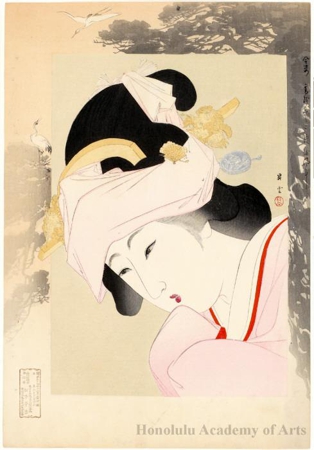
Plate 22 from Yamamoto Shoun's Women in Their Pursuits comes from the album's late sequence, where Shoun's portraits of Meiji-era women acquire their full cumulative force. The image presents another patient observation of a single figure absorbed in an everyday task, rendered with the brushed outlines, restrained palette, and generous use of unprinted paper that characterize the entire set. Shoun, born in Kochi in 1870 and trained in Kano and Maruyama-Shijo painting before he turned to woodblock design in the 1890s, drew on his classical instruction to refine the visual idiom of Meiji bijin-ga, replacing the courtesans of Edo ukiyo-e with the middle-class women of contemporary Tokyo. His celebrated companion series Ima Sugata (Modern Figures) developed the same project with a sharper focus on outward bearing, while Women in Their Pursuits concentrated on vocation and activity. The print is preserved in the Japanese Art Open Database indexed by ukiyo-e.org, which holds the album as a complete digitized sequence for serial study. Plate 22 thus belongs to a wider documentary effort, and the album's true subject becomes clear only when the sheets are read together: not any single Meiji woman, but a generation of women, each engaged in her own ordinary task and given the kind of careful attention that earlier ukiyo-e artists reserved for the celebrated beauties of the pleasure quarters. The sheet's quietness is its strength. It allows Shoun's sympathy for his subjects to come through without rhetorical embellishment, and it confirms his standing as one of the most humane chroniclers of late Meiji life and as an essential bridge figure between Edo ukiyo-e and twentieth-century shin hanga.
More Prints by Yamamoto Shoun


Featured in Collections
Curated cross-cuts that include this print.
Frequently Asked Questions
22 was created by Yamamoto Shoun (山本昇雲).