
5
- Source:
- ukiyo-e.org
Description
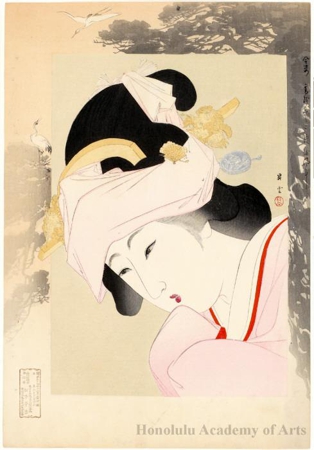
Plate 5 from Yamamoto Shoun's Women in Their Pursuits closes the album's opening sequence with another careful study of a Meiji-era woman absorbed in a daily task. By this point the album's visual rules have been firmly established, and the present sheet conforms to them with quiet confidence: a single figure framed against generous unprinted ground, brushed calligraphic outlines that taper like writing, and a restrained palette designed to avoid the harsher aniline saturations of much late Meiji commercial printing. Shoun, born in Kochi in 1870 and trained in Kano and Maruyama-Shijo painting before turning to woodblock design in the early 1890s, brought a painter's economy to bijin-ga, and the print exemplifies that approach. Within the wider Meiji bijin-ga tradition his choice of subject was distinctive. Rather than reuse the famous courtesans of Edo ukiyo-e, he documented the middle-class women of modernizing Tokyo, an editorial decision he extended into his celebrated parallel album Ima Sugata (Modern Figures). The print is preserved in the Japanese Art Open Database indexed by ukiyo-e.org, which has digitized the entire Women in Their Pursuits album as a coherent sequence for serial study. Plate 5 thus completes the album's first arc, contributing another observation to the cumulative portrait of Meiji feminine life that is the project's true subject. Even on its own it is a thoughtful sheet, and read among its siblings it confirms why Shoun is now regarded as one of the most consistent and humane chroniclers of late Meiji daily life, a bridge between the Edo ukiyo-e tradition and the early-twentieth-century shin hanga movement that followed.
More Prints by Yamamoto Shoun


Featured in Collections
Curated cross-cuts that include this print.
Frequently Asked Questions
5 was created by Yamamoto Shoun (山本昇雲).