
6
- Source:
- ukiyo-e.org
Description
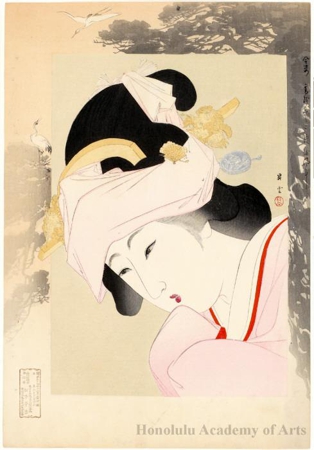
Plate 6 from Yamamoto Shoun's Women in Their Pursuits sits in the album's opening stretch, where the artist's design language is still revealing its priorities. Like its siblings, the print offers a single Meiji-era woman caught in the middle of an ordinary task, framed by generous unprinted ground and rendered in the muted, painterly palette that became Shoun's signature. Shoun, born in 1870 in Kochi prefecture, trained in Kano and Maruyama-Shijo painting before turning to woodblock design in the early 1890s, and the influence of those classical schools shaped his approach to bijin-ga, lending his outlines an unusual calligraphic suppleness and his colors a restrained warmth. Within the Meiji bijin-ga tradition he distinguished himself by replacing the famous courtesans and stage beauties of Edo ukiyo-e with the middle-class women of modernizing Tokyo, treating them as worthy subjects for serial portraiture. His celebrated companion album Ima Sugata (Modern Figures) shared the same impulse with a focus on dress and outward bearing, while Women in Their Pursuits emphasized what its subjects were actually doing. The print is preserved in the Japanese Art Open Database indexed by ukiyo-e.org, which has digitized the entire album as a single coherent sequence to allow for comparative reading. Plate 6 thus contributes to a larger cumulative portrait of late Meiji feminine life. Even on its own it is a tender observation, and read alongside its siblings it helps to define the album's quiet, sociological ambition: to record a generation of women not by their fame or beauty but by the patient daily activities through which they organized their lives during one of the most consequential decades in modern Japanese history.
More Prints by Yamamoto Shoun


Featured in Collections
Curated cross-cuts that include this print.
Frequently Asked Questions
6 was created by Yamamoto Shoun (山本昇雲).