
8
- Source:
- ukiyo-e.org
Description
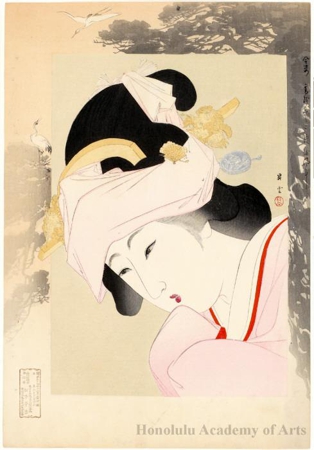
Plate 8 of Yamamoto Shoun's Women in Their Pursuits continues the album's second arc with another patient observation of a Meiji-era woman absorbed in a daily task. As with the rest of the set, the print works through brushed calligraphic outlines, a restrained palette, and the generous use of unprinted paper that became Shoun's signature, all of which encourage the viewer to focus on a single figure's posture and concentration rather than on incident or narrative drama. Shoun, born in 1870 in Kochi prefecture and trained in Kano and Maruyama-Shijo painting before turning to woodblock design in the early 1890s, drew on his classical instruction to develop a distinctive visual idiom within the Meiji bijin-ga tradition. He extended the genre beyond the celebrated courtesans of Edo ukiyo-e into the middle-class daily life of contemporary Tokyo, and his parallel album Ima Sugata (Modern Figures) developed the same impulse with an emphasis on dress and outward bearing, while Women in Their Pursuits focused on vocation and activity. The print is preserved in the Japanese Art Open Database indexed by ukiyo-e.org, which holds the album as a complete digitized sequence so that researchers and collectors can study the plates in their intended order. Plate 8 belongs to that ongoing serial portrait of late Meiji womanhood, and its full meaning emerges only when it is read alongside its siblings. In aggregate the album builds a sustained, multi-plate portrait of a generation, and plate 8 is one of the patient observations that makes that portrait possible, confirming Shoun's stature as one of the most humane chroniclers of Meiji bijin-ga and a key bridge figure between Edo ukiyo-e and twentieth-century shin hanga.
More Prints by Yamamoto Shoun


Featured in Collections
Curated cross-cuts that include this print.
Frequently Asked Questions
8 was created by Yamamoto Shoun (山本昇雲).