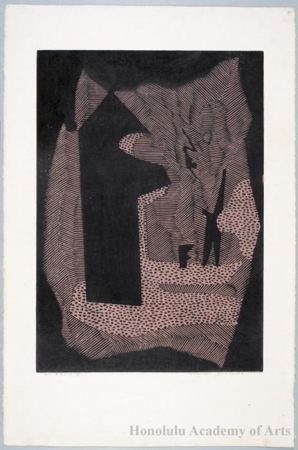
Empty Day
- Medium:
- Woodblock print
- Edition:
- Self-printed
- Source:
- Honolulu Museum of Art
Description
The title "Empty Day" evokes a specific emotional state: not despair but a kind of hollowed-out stillness, a day drained of event or purpose. Masaji translates this psychological condition into abstract visual form, likely using open expanses of muted color punctuated by sparse, isolated marks. The sosaku-hanga approach allowed him to work through such emotional subjects directly in the carving and printing process, treating the block as a surface for improvised mark-making rather than the reproduction of a predetermined design. The print belongs to a strain of postwar Japanese abstraction that drew on Buddhist concepts of emptiness (ku) and impermanence (mujo) while engaging simultaneously with Western abstract expressionism. Masaji's version of this synthesis is quieter and more contained than the gestural excess of action painting.
More Prints by Yoshida Masaji


More Abstract Prints

![[abstract composition with diagonal woodgrain] by Gen Yamaguchi](https://1.api.artsmia.org/800/135949.jpg)
Featured in Collections
Curated cross-cuts that include this print.
Frequently Asked Questions
Empty Day was created by Yoshida Masaji (吉田政次).
Empty Day depicts abstract.