
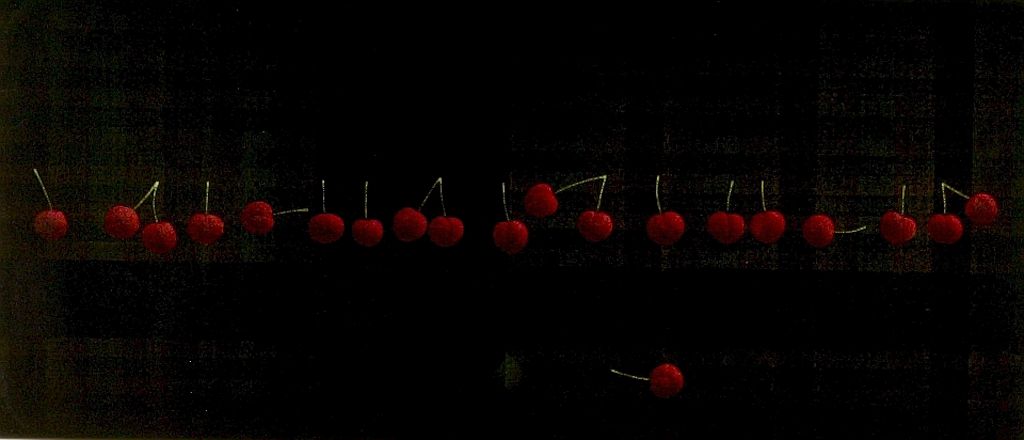
Nineteen Cherries and One, Shôwa period, dated 1965
- Source:
- ukiyo-e.org
Description
Nineteen Cherries and One, dated 1965, is a Shōwa-period color mezzotint by Yozo Hamaguchi (1909-2000), the artist who almost single-handedly revived and modernized the mezzotint in the twentieth century. The composition arrays a cluster of cherries against the deep, velvety black ground that became Hamaguchi's signature, with a single cherry set slightly apart from the group as the quiet pictorial event that gives the print its title. The fruits emerge from darkness with a soft, palpable roundness, their skins catching faint reflections that read as both light on lacquered objects and as the breath of color trapped within Hamaguchi's painstakingly rocked copper plates. This impression is preserved in the Harvard Art Museums collection, with a digital reproduction accessible via ukiyo-e.org. Hamaguchi's still lifes of cherries, walnuts, and butterflies are central to the story of Paris-Japan postwar printmaking: trained in oil painting in Tokyo, he settled in Paris in 1930, returned to Japan during the war, and went back to Paris in 1953, where he refined a color mezzotint technique that required printing one plate per color, each plate rocked by hand for weeks before any image could be incised. By 1965 his prints were circulating widely through exhibitions in Paris, Tokyo, and New York, and works of this kind helped redefine what mezzotint could mean after centuries of reproductive use. Within the broader sōsaku-hanga and international print revival of postwar Japan, Hamaguchi occupies a distinct position: a Japanese artist working in a European intaglio medium, using its blackest possible darks to slow the viewer down and direct attention to the smallest perceptual incidents in an otherwise austere field.
More Prints by Yozo Hamaguchi
Featured in Collections
Curated cross-cuts that include this print.
Frequently Asked Questions
Nineteen Cherries and One, Shôwa period, dated 1965 was created by Yozo Hamaguchi (浜口陽三).