
Hall of the Great Buddha (Nara Daibutsuden)
by Kawase Hasui
- Date:
- 1950
- Medium:
- Color woodblock print
- Format:
- Oban
- Publisher:
- Watanabe Shozaburo
- Edition:
- Published by Watanabe Shozaburo
- Source:
- Art Institute of Chicago
Description
Hall of the Great Buddha at Nara (Nara Daibutsuden), published in 1950, depicts the Todai-ji's Great Buddha Hall (Daibutsuden) — the largest wooden building in the world, housing the 15-meter bronze Buddha cast in the eighth century — in a postwar composition that reasserts the ancient monument's continued grandeur. The Great Buddha Hall, its massive gabled roof rising above Nara's deer park, was a subject demanding compositional care to convey the scale of the structure relative to its natural surroundings. The 1950 date, five years after the war's end, gives this depiction of Japan's most monumental ancient structure a particular cultural resonance.
More Prints by Kawase Hasui


More Temples & Shrines Prints
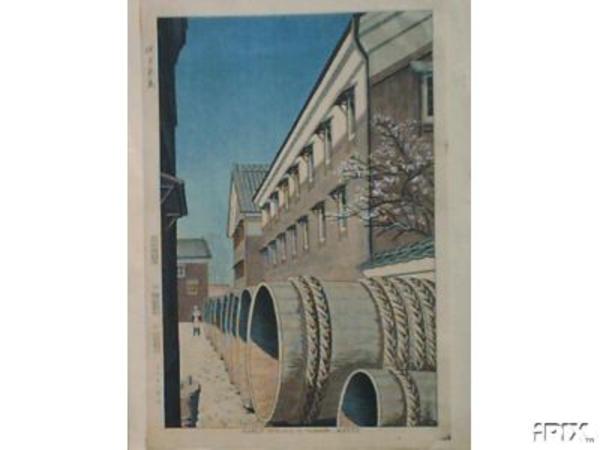
Fushimi Inari Temple
伏見稲荷
Woodblock print

The Compound of the Tenman Shrine at Kameido in the Snow (Kameido Tenmangu keidai no yuki), from the series "Famous Places in the Eastern Capital (Toto meisho)"
c. 1832/38
Color woodblock print; oban
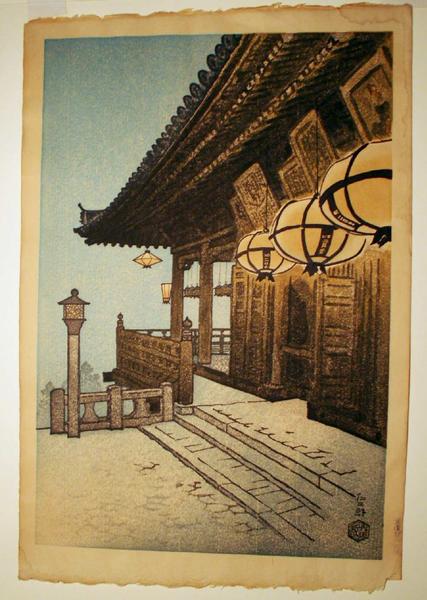
Temple with lanterns
Woodblock print

A Section of the Byodo Temple at Uji (Uji Byodoin no ichibu), from the series "Souvenirs of Travel, Second Series (Tabi miyage dai nishu)"
Uji Byodoin no ichibu
1921
Color woodblock print; oban
Featured in Collections
Curated cross-cuts that include this print.
Frequently Asked Questions
Hall of the Great Buddha (Nara Daibutsuden) was created by Kawase Hasui (川瀬巴水) in 1950.
Hall of the Great Buddha (Nara Daibutsuden) was published by Watanabe Shozaburo (1950).
Hall of the Great Buddha (Nara Daibutsuden) depicts temples & shrines, religious, and architecture, set at Nara.