
The Great Buddha, Kamakura (Kamakura Daibutsu)
Kamakura Daibutsu
by Kawase Hasui
- Date:
- 1930
- Medium:
- Color woodblock print
- Format:
- Oban
- Dimensions:
- 24.1 × 36.3 cm
- Publisher:
- Watanabe Shozaburo
- Edition:
- Published by Watanabe Shozaburo
- Source:
- Art Institute of Chicago
Description
The Great Buddha, Kamakura presents one of Japan's most universally recognized monuments — the colossal bronze Amida Buddha statue at Kotoku-in temple in Kamakura. Created in 1930 and published by Watanabe Shozaburo, this print depicts the thirteen-meter-tall seated figure with the serene composure and monumental presence that has made it an enduring symbol of Japanese Buddhist art. Hasui frames the great statue within its natural setting, with trees flanking the composition and visitors or pilgrims providing scale that emphasizes the Buddha's immense proportions.
The Kamakura Daibutsu was cast in bronze in 1252 during the Kamakura period and has sat in the open air since a tsunami destroyed the hall that originally housed it in the fifteenth century. By the time Hasui depicted it, the statue had been a destination for pilgrims and tourists for centuries and had been widely reproduced in photographs and prints. Hasui's challenge was to bring fresh artistic vision to one of the most familiar subjects in Japanese visual culture, and he achieved this through his characteristic sensitivity to atmospheric conditions and the interplay of light and shadow across the statue's massive bronze surfaces.
The print reflects Hasui's interest in the spiritual dimension of Japanese landscape, a theme that runs throughout his career from temple scenes to sacred groves. The Great Buddha is depicted not merely as a tourist attraction but as a living presence in the landscape, its calm expression and meditative posture radiating an aura of peace that extends to the surrounding environment. The technical printing is notable for the rendering of the bronze patina, achieved through carefully controlled overprinting of multiple color blocks. This composition demonstrates how Hasui could find personal artistic expression even within the most conventional of subjects, transforming a well-known landmark into a contemplative study of permanence and spiritual tranquility.
More Prints by Kawase Hasui

More Temples & Shrines Prints
Fushimi Inari Temple
伏見稲荷
Woodblock print

The Compound of the Tenman Shrine at Kameido in the Snow (Kameido Tenmangu keidai no yuki), from the series "Famous Places in the Eastern Capital (Toto meisho)"
c. 1832/38
Color woodblock print; oban
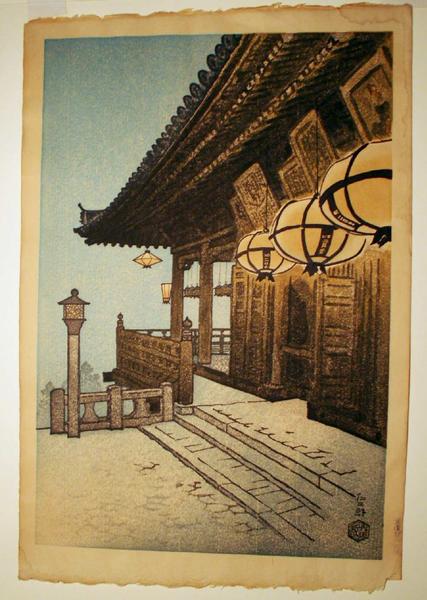
Temple with lanterns
Woodblock print

A Section of the Byodo Temple at Uji (Uji Byodoin no ichibu), from the series "Souvenirs of Travel, Second Series (Tabi miyage dai nishu)"
Uji Byodoin no ichibu
1921
Color woodblock print; oban
Featured in Collections
Curated cross-cuts that include this print.
Frequently Asked Questions
The Great Buddha, Kamakura (Kamakura Daibutsu) (Kamakura Daibutsu) was created by Kawase Hasui (川瀬巴水) in 1930.
The Great Buddha, Kamakura (Kamakura Daibutsu) uses Bokashi, Nishiki-e, and Moku-hanga, on color woodblock print.
The Great Buddha, Kamakura (Kamakura Daibutsu) was published by Watanabe Shozaburo (1930).
The Great Buddha, Kamakura (Kamakura Daibutsu) depicts temples & shrines and religious, set at Kamakura.
The Great Buddha, Kamakura (Kamakura Daibutsu) measures 24.1 × 36.3 cm (Oban format).