How to Identify a Genuine Japanese Woodblock Print: An Authentication Guide
You see a print at an estate sale, an antiques fair, or an online auction. It looks right — the colors are vibrant, the paper feels textured, the seals are there. Is it a genuine original Japanese woodblock print, or a reproduction worth a fraction of its asking price? This is one of the hardest practical problems in collecting, and one that even experienced dealers occasionally get wrong. This guide walks through the authentication process step by step, in the order you should actually use it.

The Five Categories of "Not an Original"
Before you can spot a fake you need to know what you might be looking at. There are five distinct categories of non-original Japanese print, with very different value implications:
- Modern photomechanical reproductions — printed by offset lithography, halftone, or inkjet from a digital scan. Often sold honestly as "reproduction" or "art print" but sometimes laundered into auctions. Value: $5–50 framed.
- Posthumous/estate woodblock editions — pulled from the original or recarved blocks after the artist's death, often by descendants or workshops. Made the same way as originals, with the same materials, but not lifetime impressions. Value: 5–20% of a lifetime impression.
- Late lifetime impressions from worn blocks — pulled by the original publisher near the end of an edition's run, with blocks that have lost crispness. Value: 30–60% of a first impression.
- Tourist-trade and souvenir woodblock prints — made by hand using traditional techniques but for the tourist market, often labelled with the original artist's name in a misleading way. Value: $30–200.
- Outright forgeries — deliberate fakes designed to deceive. Rare for major prints (the technique is hard to fake well) but they exist for the most valuable designs. Value: zero.
A confident authentication separates these five categories, not just "real vs. fake." We'll work through the steps that allow you to make that distinction.
Step 1: Look at the Paper Under a Strong Light
Authentic Japanese woodblock prints are printed on washi — traditional handmade paper made from the inner bark of the kōzo (paper mulberry) plant, or sometimes mitsumata or gampi. The paper is one of the easiest distinguishing features once you know what to look for.
Hold the print up to a bright light source (a window or a strong lamp). Authentic washi shows:
- Long, visible plant fibers running through the sheet, easily visible as the light passes through.
- Subtle thickness variation — washi is not perfectly uniform; you should see slight cloud-like density variations.
- No regular fiber pattern — machine-made paper shows a clear lined pattern from the mesh; handmade washi does not.
- A faint warmth in the white — aged washi is never bright optical-bright-white, but slightly cream or honey-colored even when fresh.
What to watch for:
- Smooth, uniform machine paper = modern reproduction, almost without exception.
- Wood-pulp paper (the slightly grayish off-white of newsprint or cheap print stock) = either a modern reproduction or a low-grade tourist piece.
- Bright optical-brightener white under UV = modern paper, generally post-1960s.
For Edo-period and early Meiji ukiyo-e the paper is typically a smooth, thin hosho washi. For shin-hanga the paper is heavier, sometimes with deliberate texture. Sōsaku-hanga papers vary widely and were sometimes Western papers — that movement was less doctrinaire about materials.
Step 2: Examine the Surface for Embossing and Texture
A genuine hand-burnished woodblock print has subtle physical depth that no photomechanical reproduction can fake. Tilt the print under raking light (light from a low angle) and look at the surface obliquely.
You should see:
- Slight relief along carved lines where the baren has pressed the paper into the small recesses cut by the carver.
- [Karazuri](/glossary/karazuri) blind embossing in some prints — areas pressed into the paper without ink, used for snow textures, cloud patterns, fabric brocades, and architectural details. These are completely invisible in a photomechanical reproduction.
- The subtle pile of ink sitting in the paper rather than flat on its surface. Water-based sumi and pigments soak into washi rather than sitting on top.
What to watch for:
- A perfectly flat, glossy surface under raking light = offset or inkjet reproduction.
- A regular dot pattern visible under 10× magnification = halftone offset reproduction. Use a loupe or jeweler's eyepiece; if you see a CMYK dot rosette pattern, it is not an original.
- Visible printer-bleed marks (small ink edges where toner stuck to the wrong area) = inkjet reproduction.
This one test — looking for the printing-dot pattern under magnification — settles maybe half of all authentication questions immediately. Real woodblock prints have no halftone dots because the color is laid down as a continuous wash from a carved surface.
Step 3: Read the Seals and Signatures
Every authentic Japanese woodblock print carries one or more seals (carved stamp impressions) and usually an artist's signature, in addition to the published name in the design. These are critical because their style and combination encode when the print was made.
The basic anatomy:
- The artist's signature in the design, often in the lower corner. Usually a brushed signature followed by an "in" (kanji for "seal") and a carved seal impression below.
- The publisher's seal identifying the hanmoto firm that produced the print. For ukiyo-e this is usually a small mark in the margin or corner. For shin-hanga it is often a Watanabe seal or another publisher's mark.
- The censor's seal(s) on Edo-period prints — government approval stamps. These changed format over time and can date a print to a specific period within 1–3 years.
- The date seal on Edo prints — a small zodiac-cycle mark indicating the year of approval.
- The carver and printer seals — some shin-hanga publishers (Watanabe especially) included the names of the specific carver and printer on a given edition. These are valuable for distinguishing first editions from later restrikes.

For specific reference work see our guides:
- Reading Seals and Signatures on Japanese Prints — a full walkthrough of the censor seal, date seal, and publisher seal system on Edo prints.
- How to Identify Hiroshige Print Editions — edition-state identification using publisher seals across the long Hiroshige reprint history.
If a print is missing seals that should be present for its claimed period and artist, that is a serious flag. Reproductions sometimes copy the visible image but cannot reproduce all the small censor and publisher marks that authentic Edo prints carry in the margins.
Step 4: Match the Design to an Authoritative Reference
Every famous Japanese print is catalogued in one or more standard reference works. A confident authentication compares the print in hand to a published illustration of a verified authentic impression from a museum collection.
Useful references (we link to detailed lists in our recommended books guide):
- For Hokusai, Roger Keyes's *Catalogue Raisonné* and the Forrer monograph.
- For Hiroshige, the Edward Strange and Sebastian Izzard catalogs.
- For Hasui, the Watanabe series catalogs and Reigle Newland's *Crows, Cranes & Camellias*.
- For Yoshida, the catalog raisonné by Skibbe & Yoshida.
Online, the Art Institute of Chicago and British Museum collections are searchable and contain high-resolution images of verified impressions.
When you compare:
- Match exact composition, color choices, and proportions. Reproductions sometimes shift slightly or simplify color.
- Match the seal locations and types, not just their presence.
- Match the paper format size — a real ōban is roughly 39 × 26 cm; a reproduction that's been cropped to a non-standard size is suspicious.
If you cannot find your print in any reference but a major artist is claimed, that is a flag — most published designs are known.
Step 5: Check Color Saturation, Aging, and Bokashi Quality
Authentic original impressions printed during the artist's lifetime have the deepest, richest colors the design ever received. After the original blocks were used a few hundred times, the carved details began to lose crispness and color saturation declined.
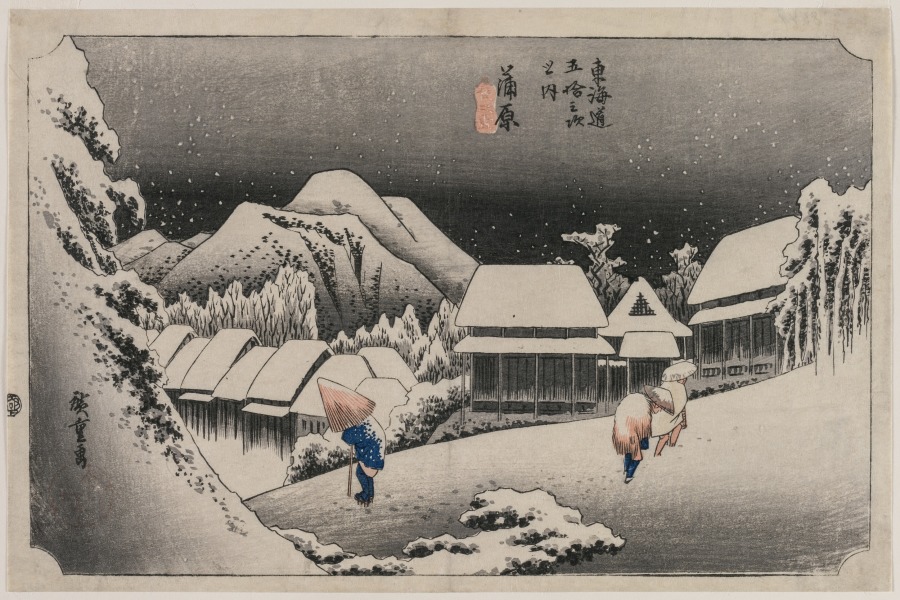
Things to assess:
- [Bokashi](/glossary/bokashi) gradations — first impressions show the printer's smoothest, deepest gradient work. Late impressions have abrupt color transitions or banding where the printer's skill was less refined or the carved gradient zone in the block had eroded.
- Color overlay registration — first impressions have perfectly aligned color blocks. Late impressions may show small mis-registrations where colors don't quite align.
- Color choice — many famous Edo prints were originally printed in subtle, restrained palettes, then re-issued in late editions with brighter Meiji-era synthetic pigments. A *Great Wave* with screaming bright Prussian blue and vermillion sky is almost certainly a late impression or reproduction; the authentic first edition is more atmospheric.
- Paper aging — genuinely old paper has subtle uniform yellowing especially at the edges, foxing (small brown spots), and natural acidic darkening on the reverse if mounted to acidic backing. *Artificially aged* paper (tea-stained reproductions) usually shows uneven coloration that doesn't match how paper actually ages.
For shin-hanga specifically, the Watanabe seal style is the single most useful dating tool: there are six recognized periods of Watanabe seal designs running from c. 1916 to the present, and a Hasui print with a post-1957 seal is necessarily a posthumous edition, not a lifetime impression. Specialist dealer sites map the seal evolution; consult them before paying lifetime-edition prices.
Step 6: Verify Provenance Where Available
For any high-value print, ask about provenance — the documented chain of ownership. A clean provenance back to a known collection or a reputable dealer significantly raises confidence.
What constitutes useful provenance:
- A dealer's invoice from a recognized firm.
- A previous auction record (with auction catalogue reference).
- A previous collection bookplate or collector's seal on the reverse.
- A purchase record going back several owners.
What doesn't constitute provenance:
- "I bought it from a man at a flea market."
- "It was my grandmother's; she lived in Japan."
- An estate sale listing with no documentation.
For high-value prints, a clear-glass-frame examination is also part of due diligence. Ask the seller to remove the print from any frame and let you examine the back. Many issues become visible only on the reverse: backing tape, mounting glue residue, signs of having been trimmed.
Step 7: When to Pay for an Expert Opinion
There are three situations where you should consult a specialist before buying:
- The asking price is above $2,000. At that level the cost of expert authentication ($100–300 typically) is small insurance.
- The design is among the top 50 most-reproduced in the field. Hokusai's *Great Wave*, *Red Fuji*, Hiroshige's *Plum Garden*, Hasui's *Inokashira Benten*, the Sharaku actor portraits. These have been reproduced in every conceivable way; an expert eye catches things a checklist misses.
- You see something inconsistent that you cannot explain. Trust your instincts. If the seller's story doesn't match the object, walk away or pay for an opinion.
Specialist dealers in major cities (Castle Fine Arts in San Francisco, The Tolman Collection in Tokyo, Hara Shobō in Tokyo, Egenolf Gallery in California, others listed in our recommended dealers guide) will provide authentication opinions for a fee or as part of a purchase. Major auction houses (Christie's, Sotheby's, Bonhams) authenticate items they sell but generally not external pieces.
Common Red Flags Summary
A consolidated list of the warning signs from the steps above:
- Smooth machine paper with no visible fibers under transmitted light.
- Halftone dot pattern visible under 10× magnification.
- No physical relief or surface texture under raking light.
- Bright, uniform optical-brightener white in the paper.
- Missing publisher, censor, or date seals where they should be present.
- Inconsistencies between claimed period and seal style.
- The design cannot be matched to any published catalogue raisonné entry.
- Color and bokashi quality that doesn't match published reference images.
- Suspicious or absent provenance for a high-value print.
- The seller is reluctant to remove framing for inspection.
- Price significantly below current market rates.
The last one is worth highlighting: a price too good to be true almost always is. If a "first edition Hasui" is listed at $200 when comparable examples sell for $2,000, the explanation is usually that it is not what it is claimed to be — and occasionally that the seller has a serious problem with their inventory.
Examples of Authentication in Practice
Example: A Hokusai Great Wave
The single most-reproduced Japanese print. There are tens of thousands of authentic impressions across multiple editions spanning two centuries, plus uncountable photomechanical reproductions.
First-edition Hokusai *Great Waves* (printed 1831–1833) have:
- Deep Prussian blue and a more atmospheric, slightly muted color palette.
- The publisher Eijudō seal in the lower left.
- The artist signature in a specific kanji form that changed across Hokusai's career.
- A specific yellowed-tan tonality to the paper.
- They sell at major auction for $200,000+ in fine condition.
A "Great Wave" at a flea market for $80 is, with near-certainty, a modern offset reproduction. A "Great Wave" at $800 is most likely a tourist-trade woodblock reproduction, possibly genuinely hand-printed in modern Japan from recarved blocks but not an antique. Use the magnification test first: photomechanical reproductions are immediately distinguishable under a loupe.
Example: A Kawase Hasui Snow Scene
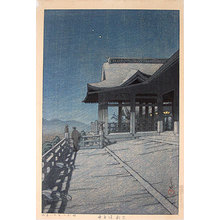
For Hasui, the Watanabe seal is the principal authenticator. The 6mm round "C" seal indicates 1929–1942 (the great pre-war period); the "D" seal post-1953; the "E" seal 1957–1962 (just after Hasui's death — these are mostly posthumous editions from existing blocks). A lifetime impression has the artist's "Hasui" signature in fluent brush handwriting and a clean impression; a posthumous edition typically has a stamped facsimile signature or shows wear in the carved seal. The price gap between lifetime and posthumous editions is roughly 4:1 to 10:1, so the seal identification matters a great deal.
Frequently Asked Questions
Can I authenticate a print from a photograph?
Partially. A photograph can rule out obvious reproductions if the resolution is high enough to see paper fibers and halftone dots, and it can match the design to a reference catalogue. It cannot evaluate paper feel, surface relief, or color saturation accurately. For any high-value purchase, in-person inspection or expert review is required.
Are there modern hand-printed reproductions that are honest?
Yes, and many are excellent. Workshops including the present-day Watanabe firm and several independent studios in Japan and abroad produce honest contemporary mokuhanga reproductions of classic designs using traditional materials. These are typically labeled as such (or sold as reproductions) and priced in the $200–$800 range. They are real woodblock prints — they just aren't antique original impressions of the original artist's work. They have collecting value of their own, just not at antique pricing. See the contemporary mokuhanga movement page.
What about prints labeled "after Hiroshige" or "after Hokusai"?
The "after [Artist]" formulation is the art-historical convention for a work that copies, references, or reproduces another artist's design. It is *always* a tell that the print is not by the named artist. It might be a contemporary tribute by a modern artist, a workshop copy, or a tourist-trade item — but it is not a Hiroshige or a Hokusai. Price accordingly.
How do I tell a Meiji-era reprint from an Edo-era original?
Meiji-period (1868–1912) reprints from Edo-period blocks are common for famous Hiroshige and Hokusai designs. Distinguishing features: Meiji reprints often use synthetic aniline dyes (especially bright red, pink, and purple) that weren't available during the Edo period; the paper is often slightly different (Meiji paper is whiter and more uniform); some Meiji reprints have updated censor seals. The standard reference catalogues mark which editions a given design exists in. The Hiroshige edition guide covers this in detail.
Is a damaged original worth more than a perfect reproduction?
For investment and collecting, yes — almost always. A genuinely-first-edition Hokusai with foxing and a small tear is still a real Hokusai and retains 30–60% of pristine value. A perfect photomechanical reproduction is worth $20 framed. For pure decoration the calculation reverses, but most people interested enough to ask about authentication are also interested in genuine provenance.
What if I think I have a fake but the dealer won't take it back?
Document everything (photos, the listing, communications), then contact the platform's authentication or buyer protection service. For eBay, the "item not as described" path handles this. For auction houses, formal consignment terms usually require authenticity warranties. For private dealers, your remedy depends on the sale contract — but for high-value disputes, an expert authentication report from a recognized specialist is usually decisive.
What to Read Next
- Original vs. Reproduction Japanese Prints — a deeper introduction to the difference between an original print, a reproduction, and an edition state.
- Reading Seals and Signatures on Japanese Prints — the seal and signature system in detail.
- How to Start Collecting Japanese Woodblock Prints — a practical introduction to buying with confidence.
- Best Books on Japanese Woodblock Prints — the catalogue raisonné and reference works that ground every authentication.
Or browse verified artworks — every print on this site is from a museum collection or reputable institutional source, so they make a useful reference image library.
Related Articles
Every Japanese woodblock print carries a constellation of marks — artist signatures, publisher seals, censor stamps, and sometimes carver and printer credits — that together form a detailed record of who made the print, when it was published, and under what authority. Learning to read these marks is one of the most rewarding skills a collector can develop.
You don't need thousands of dollars to start a serious Japanese woodblock print collection. This guide covers the realistic under-$200 market — which artists are genuinely available at this price point, what to look for, what to avoid, and how to build a coherent collection on $50–200 per print.
Hiroshi Yoshida and Kawase Hasui are the two most-collected shin-hanga landscape artists, and new collectors often ask which they should focus on first. This side-by-side comparison covers their biographies, styles, production methods, subject matter, current market prices, and which artist suits which collector.
Start exploring Japanese woodblock prints