Collecting Japanese Woodblock Prints Under $200: Where to Start When the Budget Is Small
There is a persistent assumption that collecting authentic Japanese woodblock prints requires four-figure budgets. It's not true. A patient buyer can acquire genuine, hand-printed, historically significant prints for under $200 — many of them every month, across multiple movements and artists. This guide is the practical roadmap to doing that without ending up with reproductions, fakes, or sad framed posters.
The under-$200 segment is real but it requires discipline. You will not find a first-edition Hasui or a Hokusai *Great Wave* at this price (the floor for either is roughly 10× higher). What you will find — and what makes serious collecting at this budget possible — is summarized in the six paths below.
Path 1: Late-Edition Meiji Hiroshige (and Kunisada)
Hiroshige's most famous landscape series — the *Fifty-three Stations of the Tōkaidō*, the *One Hundred Famous Views of Edo*, the *Sixty-nine Stations of the Kisokaidō* — were reprinted multiple times across the late Edo period and the Meiji era (1868–1912). These late editions were pulled from the original or recarved blocks by legitimate Edo-era publishers and represent the most accessible entry point into historically important ukiyo-e.
What you can buy under $200:
- A Meiji-period Utagawa Hiroshige impression of a *Fifty-three Stations* design in fair-to-good condition: $80–$180.
- A late-Edo or Meiji Utagawa Kunisada actor portrait: $60–$150. Kunisada produced more designs than any other ukiyo-e artist (~20,000 estimated) so supply is enormous.
- A Meiji Utagawa Kuniyoshi warrior print in average condition: $100–$200.
- A late Hiroshige III (Hiroshige's adopted student who used the name) Meiji landscape: $50–$120.
What you sacrifice: these are not lifetime first impressions. Color saturation is reduced; some prints will show toning, foxing, edge wear, or trimmed margins. The catalogues raisonné record these editions as distinct states, often less valued than first impressions, but they are unambiguously authentic original Edo/Meiji woodblock prints.
For edition-state reasoning see our Hiroshige edition guide — the same logic applies to other ukiyo-e artists with reprinted designs.
Path 2: Ohara Koson (and Other Kachō-e)
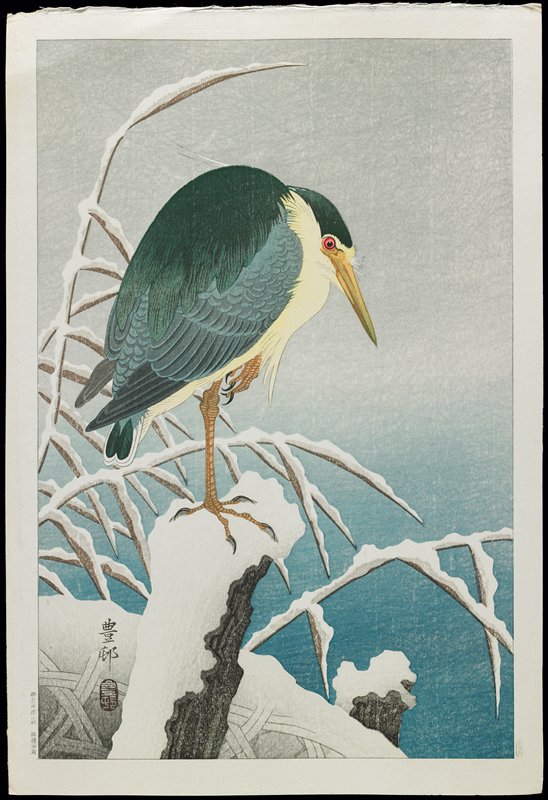
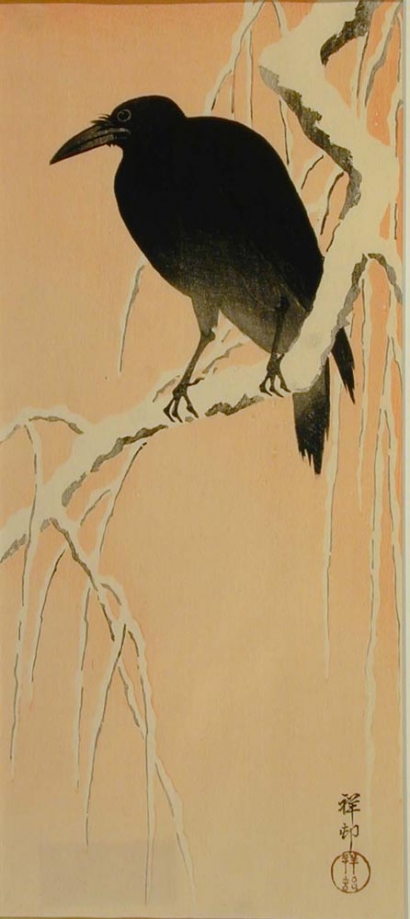
Bird-and-flower prints by Ohara Koson / Shōson are the single best value in the entire shin-hanga market. Koson produced roughly 500 designs across his career, the editions were sometimes large, and the genre is less famous outside specialist collecting circles than Hasui's landscapes. Lifetime impressions in good condition often sell under $300.
What you can buy under $200:
- A Koson bird print in fair-to-good condition with light toning or minor edge wear: $80–$200.
- A Koson "Shōson"-signed print (his later name): often slightly cheaper because the brand recognition is lower.
- Less-known kachō-e artists like Imao Keinen, Bairei, Bunchō, and contemporary kachō painters: $40–$150.
What to look for: Koson is well-documented and most designs appear in standard reference works. Match your candidate to a published image before paying. The Koson market is also large and forgiveness for minor condition issues is high — collectors generally accept light browning of paper since these prints have been displayed for a hundred years.
Path 3: Late Yoshitoshi and Other Late-Period Ukiyo-e
Tsukioka Yoshitoshi is the last great ukiyo-e artist; his late work straddles the Edo and Meiji periods. His most famous series — *One Hundred Aspects of the Moon* — is well-known and expensive at the top tier, but a great deal of Yoshitoshi's output is more affordable.
What you can buy under $200:
- A minor Yoshitoshi print or one from a less-famous series: $80–$200.
- A print from the *Twenty-Four Hours at Shinyanagi* or other smaller series: often $100–$200.
- An impression with condition issues from a major series (small tears, faded color): $120–$200.
- Posthumous Yoshitoshi editions printed from the original blocks before they wore out: $60–$150.
Risk note: Yoshitoshi is heavily reproduced and the price gap between original and reproduction is large. Use the magnification test in our authentication guide to confirm an impression is a real woodblock print and not a modern offset reproduction. A "Yoshitoshi" at $30 is almost always not.
Path 4: Lesser-Known Sōsaku-hanga
The sōsaku-hanga movement (1905–1980) produced enormous variety, from major figures whose work is now expensive (Munakata, Hiratsuka, Saitō) to dozens of mid-career artists whose work is genuinely under-priced. Editions were small, distribution was domestic, and many designs simply have not yet been recognized outside Japan.
What you can buy under $200:
- A Saitō Kiyoshi small print: $100–$200. (His major prints are $500+ but he made many smaller designs that come up affordable.) See Saitō Kiyoshi's profile.
- A Tomikichirō Tokuriki print: $80–$180.
- Lesser-known sōsaku artists, mid-career figures, and twentieth-century regional print clubs: $40–$150.
- Modernist abstract sōsaku-hanga from the 1960s–80s: an under-collected category where strong design work is available cheaply.
What you sacrifice: less name recognition, fewer reference catalogues, more research required per purchase. But the aesthetic ceiling is high — many under-collected sōsaku prints are wonderful objects. The reward is finding work before the market recognizes it.
Path 5: Modern Hand-Printed Reproductions (Honestly Sold)
This category is controversial among serious collectors but has a legitimate place. Several workshops in Japan and abroad produce honest modern woodblock impressions of classic Edo and shin-hanga designs using traditional materials — cherry-wood blocks, washi paper, baren hand-burnishing.
These are not lifetime impressions and they are not posthumous editions from original blocks; they are entirely new productions made by living craftsmen. Honest dealers label them clearly as such.
What you can buy under $200:
- A modern hand-printed Hiroshige *Sudden Shower over Shin-Ōhashi Bridge* by a Tokyo workshop: $100–$200.
- A modern *Great Wave* impression by a Japanese contemporary studio: $80–$180.
- A modern Hasui scene by the David Bull workshop or similar: $100–$250.
What to keep in mind: these are real woodblock prints with real artistic and craft value. They are *not* antique originals and should not be confused with them; the price tells you which you are buying. Sellers who advertise these as "originals" or omit the production date should be avoided — the issue is honest disclosure.
For more on the living tradition see the contemporary mokuhanga movement page.
Path 6: Surimono and Smaller Format Specialties
Surimono — privately commissioned luxury prints, often square, often with poetry — were made in small numbers for poetry circles and New Year's exchanges. The most famous surimono by Hokusai or Shunman are very expensive, but the category includes many lesser-known designs at accessible prices.
Similarly, smaller format prints in the chūban (28 × 21 cm) and koban (23 × 18 cm) sizes are typically cheaper than full-size ōban (39 × 26 cm) examples by the same artists.
What you can buy under $200:
- Edo-period surimono by lesser-known artists: $80–$200.
- Hashira-e (tall pillar prints): often under-priced because they don't fit standard frames; $100–$200.
- Small-format book illustrations and ehon plates: $30–$100 each.
- Single sheets from broken-up Hiroshige or Hokusai books: $80–$200.
Where to Hunt (And Where Not To)
Where the under-$200 market actually lives:
- Specialist online dealers — sites like Egenolf Gallery, The Tolman Collection, Castle Fine Arts, scholten Japanese Art, and various Tokyo and Kyoto specialists list under-$200 inventory regularly. These are the most reliable sources because the dealer has authenticated the work before listing.
- Specialist auction circuits — eBay has a serious Japanese-print collector subculture and reputable sellers; the lower-end of Christie's and Bonhams online sales sometimes includes sub-$500 lots.
- Estate sales in cities with historic Japanese-American populations — San Francisco, Honolulu, Seattle, Los Angeles. Risky but occasional jackpots.
- Print-only collector clubs and societies — Japan Print Association, Japan Art Society of America. Members trade and occasionally sell.
Where the under-$200 market does *not* live:
- General antiques fairs — most "Japanese prints" at these are reproductions or recent decorative items.
- Decorative-art shops — even when authentic, prints sold by general antique dealers are often overpriced because the dealer can't authenticate them and charges for the uncertainty.
- "Vintage poster" shops — almost certainly reproductions.
What You Should Not Buy at This Price
A short list of red flags:
- Anything claimed as a "Hokusai Great Wave" under $300. Modern hand-printed reproductions of this design exist and cost $100–$300 from honest sellers, but the listing should say "reproduction" or "modern impression." A "Hokusai Great Wave" at $80 is offset printing on poster paper.
- "Hashiguchi Goyō" prints at any price under $5,000. Goyō made only 14 designs and even his cheapest work is in five figures.
- "Sharaku" prints under $1,000. Same — small original output, all known designs in five figures.
- "Surimono" listings without provenance and seal verification. Surimono is heavily reproduced and the seals are subtle; this category requires expertise.
- Mid-century Hokusai or Hiroshige in vibrant uniform color. Often Showa-era recarved Watanabe-style decorative prints, sometimes sold as antiques. Beautiful but not Edo originals.
Building a Collection on $200/Month
A realistic monthly plan:
- Month 1–3: Read How to Identify a Genuine Japanese Woodblock Print and the recommended books guide. Browse extensively on this site and major museum collections to develop your eye before purchasing.
- Month 4: First purchase. A Meiji Hiroshige *Tōkaidō* or an Ohara Koson bird print — both are well-documented, often available under $200, and authentic.
- Month 5–6: Second and third purchases. Build coverage of two more areas: perhaps a sōsaku-hanga print and a late Yoshitoshi.
- Month 7–12: Six more prints across different periods and movements. By month 12 you have a small collection of 9 prints across 4 movements at $1,800 invested.
- Year 2 onward: Begin to refine. Sell or upgrade weaker prints; concentrate on the areas you find you love.
After two years at $200/month you have a 24-print collection. That's enough to fill a wall, demonstrate a coherent aesthetic, and form the basis for more selective collecting later. Many serious collectors started exactly this way.

Storage and Display on a Budget
Cheaper prints still deserve archival storage. The basics:
- Archival sleeves and folders — Hollinger Metal Edge sells museum-grade archival storage at a fraction of framing cost.
- A flat-file or print box — a flat surface to stack prints horizontally. Don't roll them.
- Stable conditions — keep at 18–22°C and 45–55% relative humidity. Avoid attics and basements.
- For display: archival mats and UV-protective glazing — frame with acid-free mat board and museum glass. A high-end frame ($150) on a $100 print is sometimes justified, especially for a print that will hang for years.
You don't need conservation-grade framing for every print. Rotate display: keep most of the collection in storage and rotate three or four out at a time. Standard practice in museum print rooms is exactly this — minimize light exposure.
A Worked Example: $1,000 for Six Real Prints
To make this concrete, here is a sample real-world starter collection within $1,000:
| Approx Price | |
|---|---|
| Meiji edition Hiroshige Tōkaidō station, fair condition | $150 |
| Ohara Koson bird print, good condition | $180 |
| Late Kunisada actor portrait, average condition | $90 |
| Tokuriki Tomikichirō landscape, fine condition | $160 |
| Modern hand-printed Hokusai reproduction (clearly labeled) | $130 |
| Late-edition Yoshitoshi *Twenty-Four Hours* print | $190 |
| Total | $900 |
Six authenticated, original (or honestly modern) woodblock prints across four periods. Total under $1,000. Total time investment: 6 hours of research, ~5 hours of buying. This is a real, achievable starter collection.
Frequently Asked Questions
Will under-$200 prints appreciate in value?
Often slightly, occasionally more. Late editions of major artists don't appreciate the way first editions do (the market for late editions is already mostly priced in), but lesser-known sōsaku-hanga and Koson birds have historically appreciated 3–8% per year over decades as scholarship catches up. Don't buy primarily for investment at this price point — buy what you love and treat appreciation as a bonus.
Are condition issues acceptable in this price range?
Yes, within limits. Light toning of paper, foxing (small brown spots), small marginal tears, and minor edge wear are all common in 100–150-year-old prints and don't materially affect display value. What to avoid: tears that cross the image, water staining, heavy abrasion, lost color, and any prior conservation work you cannot see clearly. A condition flaw is fine when you can see it and price for it.
What about prints from estate auctions where I can see only photos?
Take photos seriously. A high-resolution photo can reveal halftone dots, paper texture clues, and seal positions. But you cannot evaluate paper feel or surface relief without holding the print. For estate auctions with no return policy and a budget of $50–$150, treat the purchase as moderately risky and be willing to absorb occasional misses — that is the nature of low-price hunting.
Should I buy a single $200 print or four $50 prints?
For starting out, the four-print approach is usually better. You learn faster from multiple objects in hand, you develop range across artists and periods, and the cost of a single $50 mistake is bearable. Once you have a sense of what you love, concentrate budget on fewer, better single examples.
What about framing? Is it worth it?
For prints that will hang for years, yes — archival framing protects the print from UV, atmospheric pollution, and physical damage. For a $100 print, a $150 frame is justified if it will be displayed. For storage, archival sleeves suffice. Avoid non-archival framing entirely — acidic mat board will damage the print over years.
Where on this site can I see prints in this price range?
The marketplace page collects current dealer listings; many are over $200 but the filter system makes it easy to identify under-$200 inventory. The Ohara Koson and Kawase Hasui artist pages show the canonical look of artists whose late editions appear in budget. Browse all artworks for a broader visual library.
What to Read Next
- How to Identify a Genuine Japanese Woodblock Print — essential before any purchase.
- How to Start Collecting Japanese Woodblock Prints — broader buyer's introduction.
- Original vs. Reproduction Japanese Prints — the distinction at the heart of budget collecting.
- Best Books on Japanese Woodblock Prints — reference works that pay for themselves on the first purchase they save you from.
The under-$200 market is real, varied, and rewarding. The key constraint isn't budget — it's the patience to learn before you buy. Spend three months reading and looking; then start.
Related Articles
Hiroshi Yoshida and Kawase Hasui are the two most-collected shin-hanga landscape artists, and new collectors often ask which they should focus on first. This side-by-side comparison covers their biographies, styles, production methods, subject matter, current market prices, and which artist suits which collector.
Reproductions of famous Japanese woodblock prints — Hokusai, Hiroshige, Hasui — circulate in every market, and even experienced collectors can be fooled. This step-by-step guide walks through how to tell a genuine original impression from a modern photolithographic reproduction, a late edition, or a posthumous reprint.
Every Japanese woodblock print carries a constellation of marks — artist signatures, publisher seals, censor stamps, and sometimes carver and printer credits — that together form a detailed record of who made the print, when it was published, and under what authority. Learning to read these marks is one of the most rewarding skills a collector can develop.
Start exploring Japanese woodblock prints