Reading Seals and Signatures on Japanese Woodblock Prints
Pick up any Japanese woodblock print and look at the marks. Somewhere on the sheet — usually along the edges, sometimes within a decorative cartouche — you will find a cluster of characters and symbols that together tell the story of how this print came into existence. An artist's signature confirms the designer. A publisher's seal identifies the firm that financed production. A censor or date seal places the print in a specific year. A carver's mark credits the craftsman who cut the blocks. These marks are the print's biography, compressed into a few square centimeters of ink and paper, and learning to read them transforms a beautiful image into a historical document.
Types of Marks Found on Japanese Prints
A fully marked ukiyo-e or shin-hanga print may carry five or more distinct types of marks. Not every print has all of them — early prints may bear only an artist's signature, while late Edo-period prints can be crowded with regulatory stamps — but understanding each category is essential.
The artist's signature (rakkan) is usually the most prominent mark on the print, typically placed along the right or left edge of the image. It consists of the artist's chosen name written in kanji, often followed by a suffix indicating the act of creation: "ga" (drew/designed), "hitsu" (brushed), or occasionally "fude" (brush). For example, a print by Utagawa Hiroshige might read "Hiroshige ga" — "designed by Hiroshige."
The artist's seal (in) may appear near the signature — a small, often red-ink stamp bearing the artist's name in seal script (tensho), an archaic calligraphic style that can be difficult to read even for native Japanese speakers.
The publisher's seal (hanmoto-in) identifies the publishing house, usually appearing in the margins or lower corners as a small logo or monogram. Publisher identification is critical for dating and evaluating prints, because major publishers maintained quality standards that directly affect a print's desirability.
Censor and date seals (aratame-in) were required by the Tokugawa government during much of the Edo period. These official stamps confirmed that the design had been reviewed and approved for sale. Their form changed over time in well-documented ways, making them one of the most reliable tools for dating prints.
Finally, carver and printer seals credit the artisans who physically produced the print. These are less common on Edo-period prints but appear regularly on shin-hanga prints, where the collaborative system of designer, carver, and printer was explicitly celebrated.
Reading Artist Signatures
The artist's signature is usually the first mark a collector learns to recognize. Most ukiyo-e artists worked under professional names (go) that changed over the course of their careers, and knowing which name an artist used at which period helps narrow the date of a print.
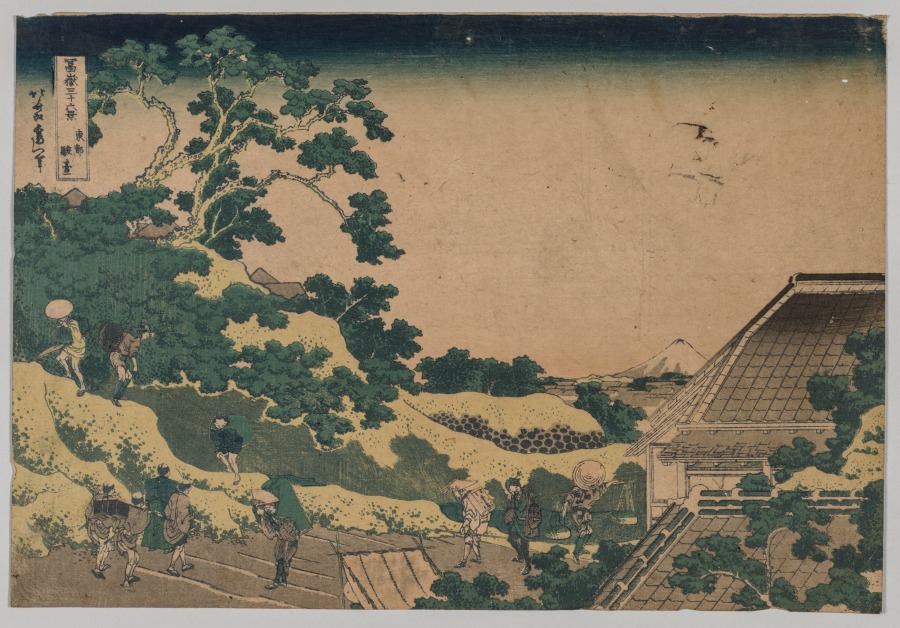
Katsushika Hokusai is the extreme case: he used more than thirty different names across his long career, including Shunro (his earliest), Sori, Kako, Taito, Iitsu, and Manji (his last). A print signed "Hokusai" alone dates to a specific middle period; one signed "Zen Hokusai Iitsu" belongs to the era of the Thirty-six Views of Mount Fuji. Collectors and scholars use these name changes as a primary dating tool.
The suffixes matter too. "Ga" is the most common, indicating that the person designed the image. "Hitsu" carries a slightly more elevated connotation, suggesting direct brushwork. In the shin-hanga context, Kawase Hasui typically signed his prints with his name followed by "saku" (made), reflecting the movement's emphasis on the artist as author of the total work.
Hiroshi Yoshida presented a special case. Having trained as a Western-style painter, he sometimes signed prints in both Japanese characters and Roman letters, reflecting his international audience.
Publisher Marks and What They Reveal
The publisher was the commercial engine of Japanese printmaking. Publishers financed productions, selected artists, coordinated the team of carvers and printers, and distributed the finished prints through a network of shops and vendors. Their marks on a print are not mere branding — they are a statement of quality and provenance.
The most important shin-hanga publisher was Watanabe Shozaburo, whose seal appears on prints by Kawase Hasui, Hiroshi Yoshida (early works), Tsuchiya Koitsu, and many others. Crucially, after the 1923 earthquake destroyed Watanabe's workshop and blocks, prints from re-carved blocks carry different seals than the originals. Recognizing pre-earthquake versus post-earthquake Watanabe seals is essential for collectors, as the distinction dramatically affects a print's rarity and value.
During the Edo period, firms like Tsutaya Juzaburo (who published Utamaro and Sharaku), Eijudo (Hiroshige's primary publisher for the Tokaido series), and Nishimuraya Yohachi were among the most prominent. Each used a distinctive trade mark — often a stylized version of their shop name or a pictorial emblem.

Censor Seals and Dating
For prints produced during the Edo period, censor seals are among the most valuable marks for establishing a date of publication. The Tokugawa shogunate required that all printed materials — including woodblock prints — be submitted for censorship before sale. The form of the censor's stamp changed at documented intervals, creating a chronological framework that scholars have mapped in detail.
The earliest censor marks, appearing from around 1790, are kiwame seals — a single character meaning "approved" or "certified." These round or oval stamps confirmed that the print's content was acceptable under government regulations. Kiwame seals alone do not provide a precise date, but their presence confirms an Edo-period origin from the late eighteenth century onward.
From 1842 to 1853, the government introduced named censor seals, which bear the personal names of the censors who reviewed the design. Since the rotation of censors is documented by year, pairing the censor names with published records allows scholars to date a print to a specific year or even month.
After 1853, the system shifted to aratame seals — a single character meaning "examined" — often accompanied by a date seal indicating the year and month of approval. The date seal uses the traditional Japanese cyclical calendar, combining one of twelve zodiac animals with one of ten celestial stems to indicate the year.
The Meiji era brought the end of government censorship, and prints from the Taisho and Showa periods do not carry censor seals. For twentieth-century prints, dating relies instead on publisher seals, signature forms, and edition markings.
The Title Block and Cartouche
Most series prints include a title block — a bordered area, often called a cartouche, containing the series title and the individual print's subtitle. On Hiroshige's Fifty-three Stations of the Tokaido, for instance, a red cartouche in the upper right corner identifies the series name, while a secondary block names the specific station depicted.
The design of the cartouche evolved as an art form in its own right. Katsushika Hokusai's Thirty-six Views of Mount Fuji uses a distinctive rectangular cartouche with a red outline in the upper left corner. Different editions and later reproductions sometimes altered the cartouche design, making it another marker for identifying the edition of a particular impression.
In shin-hanga prints, the title is often written directly on the print rather than enclosed in a formal cartouche. Kawase Hasui's prints typically bear the title in small characters along one edge, sometimes in both Japanese and English for the international market.

Practical Tips for Collectors
Reading marks on Japanese prints is a skill that develops with practice. Begin by acquiring a good reference — the standard English-language resources include Andreas Marks' "Publishers of Japanese Woodblock Prints: A Compendium" and the online databases maintained by institutions like the Museum of Fine Arts, Boston, and the Art Institute of Chicago.
When examining a print, work systematically. Start with the artist's signature: can you identify the name and suffix? Then locate the publisher's mark, usually separate from the signature. Check the margins for censor or date seals. Finally, look for additional marks — carver credits, printer credits, or collector seals applied by previous owners.
Do not be discouraged by the difficulty of reading seal script. Even experienced scholars sometimes struggle with archaic calligraphic forms. What matters is developing the habit of looking — of recognizing that every mark on a print has a story to tell about the hands that made it, the authority that approved it, and the history it has traveled through to reach yours.
Related Articles
Reproductions of famous Japanese woodblock prints — Hokusai, Hiroshige, Hasui — circulate in every market, and even experienced collectors can be fooled. This step-by-step guide walks through how to tell a genuine original impression from a modern photolithographic reproduction, a late edition, or a posthumous reprint.
You don't need thousands of dollars to start a serious Japanese woodblock print collection. This guide covers the realistic under-$200 market — which artists are genuinely available at this price point, what to look for, what to avoid, and how to build a coherent collection on $50–200 per print.
Hiroshi Yoshida and Kawase Hasui are the two most-collected shin-hanga landscape artists, and new collectors often ask which they should focus on first. This side-by-side comparison covers their biographies, styles, production methods, subject matter, current market prices, and which artist suits which collector.
Start exploring Japanese woodblock prints