Hiroshi Yoshida vs. Kawase Hasui: A Collector's Comparison
Most new collectors entering the shin-hanga market eventually face the same question: do I focus on Hiroshi Yoshida or Kawase Hasui? They are the two great landscape artists of the movement, their best work appears at every major auction, and their prices have appreciated steadily for thirty years. Both produced atmospheric, technically refined prints of striking beauty. But they are not interchangeable, and the differences matter — especially when you are deciding where to put your first $1,000 or $5,000 of collecting budget.
This guide compares them across nine dimensions, then offers practical recommendations for which artist suits which collector. By the end you should know which one to start with and why.
The One-Line Comparison
Hiroshi Yoshida (1876–1950): Western-trained painter who took up woodblock printing at age 49, traveled abroad extensively, and self-published his own work using painterly atmospheric perspective and global subject matter.
Kawase Hasui (1883–1957): Japanese-trained brush painter who worked his entire forty-year print career under publisher Watanabe Shōzaburō, producing introspective Japanese travel scenes — temples, harbors, and shrines in atmospheric weather.
If you want Western painterly atmosphere, mountain landscapes, and global travel subjects, you want Yoshida. If you want classical Japanese mood, snow scenes, twilight temples, and the canonical shin-hanga aesthetic, you want Hasui.
The rest of this guide is the detail behind that one-line answer.
Biography in Parallel
| Hiroshi Yoshida | Kawase Hasui | |
|---|---|---|
| Born | 1876, Kurume (Kyushu) | 1883, Tokyo |
| Died | 1950, Tokyo | 1957, Tokyo |
| Training | Western-style oil painting (Koyama Shōtarō, then Tamura Shōryū) | Japanese-style brush painting (Kawabata Gyokushō, Kaburaki Kiyokata) |
| First prints | 1925 (age 49) | 1918 (age 35) |
| Output | ~260 designs | ~620 designs |
| Workshop | Self-published from own studio after 1925 | Worked exclusively under Watanabe Shōzaburō |
| Travel | Yes — Europe, India, Egypt, the U.S., the Andes | Mostly within Japan |
| Other career | Watercolor and oil painting throughout life | Print designer almost exclusively after 1918 |
Yoshida
Yoshida's path was unusual. He spent his twenties and thirties as a watercolor and oil painter, exhibiting internationally and traveling extensively. He saw Whistler in London, the Grand Canyon in America (where his watercolors were collected by Boston's Museum of Fine Arts), and the Alps. He came to printmaking late — at 49 — after briefly working with Watanabe and concluding that he needed his own workshop to produce the technically ambitious prints he had in mind.
He hired his own carvers and printers, set up a studio in Tokyo, and from 1925 self-published every design he made for the remaining twenty-five years of his life. His son Toshi Yoshida inherited the workshop and continued producing into the 1980s.
Hasui
Hasui's path was conventional. He trained in classical Japanese painting and met Watanabe Shōzaburō in 1918, which became the decisive event of his career. From that year until his death in 1957 he worked exclusively under Watanabe — designing, traveling to subjects, but never carving or printing himself. The Great Kantō Earthquake of 1923 destroyed his sketchbooks and Watanabe's stock; both rebuilt and Hasui's mature period began around 1925. The Tokyo firebombings of 1945 destroyed most of the Watanabe blocks; many of Hasui's most famous designs survive only because impressions had been distributed before the war. He was named a Living National Treasure in 1956, the year before his death.
Style: How Their Prints Look Different
The fastest way to internalize the difference is to look at one of each.

This is Yoshida's *Sailing Boats: Forenoon*, one of six versions of the same composition printed in different time-of-day color schemes. Notice: the modeling of light on the water uses Western painterly conventions; the sky has aerial perspective with bluer recession; the boats are observed with the eye of someone who has painted in oil. The print could almost be a 19th-century European watercolor in a Japanese woodblock medium.

This is Hasui's *Inokashira Benten Shrine in Snow*. The image is built differently: a flatter, more graphic composition; emphasis on the silhouette of the shrine against the snow; mood from the silence and from the bokashi gradation in the sky and water. The watcher feels held within the scene rather than viewing it from outside.
In broad strokes:
- Yoshida is observational. He looks at a mountain or a harbor the way a Western plein-air painter does, then translates what he sees through the woodblock medium.
- Hasui is atmospheric. He composes a mood — twilight, snow, drizzle — and the specific place becomes the vehicle for the mood rather than the reverse.
Both use bokashi (gradation printing) as a central technique. Yoshida uses it for sky depth and water modeling; Hasui uses it for atmospheric envelopment.
Subject Matter
This is where the largest practical difference shows up.
Yoshida's Subjects
- Mountains — the Japanese Alps, the European Alps (Matterhorn, Jungfrau), the Indian Himalaya. Yoshida was an active mountaineer.
- Harbors and the sea — the *Seto Inland Sea* series and several harbor designs.
- International travel — Egypt, India, the American national parks, Europe.
- Architecture — Japanese castles, European cathedrals, Indian temples.
- Gardens — calmer, more intimate compositions of pools and bridges.
Hasui's Subjects
- Temples and shrines — often in snow or rain, often at dusk.
- Coastal Japan — quiet harbors, rocky shores, small fishing villages.
- Tokyo — his *Twenty Views of Tokyo* series capturing the city before WWII.
- Travel within Japan — the Kansai region, northern Honshu, Kyushu.
- Snow scenes — Hasui is the great snow-print master of the twentieth century.

The example above — Yoshida's *Matterhorn* — is unimaginable in Hasui's body of work. Conversely, the next image — Hasui's *Evening Snowfall at Kiyomizu Temple* — captures a meditative Japanese twilight that Yoshida rarely attempted.
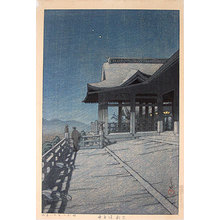
For collectors who want both Japanese landscapes and a Western-traveler's eye, the answer is to buy from both artists. For collectors who want a coherent shin-hanga aesthetic in one body of work, Hasui is the more single-minded choice.
Production: Workshop vs. Self-Published
This affects edition states, scarcity, and authentication.
Hasui Editions
Hasui's prints were published by Watanabe in multiple editions over decades — sometimes with the original blocks (until they were destroyed in 1945) and sometimes with recarved blocks afterward. A single Hasui design might exist in:
- Lifetime first edition (Watanabe pre-war seal) — typically 200–300 impressions, deeply colored, often the most valuable state.
- Lifetime postwar edition (post-1953 seal) — also valuable but typically less expensive than pre-war.
- Posthumous edition (post-1957) — from recarved blocks, less valuable, still legitimate as a hand-printed woodblock product but not a lifetime impression.
- Modern Watanabe re-issue — currently produced from various block states; clearly labeled and priced.
This means Hasui authentication is fundamentally about reading the Watanabe seal. Same design, very different value depending on which seal it carries.
Yoshida Editions
Yoshida's prints carry his personal "jizuri" seal indicating a print made in his own workshop under his supervision. After Hiroshi's death in 1950, Toshi Yoshida continued producing some of his father's designs from the original blocks. There are also estate-period prints. The distinction between Hiroshi's lifetime jizuri impressions and later Toshi-period or estate-period prints affects value, though the divergence is less extreme than with Hasui — Yoshida's blocks were less heavily reprinted and the workshop's standards stayed high under Toshi.
For practical collecting: Yoshida authentication is generally simpler (one workshop, one signature system); Hasui authentication is more complex but better documented (decades of dealer reference material on Watanabe seal periods).
Current Market Prices (2026)
Approximate current ranges for original lifetime impressions in good condition. Auction results vary widely with condition and importance.
| Tier | Hiroshi Yoshida | Kawase Hasui |
|---|---|---|
| Minor designs, fair condition | $500–$1,000 | $300–$800 |
| Major designs, good condition | $2,000–$5,000 | $1,500–$4,000 |
| Iconic designs, fine first edition | $5,000–$15,000 | $4,000–$12,000 |
| Top-tier rarities | $20,000–$80,000 | $15,000–$60,000 |
Yoshida's market floor is slightly higher than Hasui's, but Hasui has more designs in circulation overall (620 vs. 260) so the supply is broader. Both have appreciated roughly 5–10% per year over the last fifteen years.
The single biggest variable for both artists is edition state — a first-edition Hasui can be worth 4–10× a posthumous edition of the same design. For Yoshida the ratio is smaller (typically 2–4×) but still significant. Spending time on edition identification before purchase pays back enormously.

Which Artist Suits Which Collector?
A practical decision matrix:
You should start with Hasui if:
- You are drawn to twilight, snow, rain, and atmospheric mood.
- You love the canonical shin-hanga aesthetic and want to build a coherent collection within that style.
- You want broad supply at a wide range of price points (more designs, more editions, more frequent availability at auction).
- You are interested in Japanese travel and temple architecture.
- You enjoy the puzzle of edition-state identification (Watanabe seals reward careful study).
You should start with Yoshida if:
- You like Western-influenced atmospheric perspective and modeling.
- You are interested in international landscapes (Alps, Himalaya, Egypt).
- You appreciate technical achievement (Yoshida's same-block-different-color-scheme series are virtuosic).
- You want simpler authentication (one workshop, one signature system).
- You like the painter's eye applied to woodblock — Yoshida frames like an oil painter.
You should start with both if:
- Your budget allows ($3,000+ to begin meaningfully) — buying one of each gives you the two strongest points on the shin-hanga landscape map.
- You want to develop a discerning eye for the difference between Western and traditional Japanese print aesthetics within the same medium.
A Hidden Third Path: Their Heirs
Both artists have important continuators who are typically much cheaper to collect.
- [Toshi Yoshida](/artists/toshi-yoshida) (1911–1995), Hiroshi's son, ran the Yoshida workshop after 1950 and made his own prints, often more boldly modernist than his father's work. Excellent quality, prices $300–$1,500 for most designs.
- [Shirō Kasamatsu](/artists/shiro-kasamatsu) (1898–1991) worked for Watanabe alongside Hasui and produced atmospheric landscapes in a closely related style. Often considered "Hasui-adjacent" by collectors. Prices $200–$800.
- [Tsuchiya Kōitsu](/artists/tsuchiya-koitsu) (1870–1949) is another Watanabe-published landscape artist with snow and temple designs in a similar register. Prices $300–$1,200.
If your budget is tight or you want to develop your eye before committing to the headline artists, building familiarity with Toshi Yoshida and Kasamatsu first is a good path.
Frequently Asked Questions
Did Yoshida and Hasui know each other?
Yes. Both worked in Tokyo during the same forty-year period and both spent time in the Watanabe workshop early in their careers. They were aware of each other's work and shared the same circle of carvers and printers initially. After Yoshida set up his own workshop in 1925 their paths diverged commercially but they remained part of the same shin-hanga community.
Which artist influenced the West more?
Both reached significant Western collectorships in the 1920s and 30s, but Yoshida's international travel and personal sales to American collectors made him better known in the U.S. in his lifetime. After his Detroit Institute of Arts exhibition in 1926, his prints appeared in many major American museum collections. Hasui's Western reputation grew more slowly through Watanabe's distribution network but eventually became larger; today both are very well represented in Western institutions.
Are Yoshida prints really self-printed by him?
No, and this is a common confusion. Yoshida self-*published* — he ran his own workshop and supervised every print — but he did not personally carve or print the impressions. He had master carvers and printers on staff. The "jizuri" (自摺り, "self-printed") seal on his prints indicates that the print was made under his direct supervision in his own studio, distinguishing it from prints he had designed but published through others. The seal is about workshop oversight, not about his physically operating the baren.
Which artist's prints have appreciated faster?
Roughly comparable. Yoshida had a small boom in the 1990s; Hasui had several growth periods, most recently in 2015–2022. Over a thirty-year horizon both have appreciated 4–6× from their 1990 levels, with major designs from both artists outperforming the average.
Is it worth buying late editions of Hasui designs?
For collecting purposes: lifetime impressions are the meaningful target. For decoration purposes: a high-quality posthumous Watanabe edition (1957–1980s) of a famous design is a beautiful object, hand-printed using traditional methods, often available for $300–$600. Just don't pay lifetime-impression prices for one. The current Watanabe re-issues are honest products clearly labeled as new printings.
Where can I see major collections of both artists in person?
Significant Yoshida and Hasui holdings: the Art Institute of Chicago, the Museum of Fine Arts Boston, the Honolulu Museum of Art, the Smithsonian's Freer Gallery, the British Museum, and the Tokyo Metropolitan Library's Watanabe archive. The annual major auctions at Christie's (New York and London) reliably offer both. The shin-hanga movement page on this site links the most important designs from both artists currently catalogued.
What to Read Next
- What Is Shin-hanga? — the movement that both artists belong to.
- How to Identify a Genuine Japanese Woodblock Print — authentication essentials.
- How to Start Collecting Japanese Woodblock Prints — practical buyer's introduction.
- How to Identify Hiroshige Print Editions — the edition-state reasoning that also applies to Hasui's Watanabe prints.
Or browse: Hiroshi Yoshida's artworks and Kawase Hasui's artworks on this site for visual comparison at any time.
Related Articles
Not all Hiroshige prints are created equal. The difference between a first-edition impression and a later reprint can mean thousands of dollars and a fundamentally different visual experience. Here is what every collector needs to know about identifying editions, variants, and reproductions.
You don't need thousands of dollars to start a serious Japanese woodblock print collection. This guide covers the realistic under-$200 market — which artists are genuinely available at this price point, what to look for, what to avoid, and how to build a coherent collection on $50–200 per print.
Reproductions of famous Japanese woodblock prints — Hokusai, Hiroshige, Hasui — circulate in every market, and even experienced collectors can be fooled. This step-by-step guide walks through how to tell a genuine original impression from a modern photolithographic reproduction, a late edition, or a posthumous reprint.
Start exploring Japanese woodblock prints