Fushimi Inari (伏見稲荷大社)
3 prints by 2 artists
About Fushimi Inari
Fushimi Inari, formally Fushimi Inari Taisha, is the head shrine of the Inari cult, one of the most widespread Shinto traditions in Japan with more than thirty thousand affiliated subsidiary shrines across the country, located on the lower slopes of Mount Inari in Fushimi Ward in southern Kyoto. The shrine was founded according to tradition in 711 during the early Nara period, and the deity Inari is associated with rice, agriculture, prosperity, commerce, sake brewing, and success in worldly endeavors, with the fox (kitsune) figured as the messenger of the kami rather than the deity itself. The complex is celebrated for the dense rows of vermilion-painted torii gates (senbon torii, literally a thousand torii) that ascend the mountain in tunnel-like passages, donated by individuals, families, and businesses across centuries beginning seriously in the Edo period and continuing to the present day, with several thousand gates lining the principal pilgrimage route to the summit and tens of thousands of smaller gates along the secondary paths. Each torii bears the name of the donor and the date of donation on its rear face, and the gates are continually replaced as the older painted wood deteriorates. The lower precinct includes the romon front gate of 1589 reconstructed during the Momoyama period at the order of Toyotomi Hideyoshi after the recovery of his mother from illness, the haiden worship hall, the honden main hall in Inari-zukuri architectural style, and subsidiary shrines and stone fox statues distributed along the mountain path. The full circuit ascending Mount Inari and returning takes approximately two to three hours. For Japanese printmaking Fushimi Inari appears as one of the canonical Kyoto meisho. The shrine is included in Edo-period printed guidebooks to Kyoto and in individual sheets of the late Edo period, with Hiroshige and other Edo-school landscape artists treating the approach and the torii passages, and Hasegawa Sadanobu and the Osaka kamigata school producing Kansai-region sheets that include Fushimi subjects. The shin-hanga revival treated the torii passages and the precinct under varied seasonal conditions in the work of Kawase Hasui, Tsuchiya Koitsu, Asano Takeji, and Tokuriki Tomikichiro, the last of whom produced multiple Fushimi Inari sheets across his Kyoto-centered creative-print series. The shrine also figures in folk-art and sosaku-hanga prints as a recurrent emblem of Kyoto religious practice, and in modern Japanese photography and graphic arts the torii tunnels have become one of the most internationally recognized images of Japanese religious architecture. The visual character of Fushimi Inari in prints is built on the alternating vermilion and black-lacquered uprights of the torii series, the diffused light filtering through the gate tunnels, the stone fox figures bearing keys or sheaves of rice in their mouths and wearing red votive bibs, the small subsidiary shrines distributed along the mountain path, and frequently the seasonal phenomena of snow, autumn foliage, or summer green on the surrounding mountain. Contemporary visitors approach the shrine directly from the JR Inari Station on the Nara Line or the Keihan Fushimi-Inari Station, and the full pilgrimage circuit up Mount Inari, returning by the same or alternative paths, remains one of the most heavily walked sacred routes in the Kyoto basin, open continuously around the clock without admission fee, with the morning and evening hours providing the most atmospheric viewing.
Prints Depicting Fushimi Inari (3)

Artists Who Depicted Fushimi Inari (2)
Frequently Asked Questions
Fushimi Inari, formally Fushimi Inari Taisha, is the head shrine of the Inari cult, one of the most widespread Shinto traditions in Japan with more than thirty thousand affiliated subsidiary shrines across the country, located on the lower slopes of Mount Inari in Fushimi Ward in southern Kyoto. The shrine was founded according to tradition in 711 during the early Nara period, and the deity Inari is associated with rice, agriculture, prosperity, commerce, sake brewing, and success in worldly endeavors, with the fox (kitsune) figured as the messenger of the kami rather than the deity itself. The complex is celebrated for the dense rows of vermilion-painted torii gates (senbon torii, literally a thousand torii) that ascend the mountain in tunnel-like passages, donated by individuals, families, and businesses across centuries beginning seriously in the Edo period and continuing to the present day, with several thousand gates lining the principal pilgrimage route to the summit and tens of thousands of smaller gates along the secondary paths. Each torii bears the name of the donor and the date of donation on its rear face, and the gates are continually replaced as the older painted wood deteriorates. The lower precinct includes the romon front gate of 1589 reconstructed during the Momoyama period at the order of Toyotomi Hideyoshi after the recovery of his mother from illness, the haiden worship hall, the honden main hall in Inari-zukuri architectural style, and subsidiary shrines and stone fox statues distributed along the mountain path. The full circuit ascending Mount Inari and returning takes approximately two to three hours. For Japanese printmaking Fushimi Inari appears as one of the canonical Kyoto meisho. The shrine is included in Edo-period printed guidebooks to Kyoto and in individual sheets of the late Edo period, with Hiroshige and other Edo-school landscape artists treating the approach and the torii passages, and Hasegawa Sadanobu and the Osaka kamigata school producing Kansai-region sheets that include Fushimi subjects. The shin-hanga revival treated the torii passages and the precinct under varied seasonal conditions in the work of Kawase Hasui, Tsuchiya Koitsu, Asano Takeji, and Tokuriki Tomikichiro, the last of whom produced multiple Fushimi Inari sheets across his Kyoto-centered creative-print series. The shrine also figures in folk-art and sosaku-hanga prints as a recurrent emblem of Kyoto religious practice, and in modern Japanese photography and graphic arts the torii tunnels have become one of the most internationally recognized images of Japanese religious architecture. The visual character of Fushimi Inari in prints is built on the alternating vermilion and black-lacquered uprights of the torii series, the diffused light filtering through the gate tunnels, the stone fox figures bearing keys or sheaves of rice in their mouths and wearing red votive bibs, the small subsidiary shrines distributed along the mountain path, and frequently the seasonal phenomena of snow, autumn foliage, or summer green on the surrounding mountain. Contemporary visitors approach the shrine directly from the JR Inari Station on the Nara Line or the Keihan Fushimi-Inari Station, and the full pilgrimage circuit up Mount Inari, returning by the same or alternative paths, remains one of the most heavily walked sacred routes in the Kyoto basin, open continuously around the clock without admission fee, with the morning and evening hours providing the most atmospheric viewing.
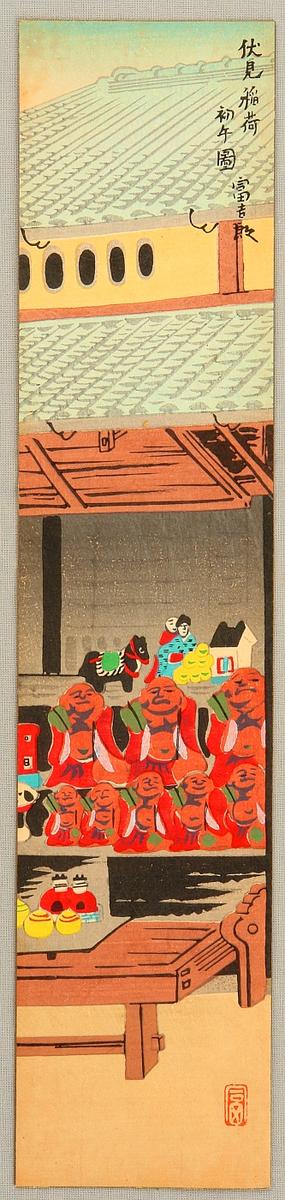
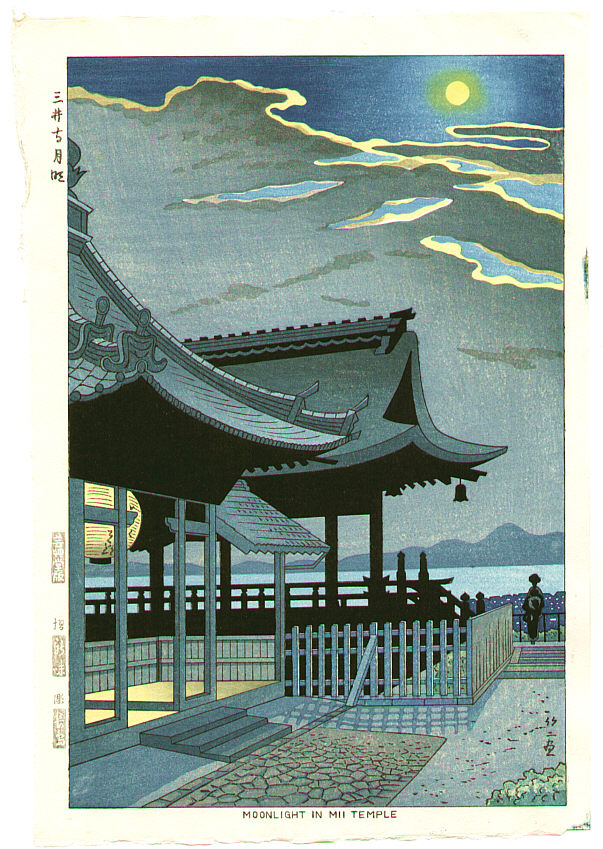
Hanga catalogues 3 prints depicting Fushimi Inari (伏見稲荷大社), by 2 different artists.
Takeji Asano and Tomikichiro Tokuriki are among the 2 artists who depicted Fushimi Inari in our collection.
Want to rate prints from Fushimi Inari?
Sign up to start rating