Biography
Andō Hiroshige IV (安藤広重四代, 1849–1925) was the fourth artist to carry the lineage name of Utagawa Hiroshige, the great Edo-period landscape master whose name became one of the most influential brand identities in the history of Japanese printmaking. Working in the late Meiji and Taishō periods, he was responsible for sustaining the Hiroshige studio name into the twentieth century, producing prints in the established Hiroshige idiom — landscapes, bird-and-flower (kachō-e) compositions, and views of famous places — at a moment when the woodblock print industry was being radically transformed by photography, lithography, and the new shin-hanga movement.
He was born in 1849, only nine years before the death of the original Andō Hiroshige (1797–1858), and his life spans the entire arc of Meiji modernization and the early Taishō era. The succession of the Hiroshige name had become a complex affair by the second half of the nineteenth century: Hiroshige II (Suzuki Chinpei) had married Hiroshige I's daughter and taken the studio name after the master's death in 1858, and Hiroshige III, another former pupil of the studio, succeeded in turn after a marital and professional rift. The Kikuchi family from which the future Hiroshige IV came had long-standing ties to the Andō household, and he eventually emerged as the holder of the Hiroshige IV name in the early twentieth century, after the death of Hiroshige III and a period in which the studio's commercial position was uncertain.
Unlike his Edo-period predecessors, who had benefited from a thriving popular print market, Hiroshige IV worked in a Meiji and Taishō Japan in which the woodblock print no longer dominated mass visual culture. Newspapers, magazines, photographic postcards, and lithographic posters had displaced ukiyo-e prints as the principal medium for popular imagery, and the great Edo publishing houses had largely disappeared. The famous-place (meisho-e) tradition that had been the heart of the Hiroshige studio's output now competed directly with cheap photographic souvenirs of the same scenic sites. Hiroshige IV nonetheless continued to produce woodblock prints in the conservative Hiroshige manner — well after the artistic energy of the print medium had migrated to the shin-hanga and sōsaku-hanga movements, whose leading practitioners (Kawase Hasui, Hashiguchi Goyō, Yoshida Hiroshi, Onchi Kōshirō) belonged to a quite different lineage from the traditional Utagawa school.
His surviving body of work is relatively small compared with the great Edo masters of the Hiroshige name. It consists chiefly of landscape compositions modelled on the famous Edo-period series established by Hiroshige I, together with kachō-e prints depicting cranes, herons, and other birds in atmospheric weather conditions, and small-format meisho-e of well-known sights in and around Tokyo. His landscapes preserve the high horizons, atmospheric weather effects, and lyrical compositional restraint that had defined the Hiroshige idiom for three generations, even as the technical printing standards of the period grew more variable.
Attribution is a recurring complication in studying Hiroshige IV's career. The Hiroshige name continued to be used after his death by other artists in the wider Utagawa-derived studio network — sometimes designated Hiroshige V in later catalogues — and Western museum and dealer records frequently conflate prints by Hiroshige IV, Hiroshige V, and other late-Meiji and Taishō imitators under the catch-all label 'Hiroshige IV.' His own signed prints are generally identified by the cursive Hiroshige signature together with the seals and publishers' marks of the 1910s and early 1920s, and his work survives today mainly in specialist dealer records and print databases rather than in large public holdings.
Hiroshige IV died in 1925, having seen the Utagawa Hiroshige tradition stretched across four generations and nearly a full century. His place in the history of Japanese printmaking is principally that of a custodian: among the last figures to carry the Hiroshige name through the woodblock print's transitional decades and into the modern era, when the tradition would be revived in radically new form by the shin-hanga publishers of the 1920s and 1930s. For collectors and scholars, his prints are of interest both as a late chapter of the original Utagawa Hiroshige studio and as a record of how a great Edo-period name sustained itself through the cultural and technological upheavals of Meiji and Taishō Japan.
Key Facts
- Active Period
- 1849–1925
- Nationality
- 🇯🇵Japan
- Movements
- Meiji/Taishō PrintsUkiyo-e
- Works Indexed
- 3
Frequently Asked Questions
Andō Hiroshige IV (安藤広重四代, 1849–1925) was the fourth artist to carry the lineage name of Utagawa Hiroshige, the great Edo-period landscape master whose name became one of the most influential brand identities in the history of Japanese printmaking. Working in the late Meiji and Taishō periods, he was responsible for sustaining the Hiroshige studio name into the twentieth century, producing prints in the established Hiroshige idiom — landscapes, bird-and-flower (kachō-e) compositions, and views of famous places — at a moment when the woodblock print industry was being radically transformed by photography, lithography, and the new shin-hanga movement.
Andō Hiroshige IV was active from 1849 to 1925. They were associated with the Meiji/Taishō Prints and Ukiyo-e movements.
Andō Hiroshige IV's work was shaped by the Meiji/Taishō Prints and Ukiyo-e traditions in Japanese woodblock printmaking. Meiji/Taishō Prints: Meiji and Taishō era prints (1868–1926) bridge the transition from traditional ukiyo-e to the modern shin-hanga and sosaku-hanga movements. Ukiyo-e: ## What is ukiyo-e? Ukiyo-e ([浮世絵](/glossary/ukiyo-e)) — literally "pictures of the floating world" — is the Edo-period Japanese print and painting tradition that flourished from roughly 1660 to 1868, depicting the pleasures of urban life in Edo (modern Tokyo): courtesans, kabuki actors, sumo wrestlers, famous landscapes, and seasonal beauties.
Andō Hiroshige IV's prints frequently feature rain, bridges, birds & flowers, mount fuji.
Original prints by Andō Hiroshige IV can be found in collections including Chazen Museum of Art, University of Wisconsin-Madison, Japanese Art Open Database.
Woodblock Prints by Andō Hiroshige IV (3)
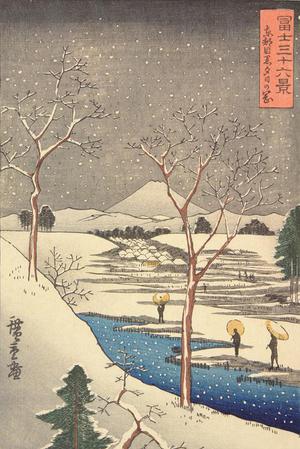
Twilight Hill at Meguro in the Eastern Capital, from the series Thirty-six Views of Mt. Fuji
early 20th century
Woodblock print; ink and color on paper
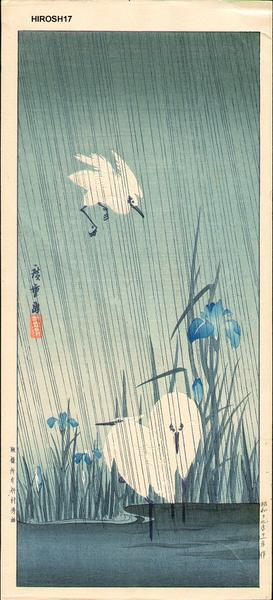
Cranes in the Rain
c. 1920
Woodblock print (kachō-e); ink and color on paper
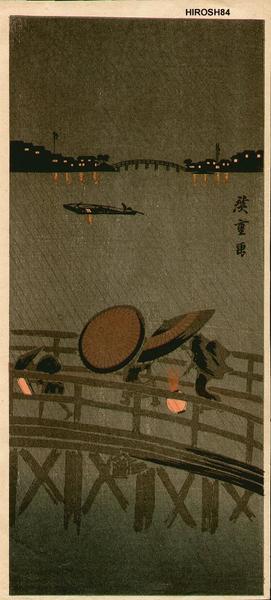
Bridge and Night Rain
c. 1920
Woodblock print (sansui-e); ink and color on paper