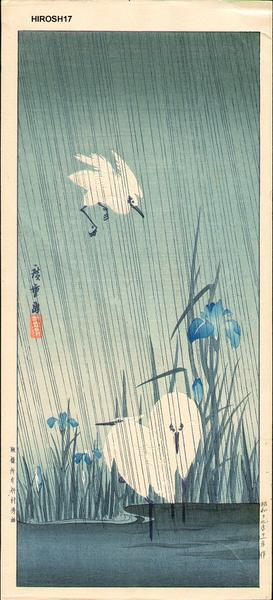
Cranes in the Rain
- Date:
- c. 1920
- Medium:
- Woodblock print (kachō-e); ink and color on paper
- Source:
- Japanese Art Open Database
Description
This kachō-e (bird-and-flower print) by Andō Hiroshige IV depicts cranes (tsuru) in a rainstorm and is documented in the Japanese Art Open Database with an explicit attribution to Hiroshige IV. The composition belongs to a small group of bird-and-flower compositions Hiroshige IV produced in the late Meiji and Taishō periods, working within the Hiroshige studio's longstanding interest in atmospheric weather effects — rain, snow, evening twilight, and moonlight — applied to natural rather than topographical subjects. Cranes had been a perennial subject in Japanese painting and printmaking for centuries, carrying associations of longevity, fidelity, and seasonal autumnal migration; their pairing with rain transposes the Hiroshige idiom of meteorological observation, well established in such famous Edo-period images as the Shōno of the Tōkaidō series, onto an avian subject. The print's vertical format and intimate scale are consistent with the kachō-e of the period, designed for tasteful interior display in a Taishō-era domestic setting and addressed to an audience that prized continuity with traditional Japanese aesthetic values at a moment of rapid cultural modernization. The dating of this and related Hiroshige IV prints is complicated by ambiguous attributions in dealer records — the catalogue places it in the late Meiji to early Taishō window during which Hiroshige IV was the documented holder of the Hiroshige name. The print is preserved in the Japanese Art Open Database's image archive.
More Prints by Andō Hiroshige IV
More Birds & Flowers Prints
Frequently Asked Questions
Cranes in the Rain was created by Andō Hiroshige IV (安藤広重四代) in c. 1920.
Cranes in the Rain depicts birds & flowers and rain.