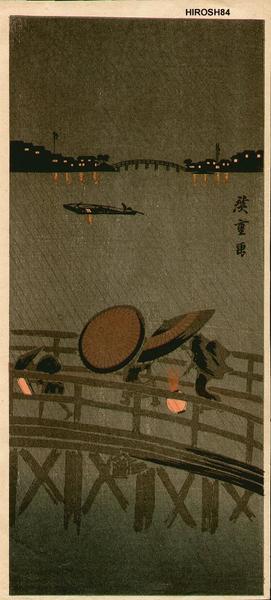
Bridge and Night Rain
- Date:
- c. 1920
- Medium:
- Woodblock print (sansui-e); ink and color on paper
- Source:
- Japanese Art Open Database
Description
This sansui-e (landscape print) by Andō Hiroshige IV depicts a wooden bridge in nocturnal rain and is documented in the Japanese Art Open Database with an explicit attribution to Hiroshige IV. The subject combines two of the most famous tropes of the Edo-period Hiroshige tradition — the bridge as a structuring vertical element within a watery landscape, and the night rain (yo no ame) as a moodily atmospheric weather condition — both of which had been canonised in Hiroshige I's earlier landscape series of the 1830s and 1840s, notably the Eight Views of Ōmi (Ōmi Hakkei) with its celebrated Karasaki Bridge at Night and the famous Ōhashi Bridge from the One Hundred Famous Views of Edo. Hiroshige IV's treatment retains the diagonal sheets of incised rain lines, the lantern-lit illumination of figures crossing the bridge, and the deep ink-saturated upper sky that were hallmarks of the original Hiroshige nocturnal compositions. Working in the late Meiji or early Taishō period, Hiroshige IV consciously preserved the visual vocabulary of his great-great-predecessor while adapting it to the smaller scale and simpler colour palette characteristic of his own period. The print is preserved in the Japanese Art Open Database's image archive.
More Prints by Andō Hiroshige IV
More Bridges Prints
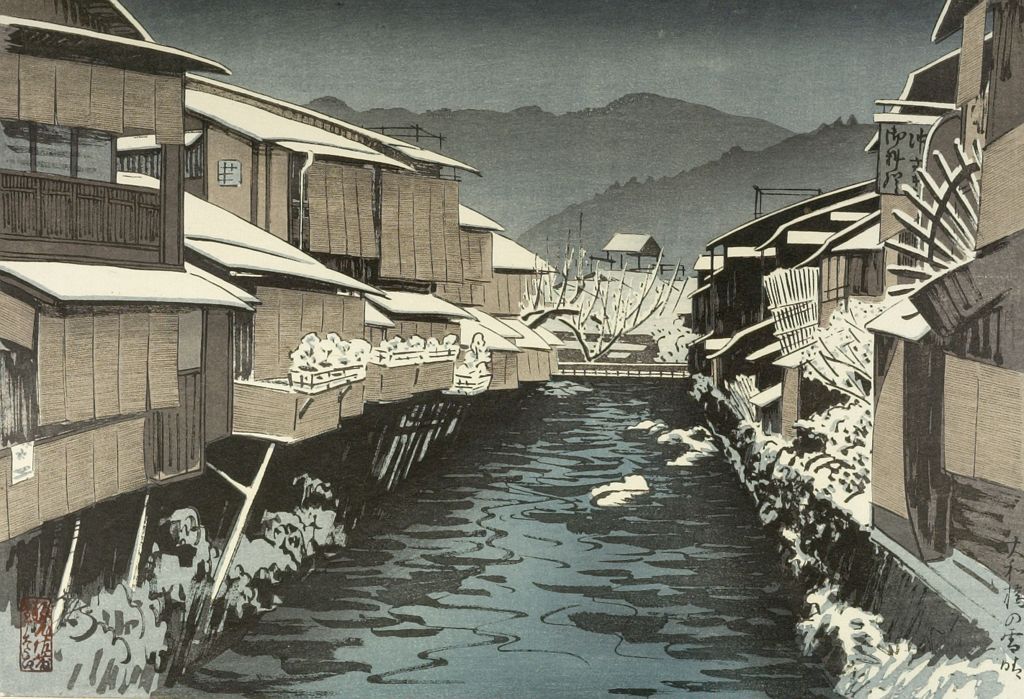
Fair Weather After Snow at Yamato Bridge, Kyoto (Yamato bashi no yukibare), Taishô period, dated 1924
Woodblock print
![Mount Fuji on a Moonlit Night, Kawai Bridge (Tsukiyo no Fuji [Kawaibashi]), from the series "Selection of Views of the Tokaido (Tokaido fukei senshu)" by Kawase Hasui](https://www.artic.edu/iiif/2/d0960668-1e73-339a-b182-fb995a54bff0/full/843,/0/default.jpg)
Mount Fuji on a Moonlit Night, Kawai Bridge (Tsukiyo no Fuji [Kawaibashi]), from the series "Selection of Views of the Tokaido (Tokaido fukei senshu)"
1947
Color woodblock print; oban

Shin Ohashi Bridge (Shin Ohashi), from the series "Twenty View of Tokyo (Tokyu nijukkei)"
1926
Color woodblock print; oban

Sacred Bridge in Nikko (Nikko Shinkyo)
1930
Color woodblock print; oban
Frequently Asked Questions
Bridge and Night Rain was created by Andō Hiroshige IV (安藤広重四代) in c. 1920.
Bridge and Night Rain depicts bridges and rain.