
Biography
Chōbunsai Eishi (鳥文斎栄之, 1756-1829) occupies a singular place in the history of Edo bijin-ga, the genre of woodblock print devoted to images of beautiful women. Born Hosoda Tokitomi into a samurai family of distinguished pedigree, Eishi was almost uniquely positioned among ukiyo-e artists: he came to the floating world from above rather than below. His grandfather Hosoda Tokitoshi had held an influential position in the shogunate as a senior finance official, and the family, direct retainers (hatamoto) of the Tokugawa, held a generous hereditary stipend. This elevated background would lend Chōbunsai Eishi's prints their characteristic atmosphere of aristocratic restraint and shape his reception by both contemporary collectors and modern scholarship on late-Edo printmaking.
Eishi's earliest artistic training reflected his samurai station. He studied under Kanō Eisen'in Michinobu (1730-1790), an eminent painter of the orthodox Kanō academy, whose manner combined Chinese-derived ink technique with the traditional canon of figure and landscape painting. It was most likely from this teacher's name — Eisen'in (栄川院) — that Eishi took his own art name, Eishi (栄之), though a persistent tradition instead credits the shogun. This rigorous classical schooling distinguishes Eishi from nearly every other major bijin-ga designer of the late eighteenth century. Where Kitagawa Utamaro, his great contemporary and stylistic counterweight, came up through the commercial ukiyo-e workshops — having trained under Toriyama Sekien — Eishi approached the popular print medium from an elite Kanō and samurai foundation.
From 1781, at about age twenty-five, Eishi held a position in the palace of the tenth shogun, Tokugawa Ieharu, and is traditionally said to have painted for him. By any measure this placed a young samurai-born artist near the heart of Tokugawa cultural patronage. Yet within a few years Chōbunsai Eishi made one of the most consequential and unexpected career changes in Edo art history. Around 1784 he stepped back from the shogun's official service and began to train under the ukiyo-e artist Bunryūsai, turning his attention toward the popular, commercial print medium then considered well beneath the dignity of a hatamoto. About 1789 he formally relinquished his samurai rank, passing the family headship and stipend to his adopted son.
The reasons for this transition remain partly speculative. Some accounts emphasize personal inclination toward the floating world; others point to the broader constriction of samurai cultural life under the Kansei reforms (1787-1793) of Matsudaira Sadanobu. Whatever the cause, Eishi entered the print world with the full force of his classical training behind him. By the late 1780s he had become one of the most sought-after bijin-ga designers in Edo, working with leading publishers including Tsutaya Jūzaburō and Nishimuraya Yohachi. Tsutaya, who also published Utamaro and Sharaku in this same decade, recognized in Eishi a distinctive sensibility that would complement rather than duplicate his other star designers.
Eishi's bijin are immediately recognizable. Where Utamaro favored fleshy, sensual courtesans rendered in close-up half-length compositions, Chōbunsai Eishi designed full-length figures of attenuated grace: necks extended like swan's necks, faces narrowed to delicate ovals, hands and feet impossibly small, kimono falling in long vertical cascades. His women suggest aristocratic ladies-in-waiting more than Yoshiwara professionals, and the prints frequently allude to classical literature, Heian-period poetry, and the imagery of Genji and the Tales of Ise. Edo bijin-ga reached one of its highest refinements in his hands. The color palette tends toward pale silvers, muted lavenders, and ivory-toned fabrics, a restrained chromatic register that contemporaries associated with court taste.
Much of Eishi's output grafts mitate (classical allusion) onto contemporary bijin imagery — a strategy that would define his career. He designed elegant series on themes drawn from the poetic canon, among them the Six Jewel Rivers (Mu Tamagawa), and comparisons of the celebrated courtesans of the Yoshiwara, in which named beauties such as Hanaōgi of the Ōgiya appear in compositions that recall poetry-collection title-pages, complete with appended kyōka verses. Other sets transposed classical landscape cycles into the pleasure quarters, in the manner of a mitate of the canonical Eight Views of Ōmi. Across his print career Chōbunsai Eishi produced a substantial oeuvre, including many multi-sheet triptychs depicting boating parties on the Sumida River, garden gatherings, and seasonal excursions.
The distinctive quality of Eishi's work attracted a large circle of pupils — some thirty in all — of whom the most accomplished were Chōkōsai Eishō, Ichirakutei Eisui, and Rekisentei Eiri. Working in the late 1790s and early 1800s, they adopted the master's refined palette and are especially known for their color prints of famous courtesans, producing a coherent body of work often catalogued together with Eishi's own. The Chōbunsai school stands as one of the most internally consistent ateliers in late-Edo ukiyo-e, distinguished from the broader bijin-ga field by its samurai-inflected dignity.
After about 1801, Eishi gradually withdrew from commercial print design and returned to the medium of his youth: original painting on silk and paper. His later paintings, prized by Edo collectors of the warrior and merchant elite, continued the bijin themes of his prints in a freer, more spontaneous brush manner. He died in the seventh month of 1829 at age seventy-three, leaving behind one of the most aesthetically coherent careers in ukiyo-e and a school that had carried his manner well into the nineteenth century. Today Chōbunsai Eishi's prints are held in depth by the Museum of Fine Arts Boston, the Metropolitan Museum of Art, the British Museum, the Art Institute of Chicago, the Honolulu Museum of Art, and the Chiba City Museum of Art. His reputation, somewhat shadowed in the twentieth century by Utamaro's fame, has been steadily restored by exhibitions and scholarship recognizing Eishi as the great aristocratic counterweight to Utamaro within late-Edo bijin-ga, and as a print designer whose samurai-trained brush gave the Yoshiwara its most refined and literary visual voice.
Key Facts
- Active Period
- 1756–1829
- Nationality
- 🇯🇵Japan
- Movement
- Ukiyo-e
- Works Indexed
- 141
Frequently Asked Questions
Chōbunsai Eishi (鳥文斎栄之, 1756-1829) occupies a singular place in the history of Edo bijin-ga, the genre of woodblock print devoted to images of beautiful women. Born Hosoda Tokitomi into a samurai family of distinguished pedigree, Eishi was almost uniquely positioned among ukiyo-e artists: he came to the floating world from above rather than below. His grandfather Hosoda Tokitoshi had held an influential position in the shogunate as a senior finance official, and the family, direct retainers (hatamoto) of the Tokugawa, held a generous hereditary stipend. This elevated background would lend Chōbunsai Eishi's prints their characteristic atmosphere of aristocratic restraint and shape his reception by both contemporary collectors and modern scholarship on late-Edo printmaking.
Chōbunsai Eishi was active from 1756 to 1829. They were associated with the Ukiyo-e movement.
Chōbunsai Eishi's work was shaped by the Ukiyo-e tradition in Japanese woodblock printmaking. Ukiyo-e: ## What is ukiyo-e? Ukiyo-e ([浮世絵](/glossary/ukiyo-e)) — literally "pictures of the floating world" — is the Edo-period Japanese print and painting tradition that flourished from roughly 1660 to 1868, depicting the pleasures of urban life in Edo (modern Tokyo): courtesans, kabuki actors, sumo wrestlers, famous landscapes, and seasonal beauties.
Chōbunsai Eishi's prints frequently feature birds & flowers, spring, mount fuji, children, bridges, autumn foliage.
Original prints by Chōbunsai Eishi can be found in collections including Art Institute of Chicago, Metropolitan Museum of Art, Cleveland Museum of Art, ukiyo-e.org.
Woodblock Prints by Chōbunsai Eishi (141)

Naniwaya Okita and Takashima Ohisa playing a game of ken
c. 1793/94
Color woodblock print; oban yoko-e

A Woman's Poetry Party
c. 1793
Color woodblock print; oban triptych

Women Viewing Cherry Blossoms
c. 1793
Color woodblock print; right sheet of oban triptych (center sheet: 1925.3088)

An Elegant Parody of the Six Poetic Immortals (Furyu yatsushi rokkasen): The Priest Kisen
c. 1793
Color woodblock print; oban

The Courtesan Hanaogi of the Ogiya, with Child Attendants Yoshino and Tatsuta
c. 1793
Color woodblock print; right sheet of oban triptych

A Selection of Beauty from the Pleasure Quarters (Seiro bijin awase): Courtesans Hired for the New Years Holidays - Takigawa of the Ogiya
c. 1794
Color woodblock print; oban

Hanamurasaki of the Kadotamaya, from the series Six Flowery Immortals of the Pleasure Quarters (Seiro bijin rokkasen)
c. 1794/95
Color woodblock print; oban

Takigawa of the Ogiya in the First Sale of the New Year (Hatsu uri zashiki no zu), from the series "A Comparison of Selected Beauties of the Pleasure Quarters (Seiro bisen awase)"
c. 1794/95
Color woodblock print; oban

Wakana of the Matsubaya, from the series "Beauties of the Pleasure Quarters as the Six Floral Immortals (Seiro bijin rokkasen)"
c. 1794/95
Color woodblock print; oban

Ohana and Ofuku, from the series "A Selection of Entertainers from the Pleasure Quarters (Seiro geisha sen)"
c. 1794/95
Color woodblock print; oban
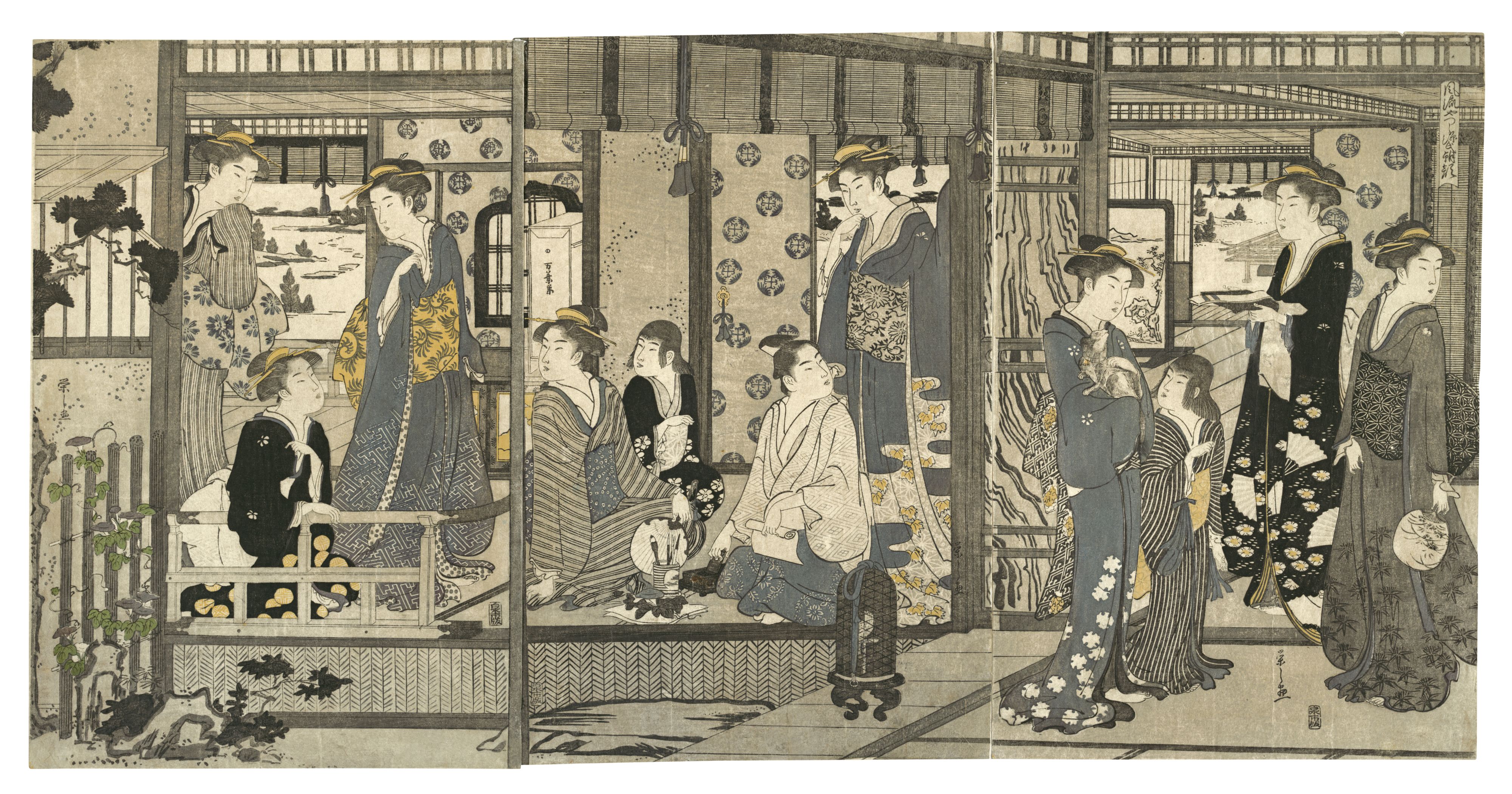
Bellflowers (Asagao), from the series Genji in Fashionable Modern Guise (Fūryū yatsushi Genji: Asagao)
1789–92
Triptych of woodblock prints; ink and color on paper

A Banquet Scene
c. 1795
Color woodblock print; right sheet of oban triptych
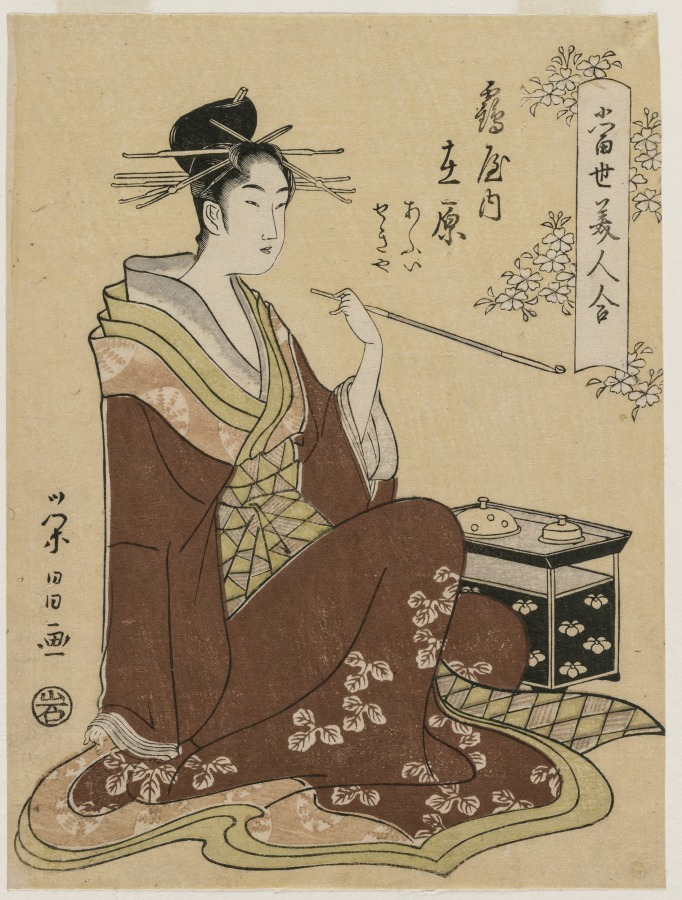
The Courtesan Ariwara of the Tsuruya Seated by a Smoking Chest (From the series A Collection of Modern Beauties)
mid 1790s
color woodblock print

Women viewing dragon and tiger made of tobacco pouches
c. 1795
Color woodblock print, triptych

A Selection of Beauty from the Pleasure Quarters (Seiro bisen awase): Hanamurasaki of the Tamaya in Procession (Tamaya Hanamurasaki dochu no zu)
c. 1795
Color woodblock print; oban

The Courtesan Shizuka of the Shizutamaya
1790s
Color woodblock print; hashira-e

Hotei, from the series "Comparison of the Treasures of the Gods of Good Fortune (Fukujin takara awase)"
c. 1795
Color woodblock print; oban

The Peacock Boat
c. 1795/96
Color woodblock print; oban triptych
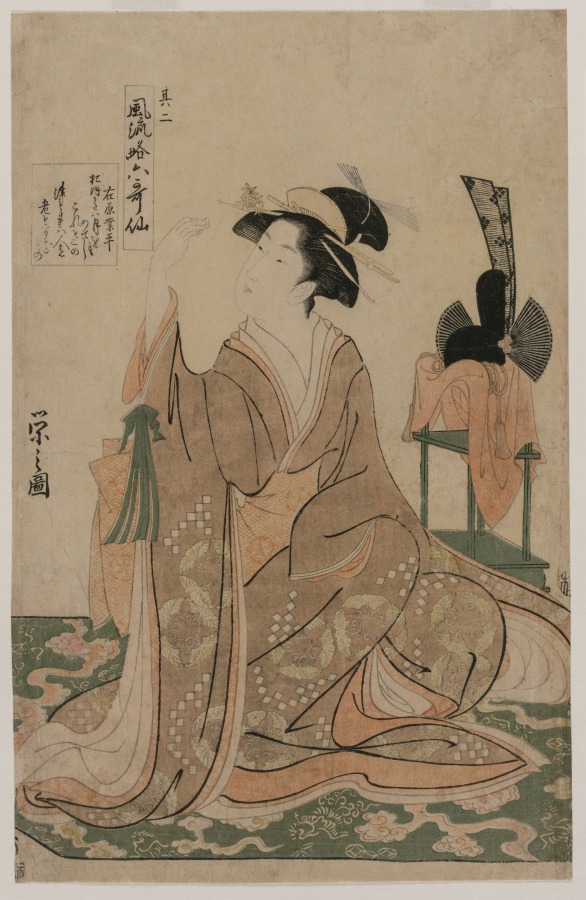
Young Woman Kneeling by a Stand with a Ceremonial Cap (from the series The Six Immortal Poets in Elegant Modern Dress)
mid 1790s
color woodblock print
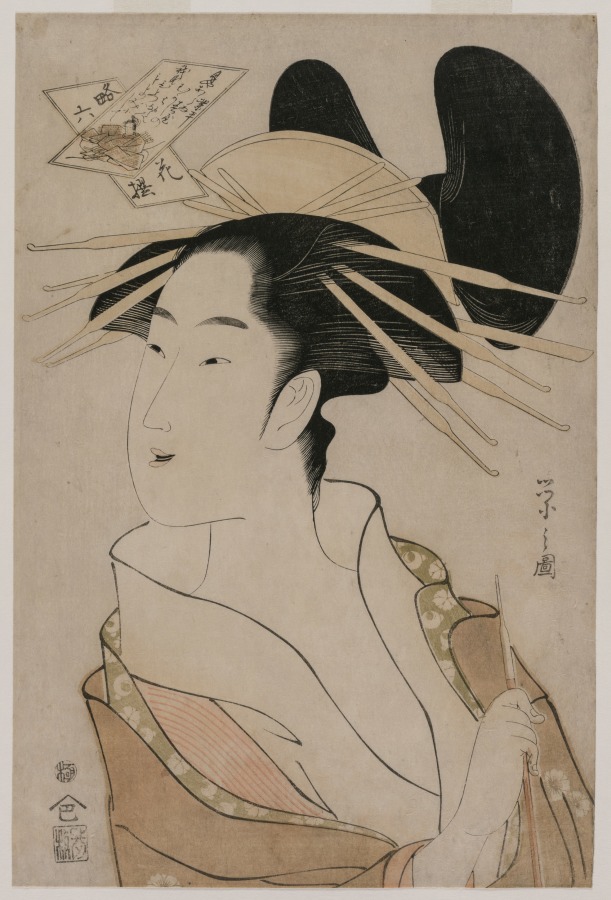
Portrait of a Courtesan Holding a Pipe (from the series The Six Immortal Poets in Modern Dress)
mid 1790s
color woodblock print
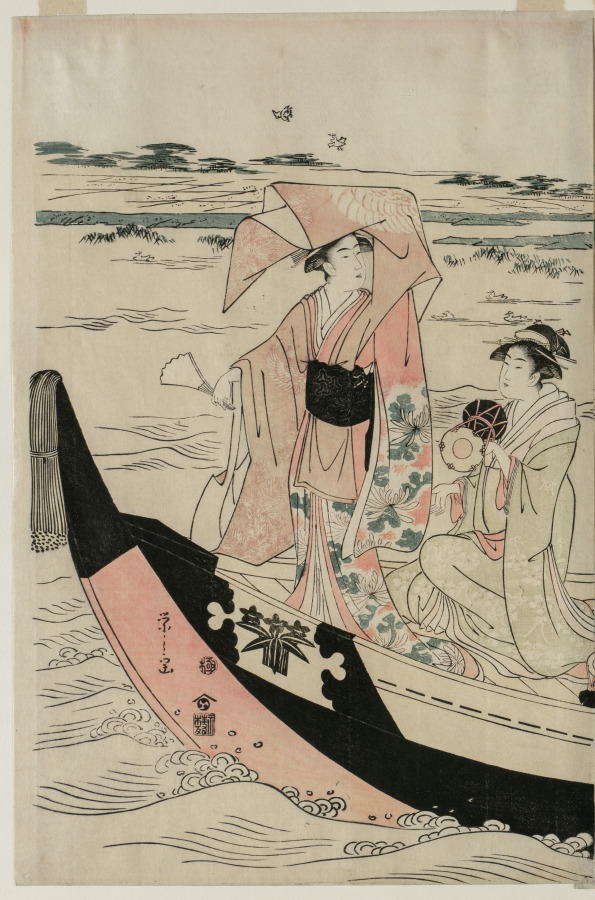
Women in a Pleasure Boat on the Sumida River
early 1790s
woodblock print from a triptych; ink and color on paper
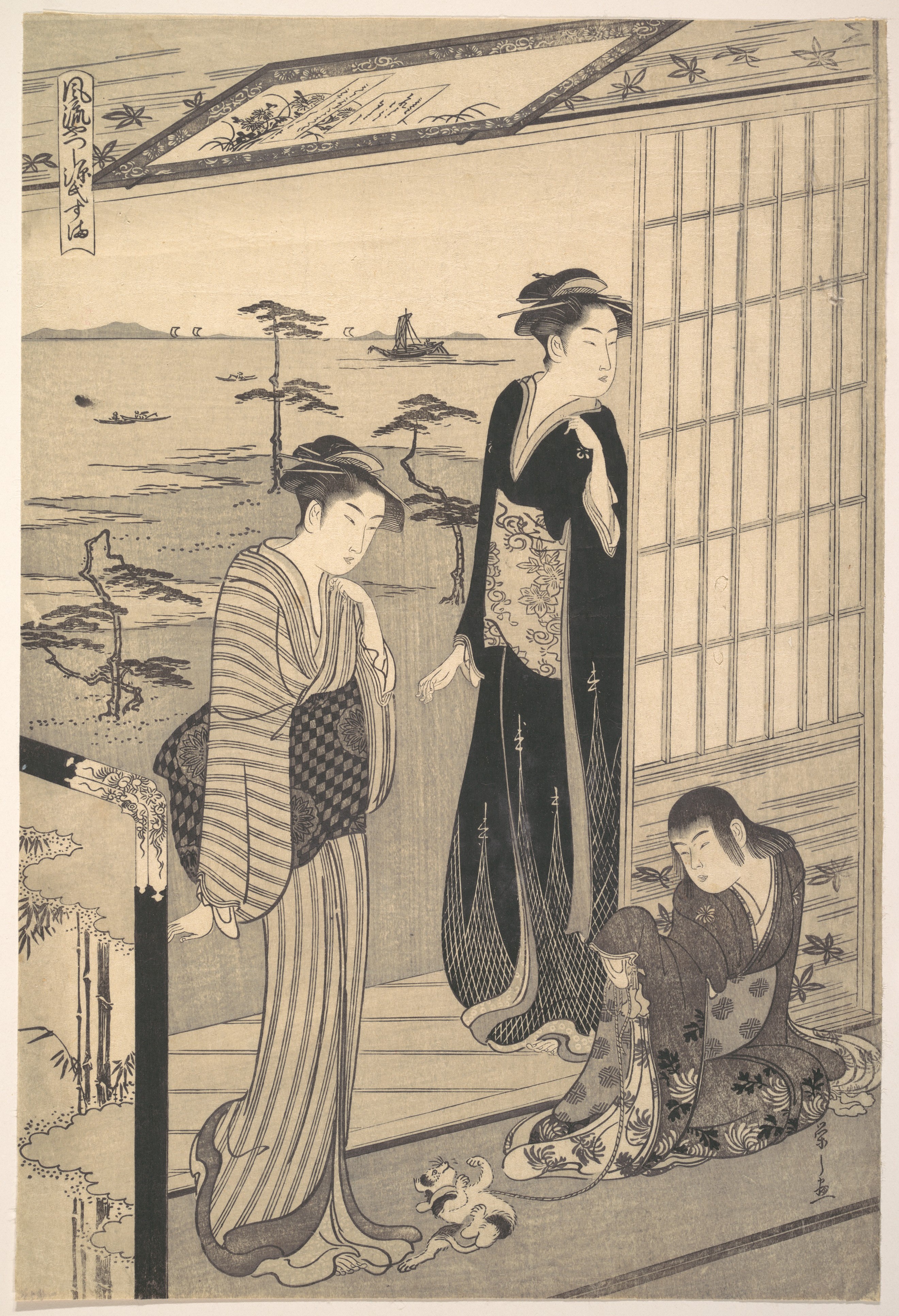
Genji in Exile at Suma, from the series Genji in Fashionable Modern Guise (Fūryū yatsushi Genji: Suma)
ca. 1791–92
Left sheet of a triptych of woodblocks; ink and color on paper

A Selection of Beauty from the Pleasure Quarters (Seiro bisen awase): Misayama of the Chojiya in Night Dress (Tokogi no zu - Chojiya Misayama)
c. 1796
Color woodblock print; oban

Noble woman in a carriage viewing cherry blossoms
c. 1796
Color woodblock print; oban triptych