
Biography
Hashiguchi Goyo, born Hashiguchi Kiyoshi in 1880 in Kagoshima, on the southern island of Kyushu, was one of the most gifted and tragically short-lived artists of the shin-hanga movement. Despite producing only a small number of woodblock prints during a concentrated period of creative activity from approximately 1915 to 1921, Goyo created some of the most exquisite and celebrated prints in the entire canon of modern Japanese printmaking. His bijin-ga (beautiful women prints) are considered by many connoisseurs to be among the finest ever produced, rivalling even those of the great ukiyo-e masters in their combination of technical perfection, psychological depth, and aesthetic refinement.
Goyo was born into a cultured family with artistic connections. His father, Hashiguchi Kanemizu, was a samurai and an amateur painter who worked in the Shijo style, and the young Kiyoshi grew up surrounded by art and cultural discourse. He showed exceptional artistic talent from childhood and was encouraged by his family to pursue a career in art. As a young man he studied at the Tokyo School of Fine Arts (Tokyo Bijutsu Gakko), where he trained in Western-style painting under Kuroda Seiki, the most important Western-trained Japanese painter of the Meiji era. This training in Western art gave Goyo a thorough grounding in anatomy, perspective, and the rendering of light and shadow — skills that would later distinguish his woodblock prints from those of artists trained exclusively in Japanese traditions.
Goyo also studied Japanese art history and developed a deep appreciation for the works of the great ukiyo-e artists, particularly Kitagawa Utamaro, whose bijin-ga prints from the late eighteenth century represented the pinnacle of the genre. He became a devoted student of Utamaro's compositions and techniques, spending many hours studying original prints and developing an intimate understanding of the aesthetic principles underlying the finest ukiyo-e. This dual training in both Western and Japanese artistic traditions would prove crucial to his later achievement.
After graduating at the top of his class from the Tokyo School of Fine Arts in 1905, Goyo initially pursued a career as a painter and graphic designer. He became involved in the burgeoning commercial art scene of Meiji-era Japan, producing illustrations, book designs, and decorative art. Most notably, he designed the binding and illustrations for the first edition of Natsume Soseki's novel "I Am a Cat" (Wagahai wa Neko de Aru), one of the landmarks of modern Japanese literature, and went on to design books for a number of other leading authors. His graphic work demonstrated a sophisticated understanding of both Japanese and Western aesthetic traditions and established his reputation as an artist of exceptional refinement and taste.
Goyo's turn to woodblock printmaking came relatively late in his career, around 1915, when he was urged by the shin-hanga publisher Watanabe Shozaburo to design a print. Unlike most shin-hanga artists, who entrusted the carving and printing of their designs to a publisher's craftsmen, Goyo soon insisted on supervising every aspect of production himself. He selected his own carvers and printers, chose the paper and pigments, and directed the printing process with obsessive attention to detail. This self-publishing approach gave him complete artistic control but also meant that production was slow and editions were small; many of his prints were produced in modest editions, and some survive in only a handful of impressions.
Goyo's woodblock output is dominated by bijin-ga, which constitute the most celebrated part of his oeuvre. These prints depict women in moments of private toilette — bathing, combing their hair, drying themselves after the bath, or sitting in quiet contemplation. The most famous of these is "Woman Combing Her Hair" (Kami sukeru onna), completed around 1920, which depicts a seated woman drawing a fine-toothed comb through her long black hair. The print is remarkable for the sensuous naturalism of its figure drawing, the exquisite rendering of the woman's skin and hair, and the subtle psychological presence of the subject, who seems lost in thought as she performs this daily ritual. "Woman Combing Her Hair" is widely considered one of the supreme achievements of Japanese printmaking.
Other celebrated bijin-ga by Goyo depict women after the bath and in hot-spring settings, presenting a nude or partly draped figure at the water's edge. These prints combine the frank naturalism of Western figure painting with the decorative elegance and technical refinement of the Japanese woodblock tradition. The flesh tones in Goyo's prints are achieved through multiple applications of translucent pigment, creating a luminous warmth that seems to glow from within the paper. The hair, rendered in deep, lustrous black, provides a striking contrast that frames the face and body with graphic boldness.
Beyond the bijin-ga that dominate his oeuvre, Goyo's small body of work also included a handful of prints on other subjects. These share with his figure prints a quality of stillness and contemplative beauty, together with the same soft gradations of color, that are distinctly Goyo's own.
The technical quality of Goyo's prints is universally acknowledged as extraordinary, even within the high standards of the shin-hanga movement. He used the finest handmade hosho paper, selected natural mineral pigments of the highest quality, and insisted on traditional keyblock techniques refined to an unusual degree of precision. The embossing (karazuri) in his prints — used to suggest the texture of skin, the weave of fabric, and the softness of hair — is among the most sophisticated in the woodblock medium. Each sheet passed under the printer's baren many times, with some designs requiring twenty or more separate impressions of color.
Tragically, Goyo's printmaking career was cut short by illness. In late 1920 his health, long fragile, deteriorated sharply as his chronic ailments developed into meningitis, and he died on February 24, 1921, at the age of only forty. At the time of his death he had completed only about fourteen finished print designs, with several additional works left unfinished or in preliminary stages. His premature death robbed the world of an artist who was arguably at the height of his creative powers and who might have produced many more masterworks had he been granted a longer life.
The rarity and exceptional quality of Goyo's prints have made them among the most coveted and admired of all Japanese woodblock prints. Major collections of his work are held at the Museum of Fine Arts Boston, the British Museum, and the Honolulu Museum of Art, among other leading museums in Japan and the West. Despite the small size of his oeuvre, Hashiguchi Goyo's influence on subsequent generations of printmakers and his reputation as one of the supreme artists of the woodblock medium remain undiminished. His prints stand as testament to what can be achieved when extraordinary artistic vision is combined with uncompromising technical standards and complete creative control.
Key Facts
- Active Period
- 1880–1921
- Nationality
- 🇯🇵Japan
- Movement
- Shin-hanga
- Works Indexed
- 126
Frequently Asked Questions
Hashiguchi Goyo, born Hashiguchi Kiyoshi in 1880 in Kagoshima, on the southern island of Kyushu, was one of the most gifted and tragically short-lived artists of the shin-hanga movement. Despite producing only a small number of woodblock prints during a concentrated period of creative activity from approximately 1915 to 1921, Goyo created some of the most exquisite and celebrated prints in the entire canon of modern Japanese printmaking. His bijin-ga (beautiful women prints) are considered by many connoisseurs to be among the finest ever produced, rivalling even those of the great ukiyo-e masters in their combination of technical perfection, psychological depth, and aesthetic refinement.
Hashiguchi Goyo was active from 1880 to 1921. They were associated with the Shin-hanga movement.
Hashiguchi Goyo's work was shaped by the Shin-hanga tradition in Japanese woodblock printmaking. Shin-hanga: ## What is Shin-hanga? Shin-hanga (新版画), literally "new prints," is the early twentieth-century revival of the collaborative Japanese woodblock workshop, organized between roughly 1915 and 1960 by the Tokyo publisher Watanabe Shōzaburō (1885–1962) and a handful of competing houses.
Hashiguchi Goyo's prints frequently feature bijin-ga, figures, nude, landscapes, portraits, interiors.
Original prints by Hashiguchi Goyo can be found in collections including Harvard Art Museums, Art Institute of Chicago, Harvard Art Museum, Honolulu Museum of Art.
External Resources
Woodblock Prints by Hashiguchi Goyo (126)
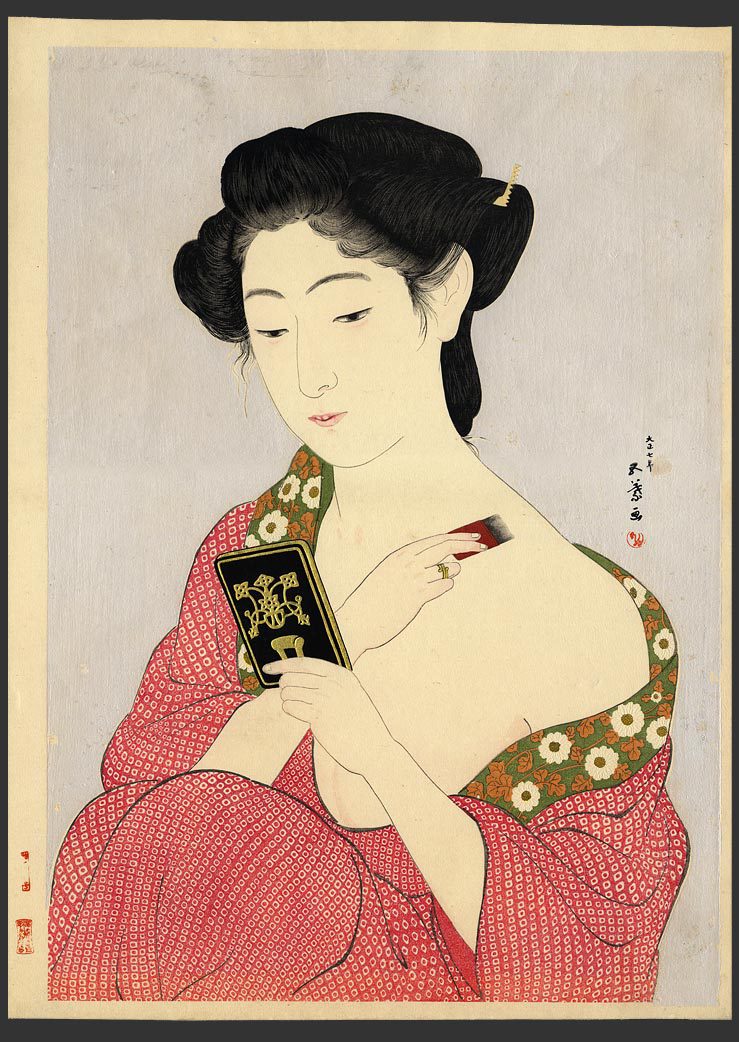
Woman with Hairpin
簪の女
1918
Color woodblock print
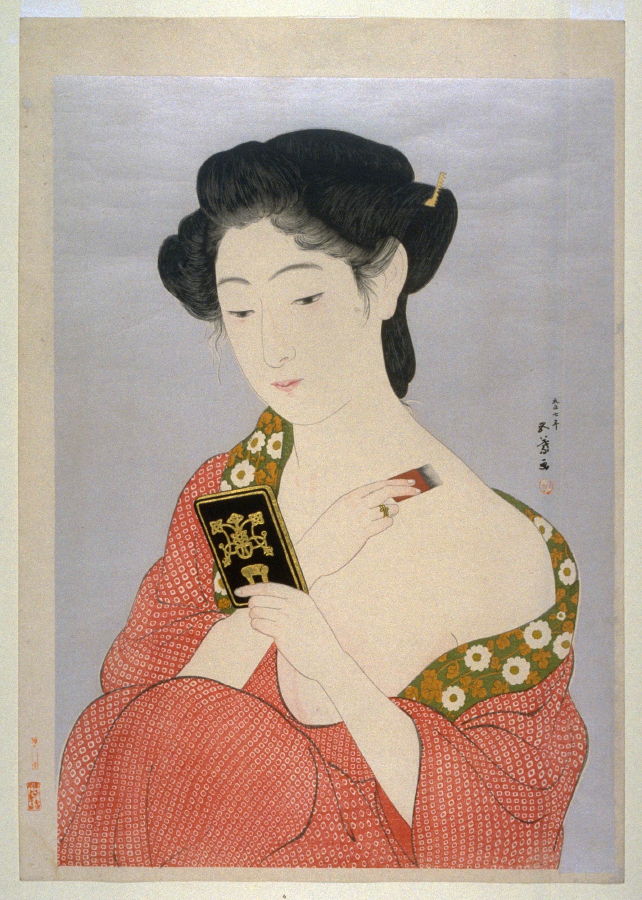
Woman at her Toilet
1918
Woodblock print
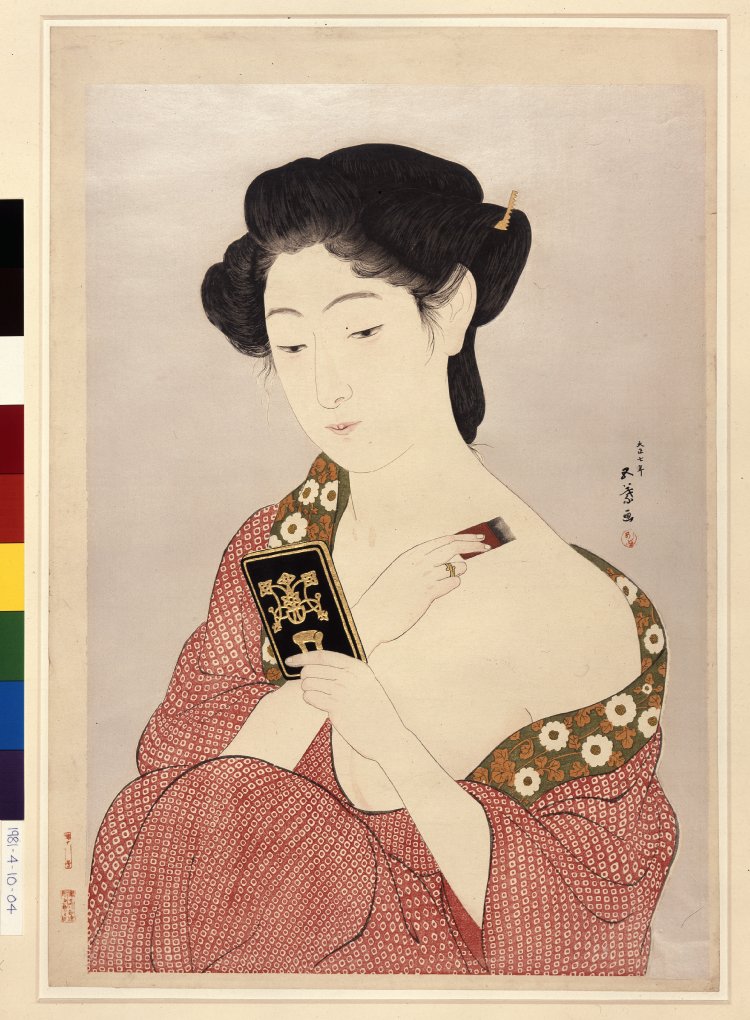
Woman Making Up
April 1918
Woodblock print
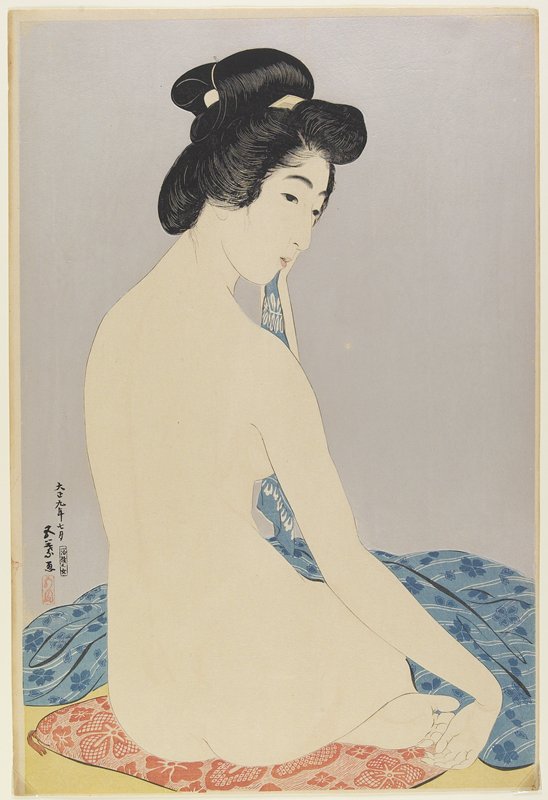
Woman Looking at a Painting
絵を見る女
1918
Color woodblock print

Woman Applying Makeup- Kesho no Onna — 化粧の女
1918
Woodblock print
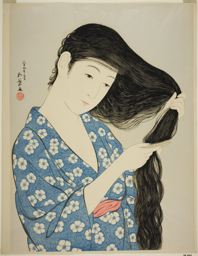
Woman Combing Her Hair
髪梳きの女
c. 1920
Color woodblock print
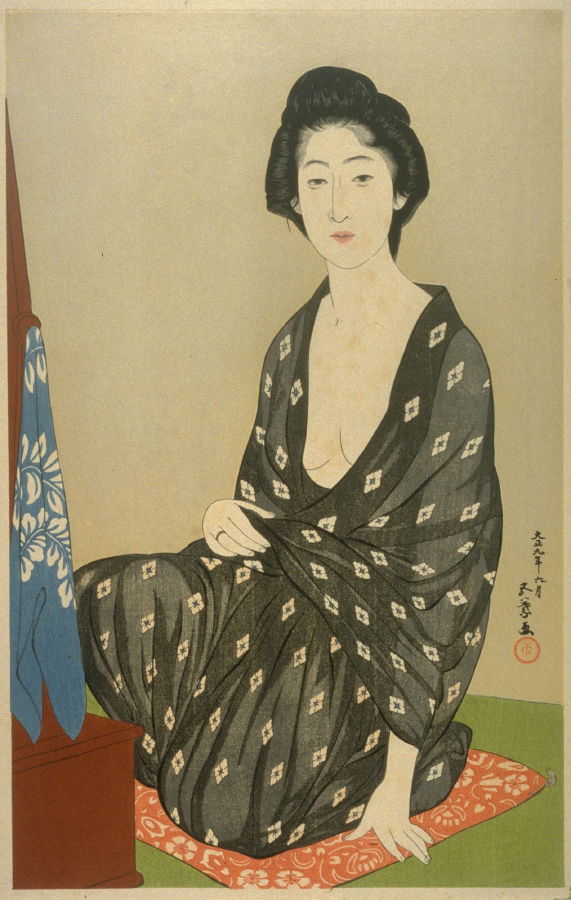
Summer Beauty
1920
Woodblock print
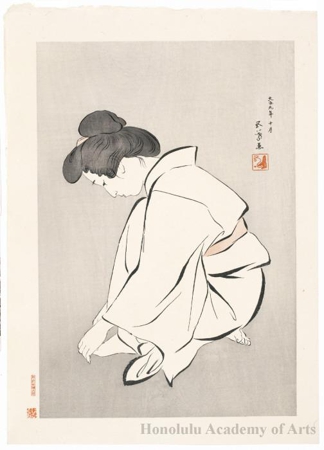
Woman Clipping Her Toe Nails
1920
Woodblock print
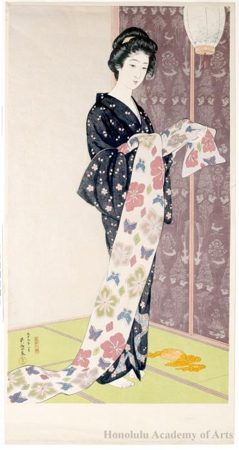
Young Woman in Summer Kimono (natsu yosoi no musume)
1920
Woodblock print
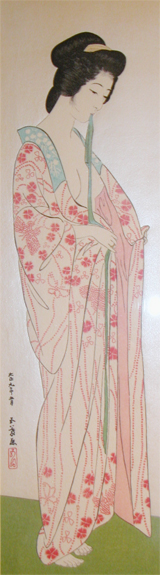
Woman with Sash
1920 (posthumous edition)
Woodblock print
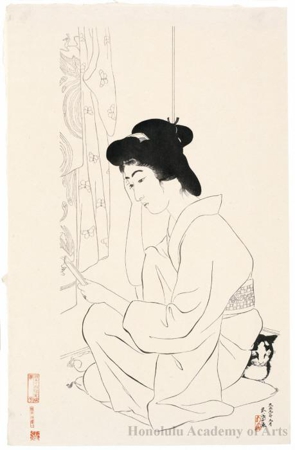
Hand Mirror
1920
Woodblock print
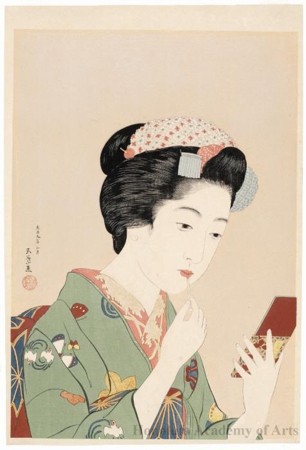
Woman with rouge brush
1920
Woodblock print
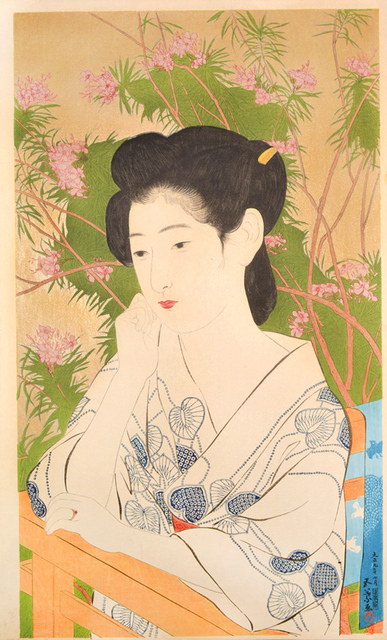
At a Hot Spring Inn
1920
N/A
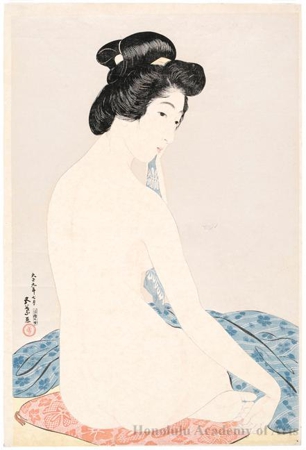
Woman after the Bath (Yokugo no onna)
1920
Woodblock print
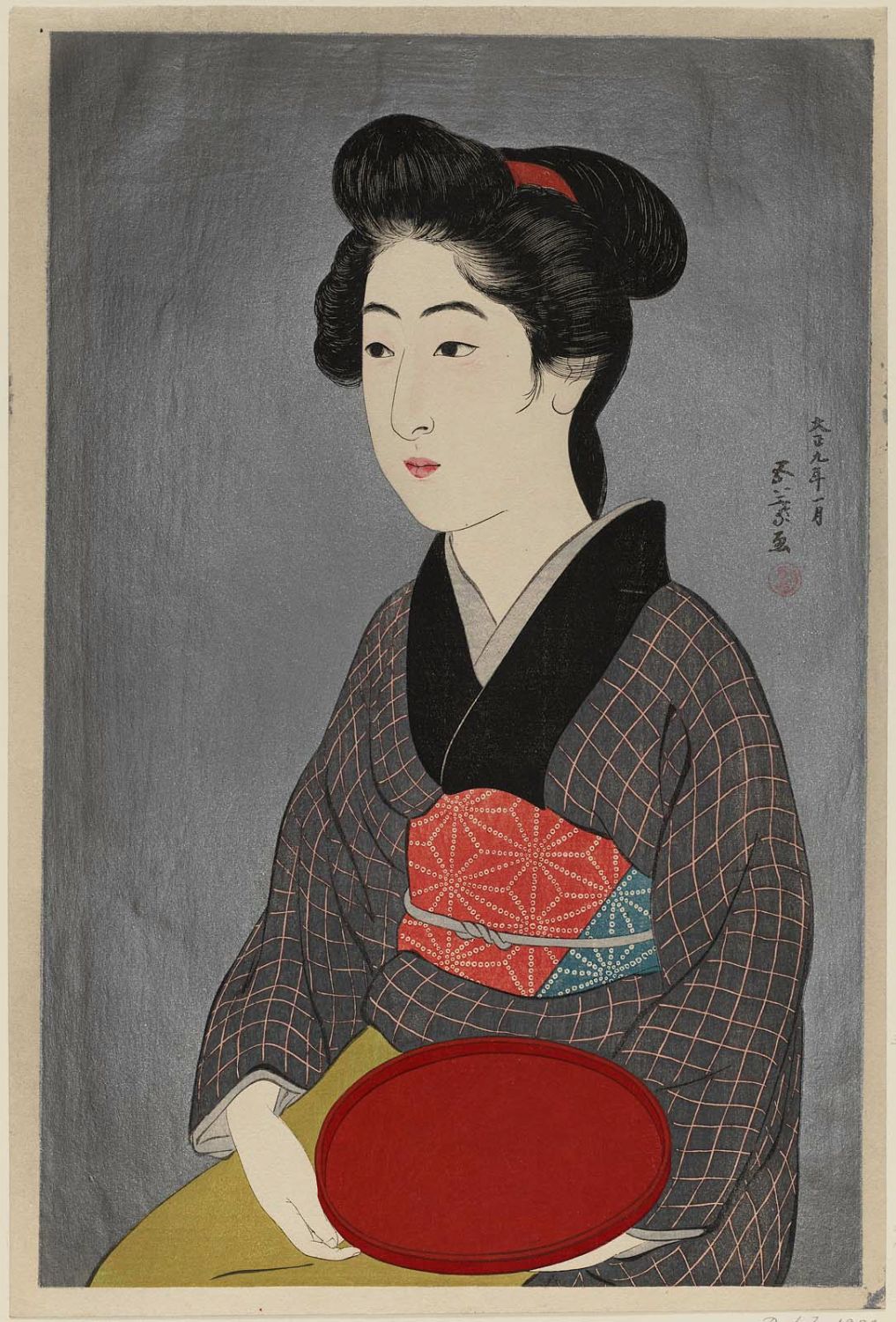
Waitress with a Red Tray (Portrait of Onao, a Maid at the Matsuyoshi Inn, Kyoto)
1920
Woodblock print
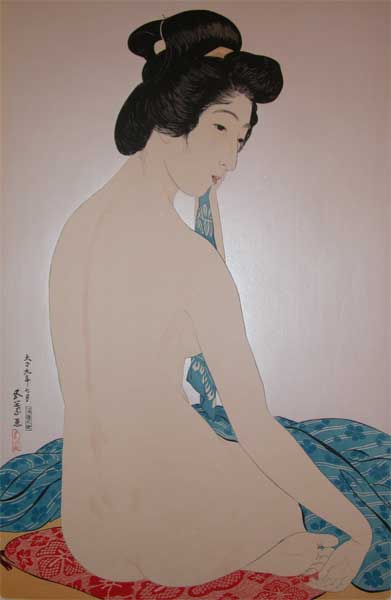
After Bath
1920 (posthumous edition)
Woodblock print

Woman in a Long Undergarment
長襦袢の女
1920
Color woodblock print
Woman at the Hot Springs
1920 (Taishō 9), 8th month
Unmatted modern Japanese woodblock print; ink and color on paper

Woman Kneeling in the Bath and Combing Her Hair
1920
Woodblock print
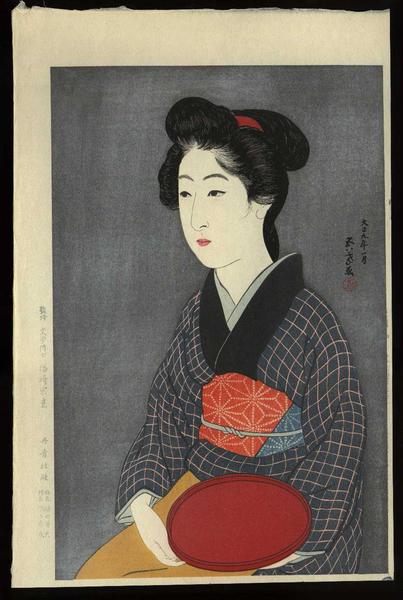
Woman Holding a Tray - Bon Moteru Onna
1920
Woodblock print

Woman Holding a Tray
1920 (Taishō 9), 1st month
Modern Japanese woodblock print; ink, color and mica on paper
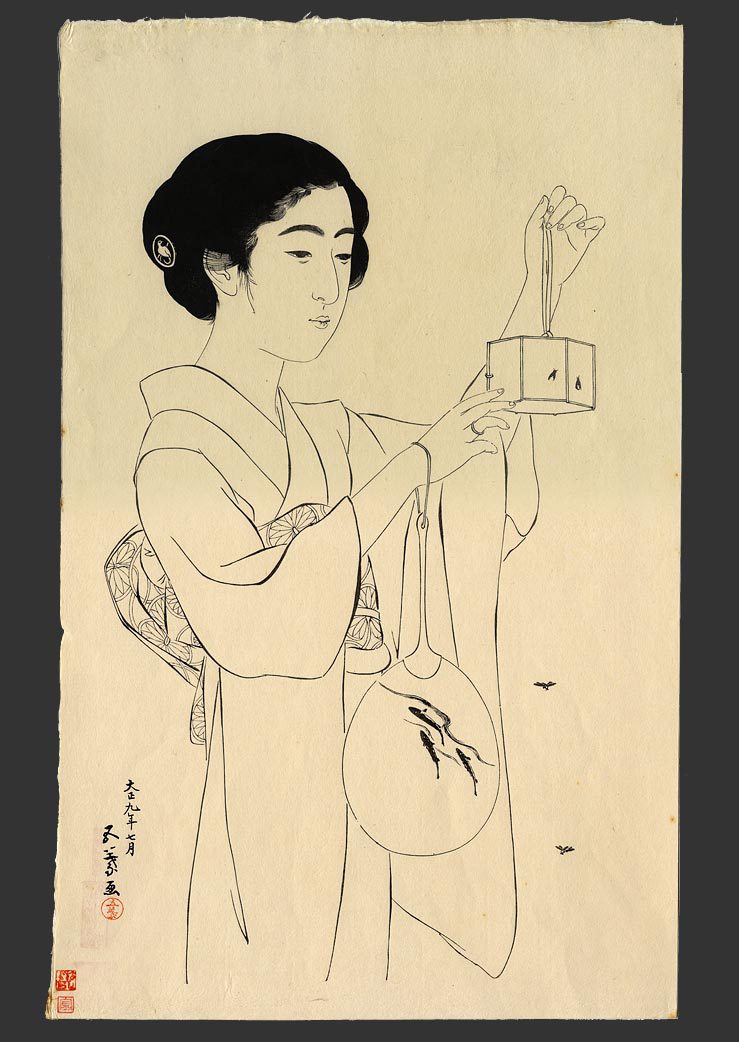
Woman with fan and cricket cage
1920
Woodblock print
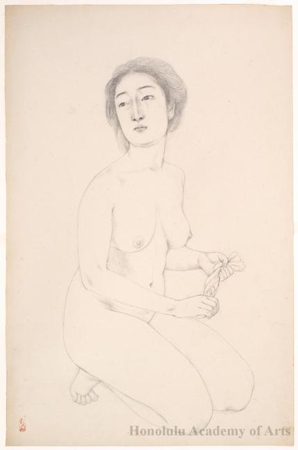
Woman Holding a Towel
手拭いを持つ女
1920
Color woodblock print
Woman Holding a Lip Brush
1920 (Taishō 9), 9th month
Modern Japanese woodblock print; ink, color, mica and gold on paper
Signature Techniques
Mokuhanga techniques most associated with Hashiguchi Goyo.
Compare With
Goyō and Shinsui are shin-hanga's two defining bijin-ga revivalists; both modernised the Kiyonaga–Utamaro tradition.