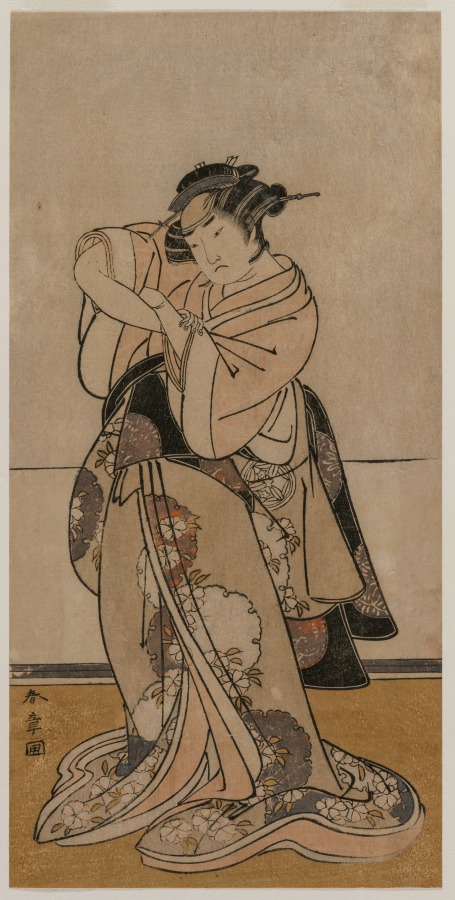
Biography
Katsukawa Shunshō (勝川春章, 1726-1793) was the founder of the Katsukawa school of ukiyo-e and the single most important reformer of Edo kabuki actor prints in the eighteenth century. Working in Edo from roughly the 1760s until his death in 1793, Shunshō transformed yakusha-e (kabuki actor prints) from a tradition of generic theatrical sign-painting into a genre of recognizable, psychologically observed portraiture. His innovations defined the visual language of actor prints for the next half-century, shaped the careers of his many pupils, and laid the groundwork for the radical experiments of Tōshūsai Sharaku in the 1790s. He was also Katsushika Hokusai's first teacher, training the young artist (then known as Shunrō) from the late 1770s until Shunshō's death in 1793.
Shunshō was born in 1726, during the Kyōhō era. The details of his early years are sparse, but the most widely accepted tradition is that he first studied painting under Miyagawa Shunsui, a follower of the Miyagawa school of painted ukiyo-e descended from Miyagawa Chōshun. Through Shunsui he inherited a lineage that stretched back to the painterly side of the floating-world tradition, and the influence of careful figural observation and pigment-based finish would remain visible across his career. He is also said to have studied with the painter Kō Sūkoku. By the early 1760s he had moved decisively from painting into commercial print design, working for Edo publishers including Nishimuraya Yohachi and Tsutaya Jūzaburō.
The transformation Shunshō brought to Edo kabuki actor prints can be dated to the second half of the 1760s. Before Shunshō, yakusha-e had been dominated by the Torii school, whose stylized, broadly drawn figures functioned more as theatrical heraldry than as portraits of individual performers; viewers identified actors not by face but by family crests (mon) printed on costumes. Shunshō, working alongside his contemporary Ippitsusai Bunchō, began producing actor prints in which facial features, posture, and gesture were so carefully individualized that contemporary audiences could recognize specific performers — Ichikawa Danjūrō V, Nakamura Nakazō I, Onoe Matsusuke I, Bandō Mitsugorō I, Ichikawa Yaozō II — without needing the crest to tell them who they were looking at. The pivotal book in this transformation was Ehon Butai Ōgi ("Picture Book of Stage Fans," 1770), produced jointly with Bunchō, which presented kabuki actors as fan paintings rendered with the new realistic facial conventions. From this point Shunshō committed himself almost entirely to actor prints, and the hosoban format — the tall, narrow single-sheet print roughly 31 by 14 centimeters — became his preferred vehicle. The hosoban was inexpensive enough for ordinary kabuki fans to collect, and Shunshō and his studio exploited it on an industrial scale, producing hundreds of documented designs across his career.
Shunshō's mature style is immediately recognizable. His Edo kabuki actor prints combine carefully observed faces — distinctive eyebrows, mouth shape, and bone structure rather than the stereotyped masks of the Torii — with the dynamic body language of the kabuki mie, the held pose at moments of dramatic climax. His drawing is firm and economical; the line varies in pressure to suggest the volume of robe and limb. His color palette is restrained, often built around a deep indigo (aizome), soft mineral pinks, mustard yellows, and gradated grays, with crisp black for hair and accessories. Compositions are tightly cropped, frequently focusing on a single full-length figure on an unornamented ground, so that all attention falls on face and pose. Within a hosoban diptych or triptych, the figures are choreographed to reproduce an actual stage tableau, which is why his work remains an important documentary record of late-eighteenth-century kabuki performance.
Beyond yakusha-e, Shunshō was also a serious painter of bijin-ga (beautiful-women pictures) and a designer of luxurious illustrated books. His most celebrated book project was Seirō Bijin Awase Sugata Kagami ("Mirror of the Beauties of the Green Houses Compared," 1776), a three-volume color-printed album of Yoshiwara courtesans designed jointly with Kitao Shigemasa and published by Tsutaya Jūzaburō and Yamazakiya Kinbei. The book is one of the great masterpieces of mid-Edo color printing, combining Shunshō's gift for individualized portraiture with Shigemasa's elegant draftsmanship and the publishers' lavish use of multi-block color. Each leaf presents a named courtesan of the Yoshiwara in a specific seasonal or domestic setting, and complete sets are preserved at the Metropolitan Museum of Art, the Art Institute of Chicago, and the Museum of Fine Arts Boston. Shunshō also produced sumō prints — full-length portraits of star wrestlers such as Tanikaze Kajinosuke and Onogawa Kisaburō — that helped establish sumō-e as a marketable genre alongside actor prints.
The Katsukawa school that Shunshō founded was, after the Torii, the most consequential print lineage of late eighteenth-century Edo. His direct pupils included Katsukawa Shunkō I (1743-1812), who took over much of the studio's actor-print work in Shunshō's later years; Katsukawa Shun'ei (1762-1819), whose more theatrical close-up portraits anticipate Sharaku; Katsukawa Shunjō; and, most consequentially, the young Katsushika Hokusai, who entered the studio in the late 1770s under the name Katsukawa Shunrō and remained until Shunshō's death in 1793. Hokusai always acknowledged Shunshō as his foundational teacher, and the careful observation of human anatomy and gesture that defines Hokusai's mature work — including the figures of the Hokusai Manga and the human staffage of the Thirty-six Views of Mount Fuji — was rooted in the Katsukawa discipline. Shunshō's influence extended outside his immediate studio as well: when Tōshūsai Sharaku produced his famous okubi-e actor portraits in 1794-1795, he was working in a Katsukawa-derived tradition of individualized likeness that Shunshō had made the default for serious yakusha-e.
Shunshō died in Edo on the eighth day of the twelfth month of Kansei 4 (January 19, 1793, by the Western calendar). He is buried at Saifuku-ji in the Asakusa district of Edo. His prints — the 1726-1793 corpus of hosoban actor portraits, the Mirror of the Beauties of the Green Houses Compared, the sumō series, and his late paintings of beauties on silk — survive in major holdings at the Metropolitan Museum of Art, the Art Institute of Chicago, the Museum of Fine Arts Boston, the British Museum, and the Tokyo National Museum. Today Shunshō is recognized as the artist who turned Edo kabuki actor prints into portraiture, the founder of a school that dominated yakusha-e for two generations, and the teacher who handed the Katsukawa observational tradition to Hokusai.
Key Facts
- Active Period
- 1726–1793
- Nationality
- 🇯🇵Japan
- Movement
- Ukiyo-e
- Works Indexed
- 342
Frequently Asked Questions
Katsukawa Shunshō (勝川春章, 1726-1793) was the founder of the Katsukawa school of ukiyo-e and the single most important reformer of Edo kabuki actor prints in the eighteenth century. Working in Edo from roughly the 1760s until his death in 1793, Shunshō transformed yakusha-e (kabuki actor prints) from a tradition of generic theatrical sign-painting into a genre of recognizable, psychologically observed portraiture. His innovations defined the visual language of actor prints for the next half-century, shaped the careers of his many pupils, and laid the groundwork for the radical experiments of Tōshūsai Sharaku in the 1790s. He was also Katsushika Hokusai's first teacher, training the young artist (then known as Shunrō) from the late 1770s until Shunshō's death in 1793.
Katsukawa Shunshō was active from 1726 to 1793. They were associated with the Ukiyo-e movement.
Katsukawa Shunshō's work was shaped by the Ukiyo-e tradition in Japanese woodblock printmaking. Ukiyo-e: ## What is ukiyo-e? Ukiyo-e ([浮世絵](/glossary/ukiyo-e)) — literally "pictures of the floating world" — is the Edo-period Japanese print and painting tradition that flourished from roughly 1660 to 1868, depicting the pleasures of urban life in Edo (modern Tokyo): courtesans, kabuki actors, sumo wrestlers, famous landscapes, and seasonal beauties.
Katsukawa Shunshō's prints frequently feature sumo, winter, birds & flowers, autumn foliage, mount fuji, moonlight.
Original prints by Katsukawa Shunshō can be found in collections including Art Institute of Chicago, Cleveland Museum of Art, ukiyo-e.org.
Woodblock Prints by Katsukawa Shunshō (342)

The Actor Nakamura Noshio I in an Unidentified Role
c. 1773
Color woodblock print; hosoban

Two Courtesans on a Moonlit Balcony at a House of Pleasure in Shinagawa, from the series "Nan'eki Shufu"
c. 1774
Color woodblock print; oban

The Actor Segawa Tomisaburo I as Kiyo-hime in the Play Hanagatami Kazaori Eboshi, Performed at the Ichimura Theater in the Third Month, 1774
c. 1774
Color woodblock print; hashira-e

The Actor Ichimura Uzaemon IX as Aza-maru in the Play Yui Kanoko Date-zome Soga, Performed at the Ichimura Theater in the First Month, 1774
c. 1774
Color woodblock print; hosoban

The Actor Segawa Yujiro (or Segawa Kikunojo III) in an Unidentified Role
c. 1774
Color woodblock print; hosoban

The Actor Nakamura Tomijuro I as Akushichibyoe Kagekiyo in the Play Kite Hajime Hatsugai Soga, Performed at the Morita Theater in the First Month, 1774
c. 1774
Color woodblock print; hosoban; right sheet of diptych (?)

The Courtesan Michinoku of the Tsutaya House with her Kamuro Midare and Shinobu, from the series "Kikkaku Hokufu"
c. 1774
Color woodblock print; oban

The Actor Matsumoto Koshiro IV as Ogata no Saburo Disguised as Matsuura Saemon in the Play Ichi no Tomi Tsuki no Kaomise, Performed at the Morita Theater in the Eleventh Month, 1774
c. 1774
Color woodblock print; hosoban; from a multisheet composition (?)

The Actor Otani Hiroemon III as Gokumon Shobei in the Play Sugata no Hana Kurofune Zukin, Performed at the Morita Theater in the Ninth Month, 1774
c. 1774
Color woodblock print; hosoban; from a multisheet composition (?)

Nakamura Utaemon I as Karashi Baba and Yoshizawa Sakinosuke III as Shirotae
About 1769
Color woodblock print; hosoban

The Actor Segawa Tomisaburo I as the Heron Maiden (Sagi Musume)
c. 1774
Color woodblock print; hosoban

The Actor Ichikawa Yaozo II as Hachio-maru Aratora in the Play Chigo Sakura Jusan Kane, Performed at the Ichimura Theater in the Eleventh Month, 1774
c. 1774
Color woodblock print; hosoban

The Actors Nakamura Nakazo I as Omi no Kotoda (right), and Otani Hiroji III as Bamba no Chuda (left), in the Joruri "Sono Chidori Yowa no Kamisuki" (The Plovers: Combing Hair at Midnight), from Part Two of the Play O-atsurae-zome Soga no Hinagata (A Soga Pattern Dyed to Order), Performed at the Nakamura Theater from the Tenth Day of the Third Month, 1774
c. 1774
Color woodblock print; hosoban diptych

The Actor Segawa Kikunojo III in Private Life, Standing in a Snow-Covered Garden
c. 1775
Color woodblock print; large hosoban

The Actor Segawa Kikunojo III as Hito-maru Disguised as the Courtesan Chiyozaki, in the Play Kuruwa no Hana Katsuragi no Kane, Performed at the Ichimura Theater in the third Month, 1775
c. 1775
Color woodblock print; hosoban

Scene at the Tsurugaoka Hachiman Shrine, from Act One of Chushingura (Treasury of the Forty-seven Loyal Retainers), from the series "Chushingura Juichimai-Tsuzuki (Set of Eleven Sheets Illustrating Chushingura)"
c. late 1770s
Color woodblock print; chuban
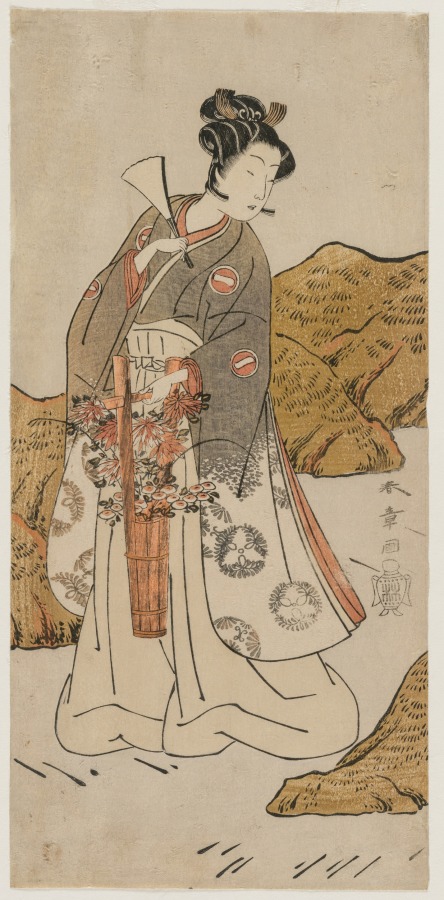
Ichikawa Monnosuke II as a Temple Page
early 1770s
color woodblock print

The Annoucement, page from "A Picture Book of Stage Fans (Ehon butai ogi)"
1770
Color woodblock print; page from illustrated book

The Actor Ichimura Uzaemon IX in an Unidentified Role
c. 1775
Color woodblock print; hosoban; left sheet of diptych

The Actors Ichikawa Yaozo II as Konoshita Hyokichi (?) (right), and Sakata Hangoro II as Matsunaga Daizen Hisahide (?) (left), in the Play Gion Sairei Shinko Ki (?), Perfomred at the Ichimura Theater (?) in the Fifth Month, 1775 (?)
c. 1775
Color woodblock print; hosoban

The Actor Ichikawa Danjuro V as Soga no Dozaburo (?) in the Play Shida Yuzuriha Horai Soga (?), Performed at the Morita Theater (?) in the First Month, 1775 (?)
c. 1775
Color woodblock print; hosoban

The Actor Segawa Kikunojo III as the Courtesan Kisewata (Tagasode) (?) in the Play Hana-zumo Genji Hiiki (?), Performed at the Nakamura Theater (?) in the Eleventh Month, 1775 (?)
c. 1775
Color woodblock print; hosoban

The Actor Nakamura Noshio I as a Dragon Maiden Disguised a Tamanami, in the Play Oyafune Taiheiki, Performed at the Ichimura Theater in the Eleventh Month, 1775
c. 1775
Color woodblock print; hosoban

The Actor Nakamura Nakazo I in the Role of an Evil Courtier, Probably Prince Takahito, Illegitimate Son of Emperor Takakura, Disguised as Aso no Matsuwaka, in Part One of the Play Iro Moyo Aoyagi Soga (Green Willow Soga of Erotic Design), Performed at the Nakamura Theater from the Thirteenth Day of the Second Month, 1775
c. 1775
Color woodblock print; hosoban