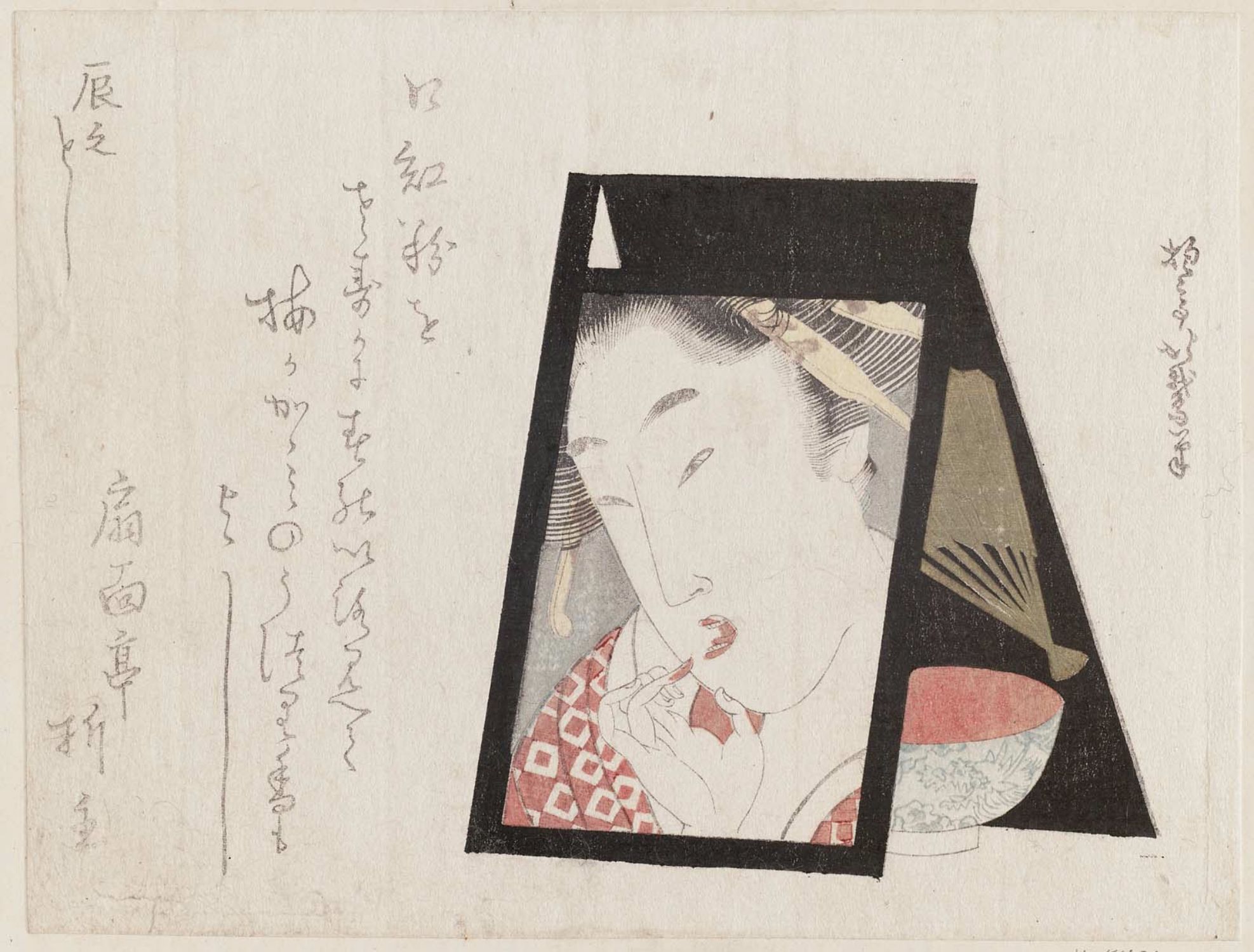
Biography
Katsushika Hokuga (葛飾北峩, active c. 1804-1844) was a direct pupil of Katsushika Hokusai and one of the small group of Hokusai-school designers whose careers were concentrated in the privately commissioned surimono format rather than in the commercial publishing market that dominated mainstream ukiyo-e. His signed and dated work falls within the late Bunka and Bunsei periods (roughly 1808-1833), and surviving impressions are now held by the Museum of Fine Arts, Boston, the British Museum, the Art Institute of Chicago, and the Metropolitan Museum of Art, which together preserve the principal Western institutional record of his output.
Like most members of the wider Hokusai studio, Hokuga left almost no biographical record beyond his prints. His personal name is not securely established (some dealers and catalogues record him as Manjirō Hokuga), his birth and death dates are unknown, and the dating of his career rests entirely on dated and dateable surimono designs and on his appearance in kyōka-poet network records as one of the studio illustrators serving the early-nineteenth-century Edo literary clubs. He signed early work as Hōtei Hokuga (布袋北峩) until around 1810, after which he generally signed simply as Hokuga. The character 北 (hoku) at the start of his art name marked him as a member of the Hokusai studio — the same convention that produced the names of fellow pupils such as Totoya Hokkei (北渓) and Teisai Hokuba (北馬) — and he belonged to the Hokusai-school cohort of surimono specialists that also included Yashima Gakutei and Katsushika Taito II, who together produced the most refined surimono of the late Bunka and Bunsei decades.
The surimono format defined Hokuga's career almost entirely. Surimono (摺物, literally 'printed things') were privately commissioned, small-format color woodblock prints produced for kyōka poetry clubs (renju), individual patrons, and gift exchanges, typically issued in small editions of fifty to a few hundred impressions and circulated outside the commercial publisher market that supplied actor and bijin prints to the broader Edo public. The standard format was the shikishiban (roughly 21 by 18 centimeters), a near-square sheet that gave the designer a contained field for the integration of image and inscribed kyōka verses, and the printing was technically lavish in ways the commercial market rarely permitted: heavy hōsho paper, metallic pigments in gold and silver, generous use of mica grounds (kira-zuri), blind printing (karazuri) for embossed surface effects, and restrained but precisely registered color palettes that emphasized refinement over decorative spectacle. Hokuga's surviving sheets conform closely to this technical register, and he is one of the designers whose work consistently exhibits the embossing, metallic inks, and dense kyōka inscriptions that distinguish high-quality Bunsei-period surimono from contemporary commercial output.
His subject range across the surimono format is broad within its small-edition conventions. The Museum of Fine Arts, Boston holds a substantial group of his sheets, among them examples from a Visiting the Shrines of the Seven Gods of Good Fortune (Shichifuku môde) series — from which a design of the deity Bishamon survives — as well as figure subjects such as Gama Sennin and His Toad, compositions of the kind designed to circulate as New Year gifts within the kyōka-club exchange tradition. Across the format his work ranges over the standard surimono categories of bijin, domestic still life, nature study, and landscape. The British Museum likewise holds surimono by him, and the Art Institute of Chicago's Helen C. Gunsaulus gift includes a c. 1833 sheet of a woman reading poems in a study room, dating to the closing phase of his documented career and characteristic of the late domestic-interior surimono favored by the kyōka networks of the early Tenpō years.
Hokuga's signed work tapers off in the early 1830s, with the latest reliably dated sheets falling around 1833, although secondary attributions extend his active period into the early 1840s. The cause and date of his death are unrecorded. His position within the broader Hokusai-school surimono tradition places him alongside the more prolific Hokkei and Gakutei as one of the second-tier studio designers whose careful, technically refined sheets sustain the documentary record of late-Bunka and Bunsei kyōka culture, and the surviving Western institutional holdings — concentrated at the Museum of Fine Arts in Boston, the British Museum, the Art Institute of Chicago, and the Metropolitan Museum of Art — preserve a coherent if dispersed corpus of his work that continues to support study of the surimono format and of the kyōka literary networks for which it was made.
Key Facts
Frequently Asked Questions
Katsushika Hokuga (葛飾北峩, active c. 1804-1844) was a direct pupil of Katsushika Hokusai and one of the small group of Hokusai-school designers whose careers were concentrated in the privately commissioned surimono format rather than in the commercial publishing market that dominated mainstream ukiyo-e. His signed and dated work falls within the late Bunka and Bunsei periods (roughly 1808-1833), and surviving impressions are now held by the Museum of Fine Arts, Boston, the British Museum, the Art Institute of Chicago, and the Metropolitan Museum of Art, which together preserve the principal Western institutional record of his output.
Katsushika Hokuga's work was shaped by the Ukiyo-e tradition in Japanese woodblock printmaking. Ukiyo-e: ## What is ukiyo-e? Ukiyo-e ([浮世絵](/glossary/ukiyo-e)) — literally "pictures of the floating world" — is the Edo-period Japanese print and painting tradition that flourished from roughly 1660 to 1868, depicting the pleasures of urban life in Edo (modern Tokyo): courtesans, kabuki actors, sumo wrestlers, famous landscapes, and seasonal beauties.
Katsushika Hokuga's prints frequently feature winter.
Original prints by Katsushika Hokuga can be found in collections including Museum of Fine Arts, Boston, Art Institute of Chicago.
Woodblock Prints by Katsushika Hokuga (4)
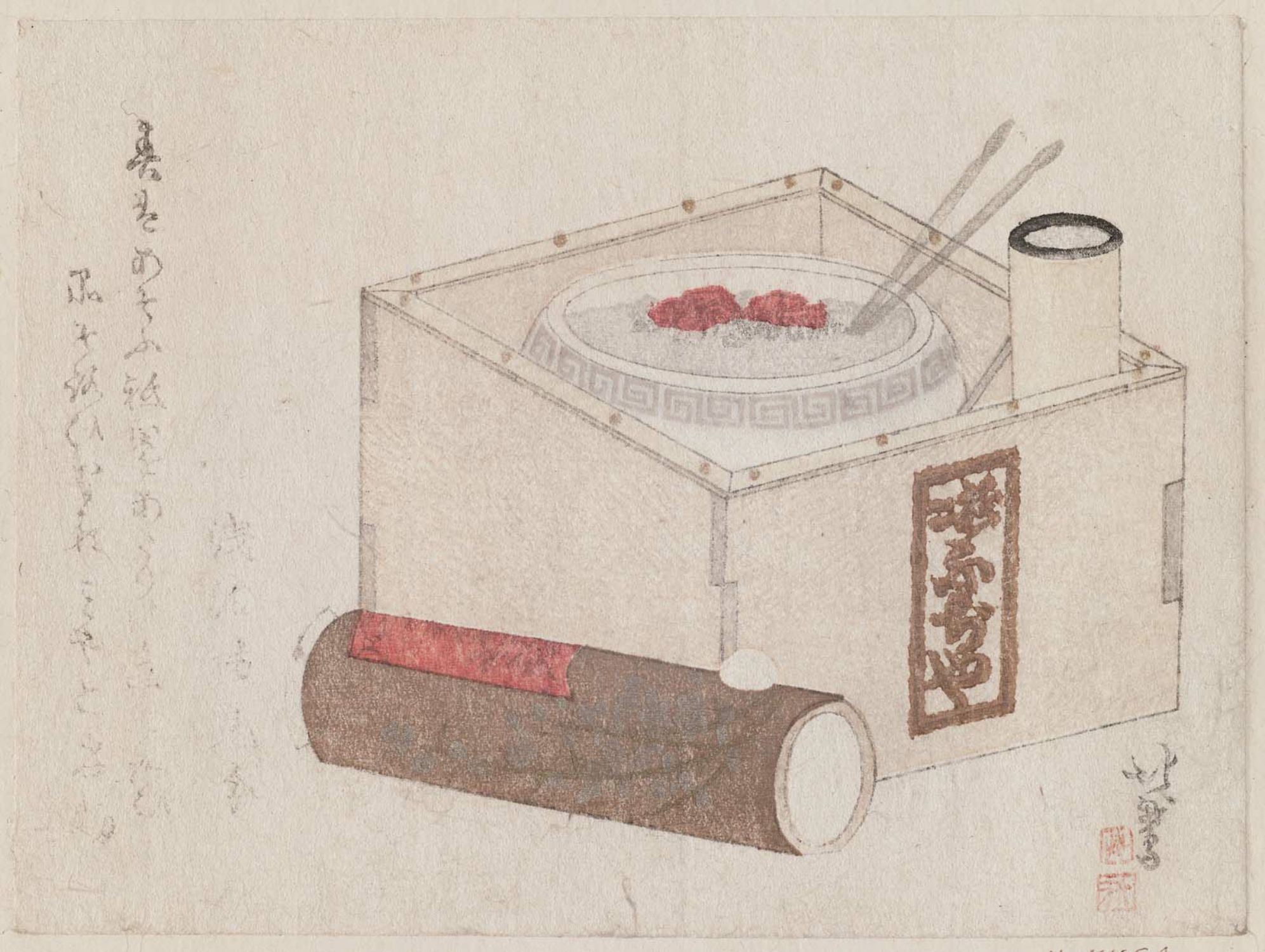
Hibachi, Scroll, and Poem
Edo period, c. 1810
Woodblock print (surimono); ink and color on paper
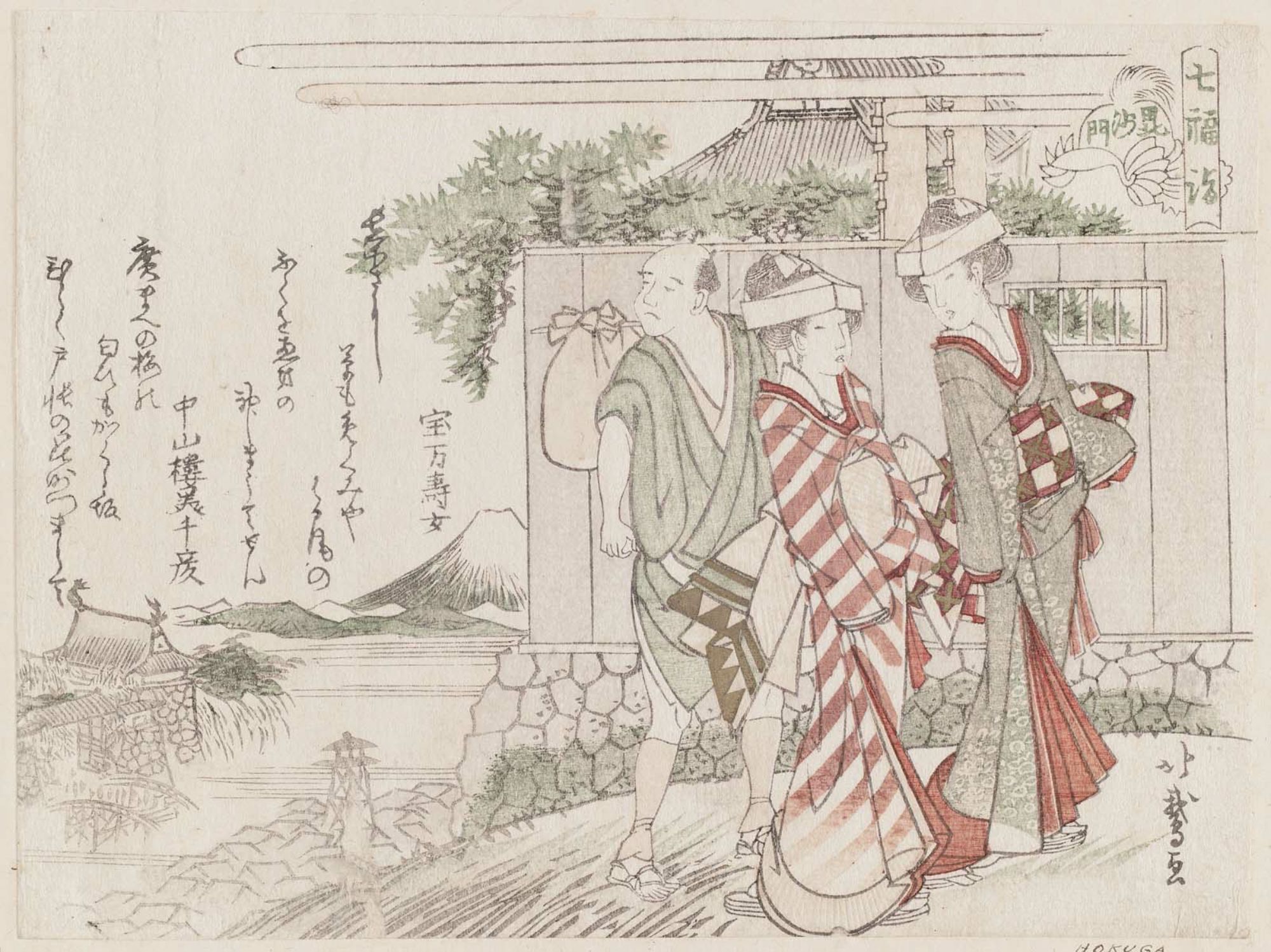
Bishamon, from the series Visiting the Shrines of the Seven Gods of Good Fortune (Shichifuku mairi)
Edo period, c. 1810
Woodblock print (surimono); ink and color on paper
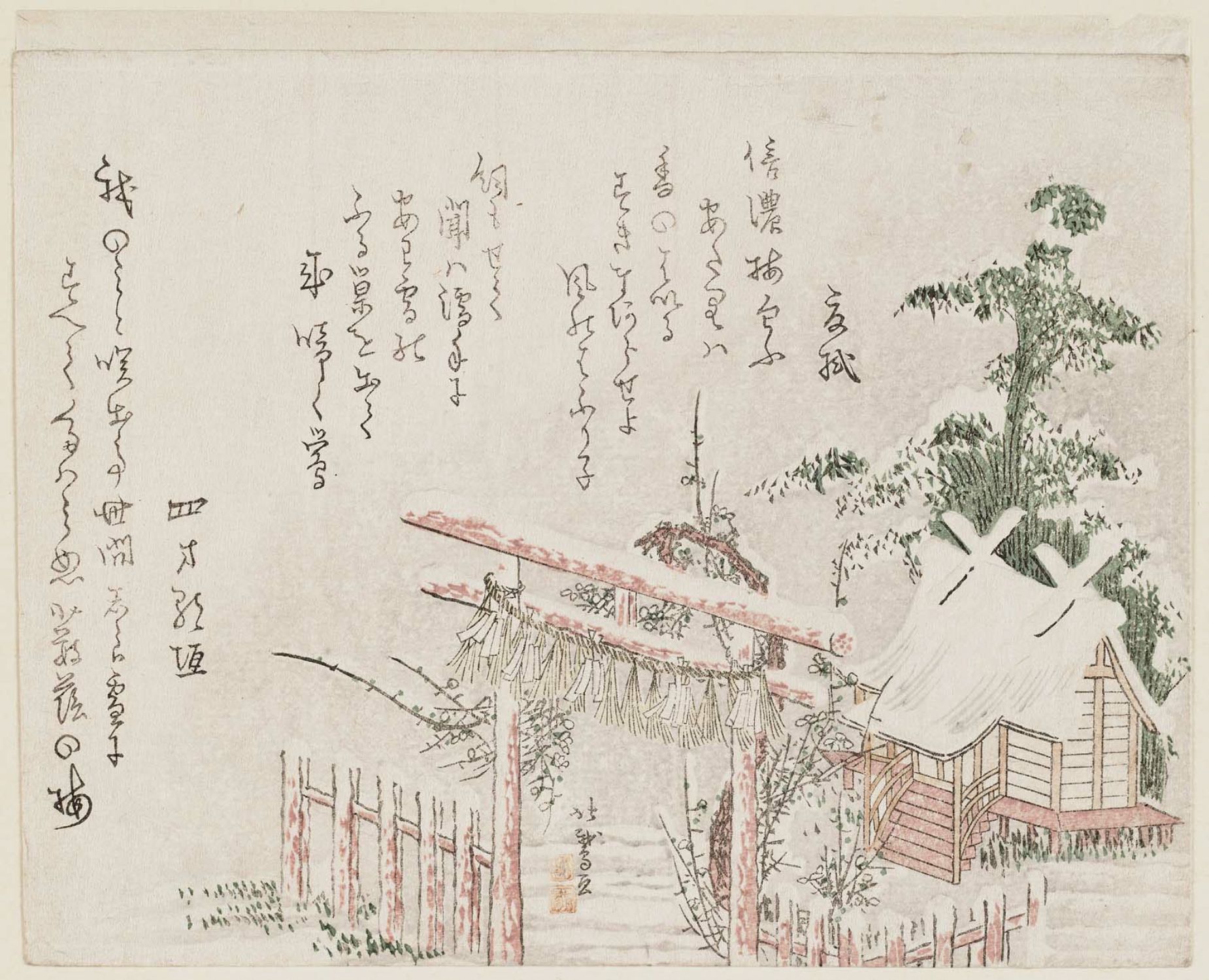
Shrine in Snow
Edo period, c. 1820
Woodblock print (surimono); ink and color on paper

Woman reading poems in a study room
c. 1833
Color woodblock print; shikishiban, surimono