Biography
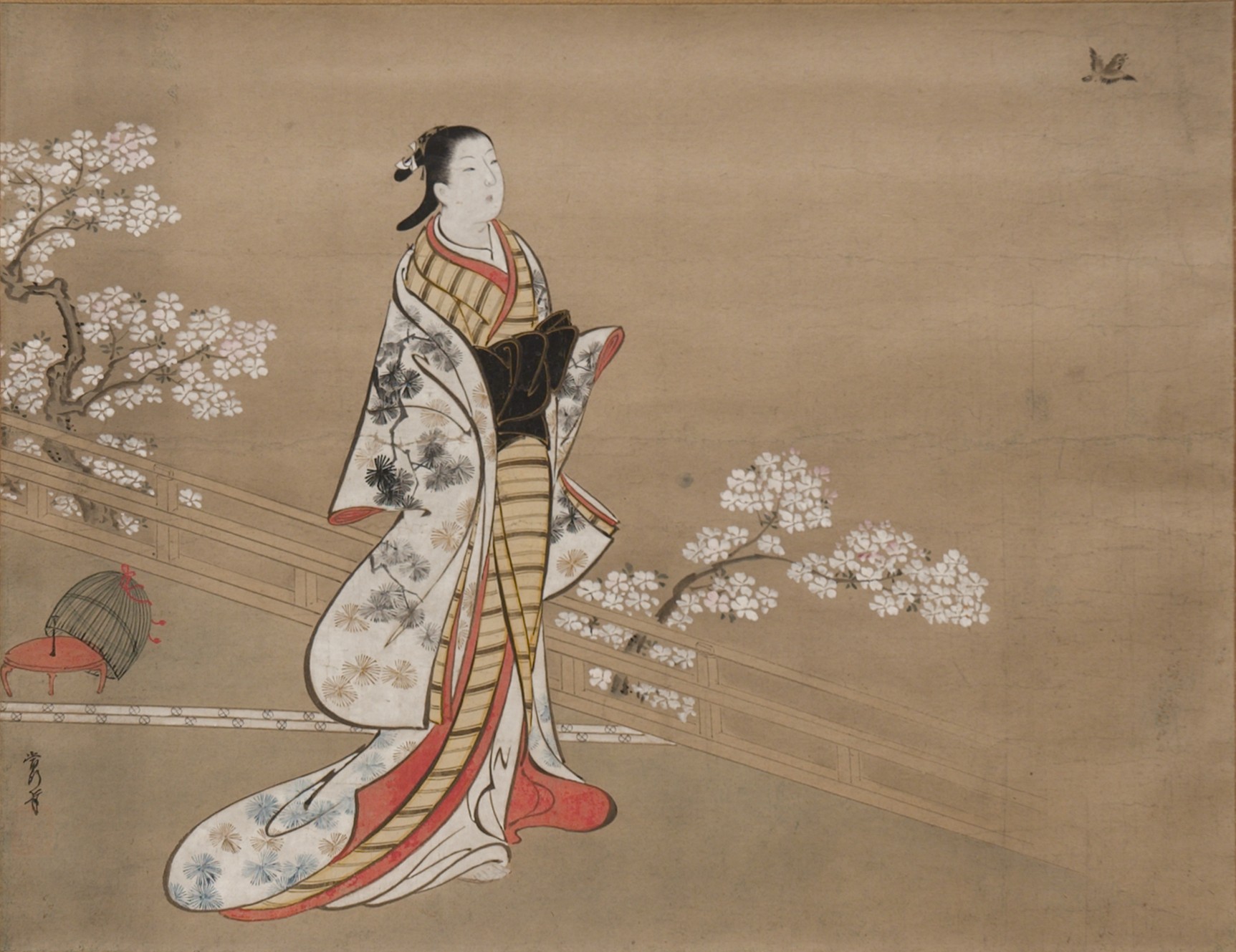
Kawamata Tsuneyuki (川又常行, c. 1677 – after 1741) was an early-eighteenth-century Edo painter who founded the small but accomplished Kawamata line of ukiyo-e bijinga painters and produced some of the most refined surviving examples of painted-bijinga in the Kyōhō and Genbun decades that immediately preceded the rise of the polychrome nishiki-e print. Tsuneyuki worked almost exclusively in painted formats — hanging scrolls and handscrolls in ink and color on silk and paper — at the moment when the painted bijin tradition descending from the Kaigetsudō school had reached its highest stylistic refinement and when artists like Miyagawa Chōshun, Hanekawa Chinchō, and Tsuneyuki himself were jointly extending the genre into a more delicate, atmospheric idiom that emphasized restrained palette, attenuated figural proportions, and sharply outlined yet florid drapery. Though something more than twenty paintings identified as Tsuneyuki survive today, his work is sparingly represented in museum collections, with notable holdings at the Metropolitan Museum of Art, the British Museum, the Harvard Art Museums, and the Freer Gallery of Art at the Smithsonian, where they document an artist of distinct elegance and a confident command of the painted bijin idiom.
Biographical details for Tsuneyuki are sparse and largely derive from a brief notice in the Ukiyo-e Ruikō, the foundational nineteenth-century compilation on the floating-world tradition, which records that Tsuneyuki was 65 years old in the year 1741 — yielding a probable birth date of around 1677 and an active career that extended through the Kyōhō (1716–1736), Genbun (1736–1741), and into the Kanpō (1741–1744) era. His date of death is not recorded. Beyond this skeletal chronology, almost nothing is documented about his training, his workshop arrangements, or his patronage network. Scholarship has generally placed him within the broader stylistic sphere influenced by Miyagawa Chōshun, the great painted-bijinga master of the same generation, though whether Tsuneyuki studied directly with Chōshun, with one of the late Kaigetsudō masters, or developed independently within the Edo painted-ukiyo-e milieu remains an open question. What is clearer is that he established the Kawamata atelier as a modest but distinguished Edo studio operating in parallel with the more famous Miyagawa and Kaigetsudō workshops, and that he trained the painter who would become the line's most thoroughly documented practitioner — Kawamata Tsunemasa (川又常正), generally considered to have been Tsuneyuki's son, adopted son, or studio pupil who inherited the family name.
Stylistically, Tsuneyuki's paintings are characterized by a combination of sharp, confident outline drawing and floridly patterned drapery that distinguishes them within the broader painted-bijinga tradition. His figures display the attenuated elegance — long bodies, small heads, exaggerated grace of pose — that the Kaigetsudō school had codified as the canonical form for painted ukiyo-e beauties, but Tsuneyuki softened the muscular monumentality of the Kaigetsudō manner with a more linear, decorative approach that emphasized the patterned surfaces of his subjects' elaborate kimono and the lyrical flow of their robes. His palette, while disciplined, deploys color more assertively than the most restrained examples of the painted-bijinga genre, with rich purples, deep reds, and gold pigment used to bring his courtesan and genre subjects into focused decorative relief against neutral silk or paper grounds. The frequent appearance of gold leaf and gold-flecked silk in his hanging scrolls signals an orientation toward the upper-tier private collector market for which the painted-bijinga genre was primarily produced, distinct from the more democratic commercial-print economy that the woodblock medium served.
In subject matter, Tsuneyuki worked the central themes of the painted ukiyo-e repertoire: depictions of high-ranking Yoshiwara courtesans (oiran) and their attendant kamuro and shinzō in formal procession or interior settings; intimate genre scenes of contemporary Edo women engaged in seasonal pastimes, music-making, and domestic leisure; and literary subjects drawn from the classical tradition, most notably the Genji monogatari, which provided painted-bijinga with one of its most prestigious sources of iconography through the Genji-e tradition. His mitate-e or “parody” pictures, of which the Metropolitan Museum's hanging scroll depicting a contemporary woman in the role of Murasaki from the Wakamurasaki chapter of the Tale of Genji is the finest surviving example, exemplify the witty and visually sophisticated mode in which painted ukiyo-e engaged the classical literary tradition, mapping the high cultural prestige of the Heian court onto the floating-world figures of the early eighteenth century.
Tsuneyuki is recognized today as the founder of one of the smaller but more accomplished painted-ukiyo-e lineages of the early eighteenth century, an artist whose surviving works document a critical moment in the development of Edo painted bijinga in the decades before the polychrome nishiki-e print transformed the floating-world visual economy. Within the Kawamata line he is the senior figure and the originator of a distinctive stylistic vocabulary — sharply outlined, floridly draped, decoratively patterned — that his pupil Kawamata Tsunemasa would carry forward into the mid-eighteenth century. Together, the two Kawamata painters represent a substantial if quiet contribution to the Kyōhō- and Genbun-era painted-bijinga tradition, working in productive parallel with the better-known studios of Miyagawa Chōshun and Hanekawa Chinchō and supplying the private collector market with painted-ukiyo-e works that have come to be valued as among the most refined surviving examples of the genre.
Key Facts
- Nationality
- 🇯🇵Japan
- Movement
- Ukiyo-e
- Works Indexed
- 3
Frequently Asked Questions
Kawamata Tsuneyuki (川又常行, c. 1677 – after 1741) was an early-eighteenth-century Edo painter who founded the small but accomplished Kawamata line of ukiyo-e bijinga painters and produced some of the most refined surviving examples of painted-bijinga in the Kyōhō and Genbun decades that immediately preceded the rise of the polychrome nishiki-e print. Tsuneyuki worked almost exclusively in painted formats — hanging scrolls and handscrolls in ink and color on silk and paper — at the moment when the painted bijin tradition descending from the Kaigetsudō school had reached its highest stylistic refinement and when artists like Miyagawa Chōshun, Hanekawa Chinchō, and Tsuneyuki himself were jointly extending the genre into a more delicate, atmospheric idiom that emphasized restrained palette, attenuated figural proportions, and sharply outlined yet florid drapery. Though something more than twenty paintings identified as Tsuneyuki survive today, his work is sparingly represented in museum collections, with notable holdings at the Metropolitan Museum of Art, the British Museum, the Harvard Art Museums, and the Freer Gallery of Art at the Smithsonian, where they document an artist of distinct elegance and a confident command of the painted bijin idiom.
Kawamata Tsuneyuki's work was shaped by the Ukiyo-e tradition in Japanese woodblock printmaking. Ukiyo-e: ## What is ukiyo-e? Ukiyo-e ([浮世絵](/glossary/ukiyo-e)) — literally "pictures of the floating world" — is the Edo-period Japanese print and painting tradition that flourished from roughly 1660 to 1868, depicting the pleasures of urban life in Edo (modern Tokyo): courtesans, kabuki actors, sumo wrestlers, famous landscapes, and seasonal beauties.
Original prints by Kawamata Tsuneyuki can be found in collections including Harvard Art Museums (Arthur M. Sackler Museum), Metropolitan Museum of Art, Wikimedia Commons (formerly Richard Kruml collection, London).