
Five Courtesans
- Date:
- 18th century
- Medium:
- Hanging scroll; ink and color on paper
Description
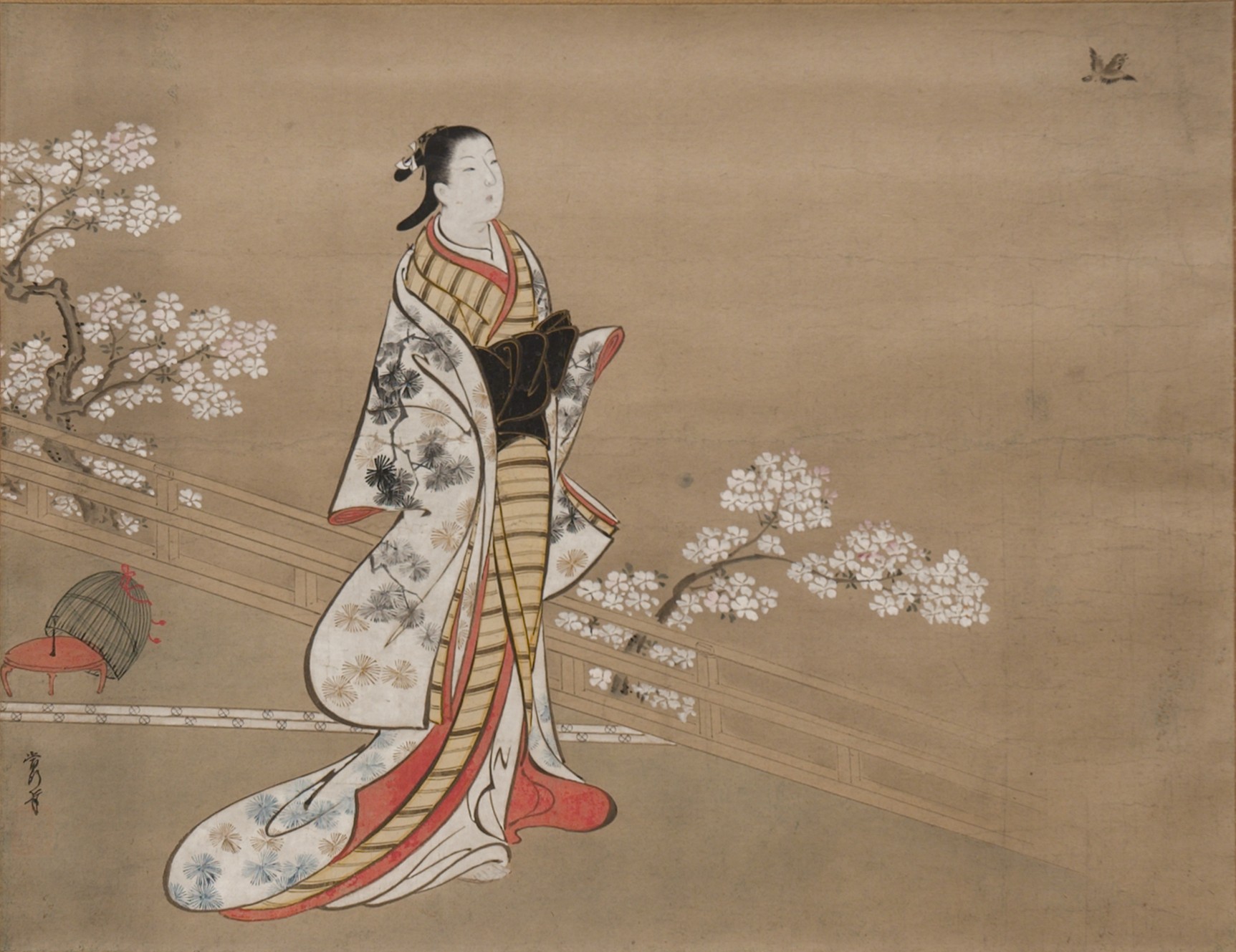
Held in the Harvard Art Museums' Arthur M. Sackler Museum (accession 1968.51) and dated to the eighteenth century, Five Courtesans is a hanging scroll in ink and color on paper that depicts a grouping of five high-ranking Yoshiwara courtesans in a horizontal composition that reads almost as a frieze of contemporary fashion in the painted-bijinga manner. The painting is among the more ambitious group compositions in Tsuneyuki's surviving oeuvre, requiring the painter to coordinate five elaborately costumed figures within a single pictorial field without sacrificing the attenuated elegance and decorative attention to drapery that defined his individual figural style. Tsuneyuki distributes the five women across the composition in a rhythmic alternation of poses and gestures — figures turning toward and away from each other, kimono patterns playing off one another in coordinated decorative counterpoint, the central figure anchoring the composition with the most elaborate textile display — that demonstrates his sophisticated handling of the multi-figure painted-bijinga format. The work exemplifies the Kawamata-school orientation toward the upper-tier private collector market, for whom such ambitious group portraits of celebrated courtesans were prized as both aesthetic objects and as documents of the contemporary Yoshiwara hierarchy, with the elaborate kimono and accessories functioning simultaneously as decorative pictorial elements and as a vocabulary of fashionable luxury that the Edo connoisseur was expected to read. As one of the principal Tsuneyuki paintings in an American museum collection, the work helps establish his presence in U.S. holdings of early-eighteenth-century Japanese painting and demonstrates the ambitions of his more developed compositional projects.
More Prints by Kawamata Tsuneyuki

Frequently Asked Questions
Five Courtesans was created by Kawamata Tsuneyuki (川又常行) in 18th century.