
Biography
Miyagawa Chōshun (1683-1753) stands as one of the most accomplished and distinctive painters of the early-eighteenth-century floating world, a master who chose to work almost exclusively in hand-painted scrolls rather than in the woodblock medium that came to dominate ukiyo-e. His decision to remain a painter at a moment when his contemporaries were rushing toward the printed sheet preserved within ukiyo-e a current of refined, individually crafted brushwork that connects directly back to the earliest yamato-e narrative tradition, and it has made his surviving scrolls among the most prized objects in the entire genre.
Chōshun was born in 1683 in the village of Miyagawa, in Owari province, from which his family name was drawn. The biographical details of his youth are sparse, as is typical for ukiyo-e artists working outside the main woodblock publishing houses, but it is generally accepted that he moved to Edo as a young man, drawn like so many provincial artists of his generation to the cultural and commercial energy of the shogunal capital, and he lived much of his later life there, near the pleasure quarters that would supply much of his subject matter.
The foundation of Chōshun's pictorial training lay in the classical yamato-e tradition of the Tosa school, in the Kanō school, and in the work of Hishikawa Moronobu, the founder of ukiyo-e as a coherent genre, who had died in 1694 when Chōshun was still a child. Whatever the precise nature of his early instruction, Chōshun's mature style reflects a deep and patient absorption of Moronobu's compositional sensibility, his treatment of the courtesan as a worthy pictorial subject, and his synthesis of Tosa-derived narrative formats with the urban subject matter of contemporary Edo. To this inheritance Chōshun added a sumptuous, jewel-toned color palette and a refinement of figural drawing that set his work apart from anything else being produced in the floating-world tradition of his time.
The single most decisive feature of Chōshun's career was his refusal to participate in woodblock printing. Where his contemporaries Okumura Masanobu, Nishikawa Sukenobu, and the early Torii masters were transforming ukiyo-e into a print-dominated commercial enterprise, Chōshun maintained a studio that produced only hand-painted works, primarily kakemono (hanging scrolls) and emakimono (handscrolls) — a tradition his pupils would continue, making the Miyagawa artists among the very few ukiyo-e masters never to have created a single print. This decision had significant economic consequences: by working one painting at a time, he could never reach the broad popular audience that printmakers commanded, and his clientele remained restricted to the wealthier patrons who could afford individual paintings. But the choice also gave his work qualities that no printed image could achieve, including the full chromatic range and subtle modulations of brushed silk painting, the textural richness of mineral pigments applied in layers, and the intimate scale of works designed to be unrolled and contemplated rather than displayed publicly.
His subject matter centered on bijin-ga, the depiction of beautiful women, treated with a refinement and individual characterization that distinguished his courtesans — typically fuller and more warmly rendered than the figures of his contemporaries — from the generic types appearing in contemporary woodblock prints. His bijin are usually shown in elaborate layered kimonos whose patterns are painted with extraordinary precision, and his attention to the texture of fabric, the fall of drapery, and the carefully arranged hair makes his scrolls valuable documents of early-eighteenth-century fashion. Beyond bijin-ga, Chōshun produced genre scrolls depicting the festivals, entertainments, and seasonal activities of the floating world — cherry-blossom viewing, music-making in the Yoshiwara, and the public spectacle of urban life — rendered with the same meticulous craft. He also produced shunga, the erotic painting tradition, in handscroll format for private collectors.
In the last years of his life, around 1750-51, Chōshun became involved in one of the most notorious episodes in early-modern Japanese painting history. He was engaged to carry out restoration work on the painted decorations at the Nikkō Tōshōgū, the great Tokugawa mausoleum complex, under the direction of Kanō Shunga, an official shogunal painter of the Kanō school. When payment for the completed work was withheld, a bitter dispute arose, and the disagreement escalated into a violent confrontation in which Shunga was killed by Chōshun's son. The consequences for the family were severe: in the aftermath Chōshun was banished from Edo for a year, while a senior member of his workshop was exiled to the island of Niijima in the Izu chain.
Chōshun died in Edo in 1753. The Miyagawa school, which he founded, persisted through his pupils Miyagawa Shunsui, Miyagawa Isshō, and others. In the wake of the Nikkō scandal, Shunsui and his followers eventually adopted the surname Katsukawa, founding the Katsukawa school; and Shunsui in turn taught Katsukawa Shunshō, whose Katsukawa atelier would become one of the dominant ukiyo-e workshops of the later eighteenth century. Through this lineage Chōshun's commitment to careful figural draftsmanship was transmitted into the actor-portrait (yakusha-e) tradition that defined late-eighteenth-century ukiyo-e print culture. In this indirect way, the painter who never made a print became a foundational ancestor of one of the great printmaking schools.
Chōshun's hand-painted scrolls survive today in many of the world's most important Japanese art collections, including the Tokyo National Museum, the British Museum, the Museum of Fine Arts Boston, the Art Institute of Chicago, the Cleveland Museum of Art, the Metropolitan Museum of Art, and the Freer Gallery of Art. His relatively limited surviving output and the refinement of his brushwork have made his scrolls particularly prized in both Japan and the West, and his work occupies a singular place in ukiyo-e historiography as evidence that floating-world subject matter could be developed at the highest level of painted craft, not only in the printed sheet.
Key Facts
Frequently Asked Questions
Miyagawa Chōshun (1683-1753) stands as one of the most accomplished and distinctive painters of the early-eighteenth-century floating world, a master who chose to work almost exclusively in hand-painted scrolls rather than in the woodblock medium that came to dominate ukiyo-e. His decision to remain a painter at a moment when his contemporaries were rushing toward the printed sheet preserved within ukiyo-e a current of refined, individually crafted brushwork that connects directly back to the earliest yamato-e narrative tradition, and it has made his surviving scrolls among the most prized objects in the entire genre.
Miyagawa Chōshun was active from 1683 to 1753. They were associated with the Ukiyo-e movement.
Miyagawa Chōshun's work was shaped by the Ukiyo-e tradition in Japanese woodblock printmaking. Ukiyo-e: ## What is ukiyo-e? Ukiyo-e ([浮世絵](/glossary/ukiyo-e)) — literally "pictures of the floating world" — is the Edo-period Japanese print and painting tradition that flourished from roughly 1660 to 1868, depicting the pleasures of urban life in Edo (modern Tokyo): courtesans, kabuki actors, sumo wrestlers, famous landscapes, and seasonal beauties.
Miyagawa Chōshun's prints frequently feature spring.
Original prints by Miyagawa Chōshun can be found in collections including Art Institute of Chicago, Metropolitan Museum of Art, Cleveland Museum of Art.
Woodblock Prints by Miyagawa Chōshun (4)
Male Figure
Edo period (1615-1868)
Hanging scroll cut from rollers; ink and colors on silk
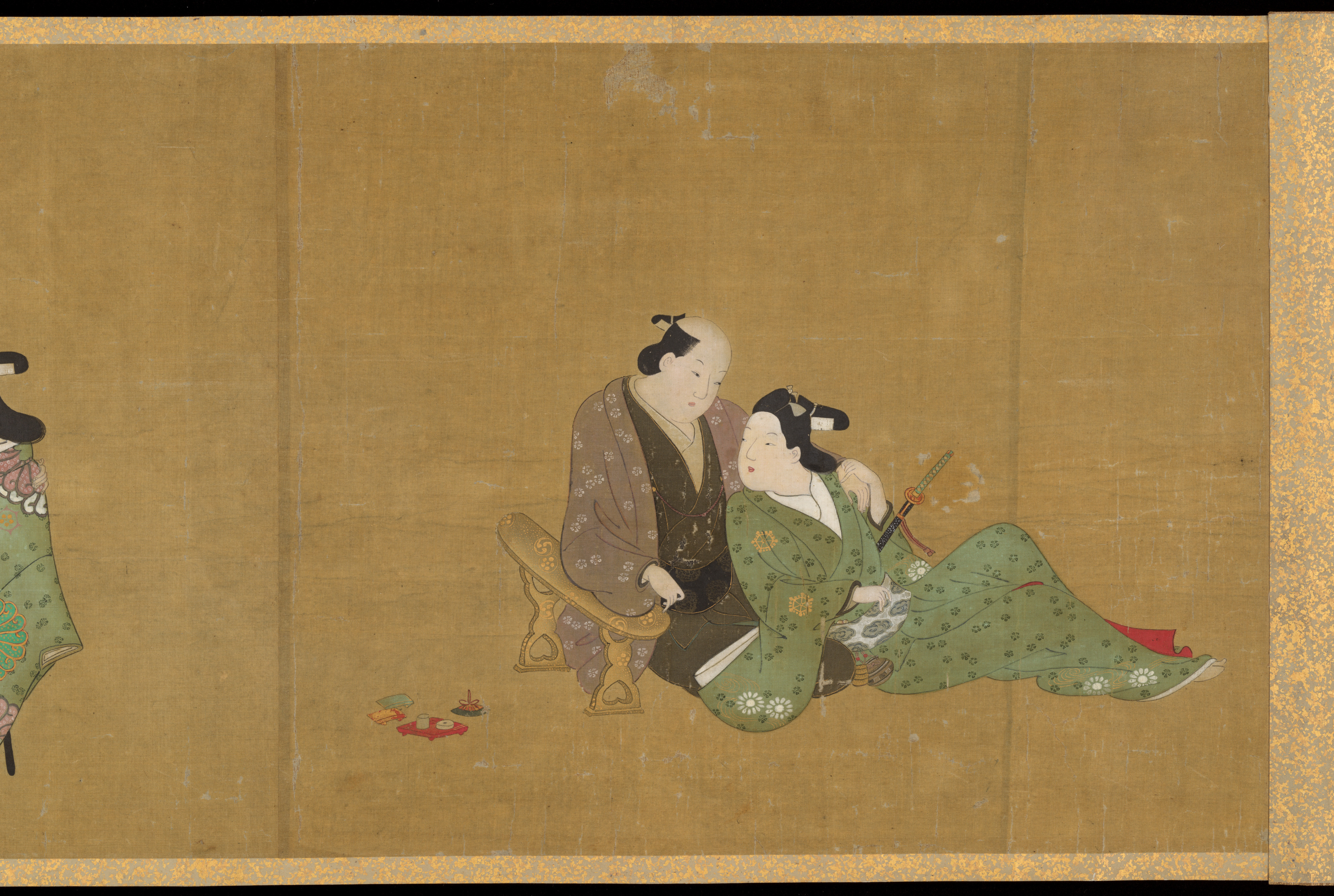
Handscroll of Ten Homoerotic (Nanshoku) Scenes
Early 18th century (1700-1733)
Handscroll; ink and colors on silk
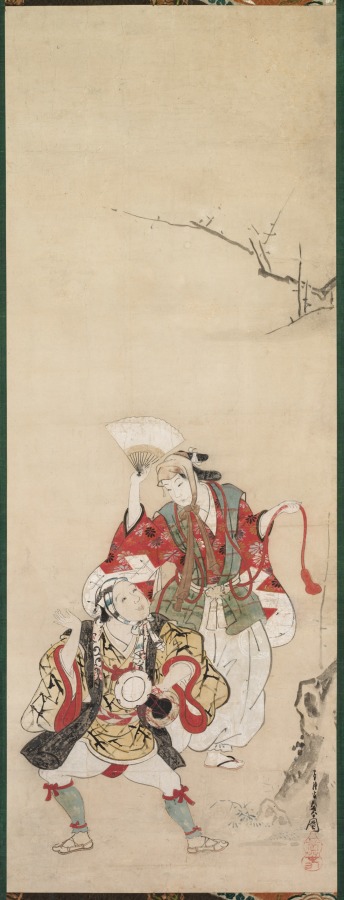
Spring Dancers (Manzai)
early to mid-1700s
Hanging scroll; ink and color on paper

A Beauty Behind a Screen
About 1750
Hanging scroll; ink and colors on silk