
Okada Beisanjin
岡田米山人
1744–1820
Japan
Biography
Okada Beisanjin (1744-1820) was an Osaka rice merchant turned literati painter whose unschooled, vigorous brushwork became one of the most distinctive voices in the late phase of Japanese nanga, the bunjinga painting tradition that drew its imaginative geography from Chinese Ming and Qing pictorial models. Working outside the academies and the hereditary studios that dominated Edo and Kyoto painting, Beisanjin built his reputation among the merchant aesthetes of Osaka, where commerce, scholarship, and Chinese-style literati cultivation overlapped in a way unique to that city.
Born in Osaka, Beisanjin made his living as a rice merchant, an occupation that gave him his art name Beisanjin, meaning roughly the rice-mountain hermit, an inversion of his trade into a literati persona. He worked for the Todo domain of Ise as a rice broker, a position that connected him to samurai patronage while still leaving him squarely within the Osaka mercantile class. His given name was Okada Shigen, and he signed paintings variously as Beisanjin and Shigen. Largely self-taught as a painter, he absorbed the nanga manner from the Chinese painting models that circulated widely among Edo-period literati. He came of age in the generation following the great founders of Japanese nanga, Ike Taiga and Yosa Buson, and he is best understood as part of the post-Taiga consolidation of bunjinga as an Osaka-centered movement.
Beisanjin belonged to the sophisticated literati circle of late Edo Osaka, and his own son and pupil Okada Hanko would carry the family painting style well into the nineteenth century. His brushwork is notable for its brusqueness and apparent naivety, qualities that contemporary critics and modern scholars have read as deliberately untutored: thick, hesitant lines, simplified mountain forms built up from short repeated strokes, and a tendency to flatten Chinese landscape conventions into something more idiosyncratic and immediate. His Shorinji Temple of 1817 at the Metropolitan Museum of Art reinterprets a Zen temple near Osaka as a Chinese-style scholar's retreat, while Rice Paddies and Fuji, after Taiga of 1816 at the Minneapolis Institute of Art openly acknowledges his debt to the founding generation of Japanese nanga. Another notable work is Old Woman on an Ox of 1813, with its inscribed Chinese-style poem on the dignity of country life.
Beisanjin painted into his seventies, and many of his hanging scrolls bear inscriptions giving his age at execution, a literati convention emphasizing the painter as scholar-elder. He died in 1820 at age seventy-six. His paintings survive principally in Japanese collections associated with the Osaka literati tradition, particularly the Mie Prefectural Art Museum, which holds the largest collection and has staged major retrospectives pairing his work with that of his son Hanko. American holdings are led by the Minneapolis Institute of Art and the Metropolitan Museum of Art, both of which have placed substantial groups of his paintings in the public domain, making him one of the most accessible of the late Osaka nanga painters for contemporary study.
Key Facts
- Active Period
- 1744–1820
- Nationality
- 🇯🇵Japan
- Subjects
- Birds & FlowersAutumn Foliage
- Works Indexed
- 6
Frequently Asked Questions
Okada Beisanjin (1744-1820) was an Osaka rice merchant turned literati painter whose unschooled, vigorous brushwork became one of the most distinctive voices in the late phase of Japanese nanga, the bunjinga painting tradition that drew its imaginative geography from Chinese Ming and Qing pictorial models. Working outside the academies and the hereditary studios that dominated Edo and Kyoto painting, Beisanjin built his reputation among the merchant aesthetes of Osaka, where commerce, scholarship, and Chinese-style literati cultivation overlapped in a way unique to that city.
Okada Beisanjin was active from 1744 to 1820.
Okada Beisanjin's prints frequently feature birds & flowers, autumn foliage.
Original prints by Okada Beisanjin can be found in collections including Minneapolis Institute of Art, Metropolitan Museum of Art.
Woodblock Prints by Okada Beisanjin (6)
A Tale of Mom and Dad in Olden Times
1793
Hanging scroll, ink and color on paper

Landscape
19th century
Hanging scroll, ink and color on paper

Autumn Landscape
19th century
Hanging scroll, ink and color on paper

Landscape with Pines in the Manner of Wang Hui
first half 19th century
Hanging scroll, ink and color on paper

Rocks and Flowers
1817
Hanging scroll, ink and color on paper
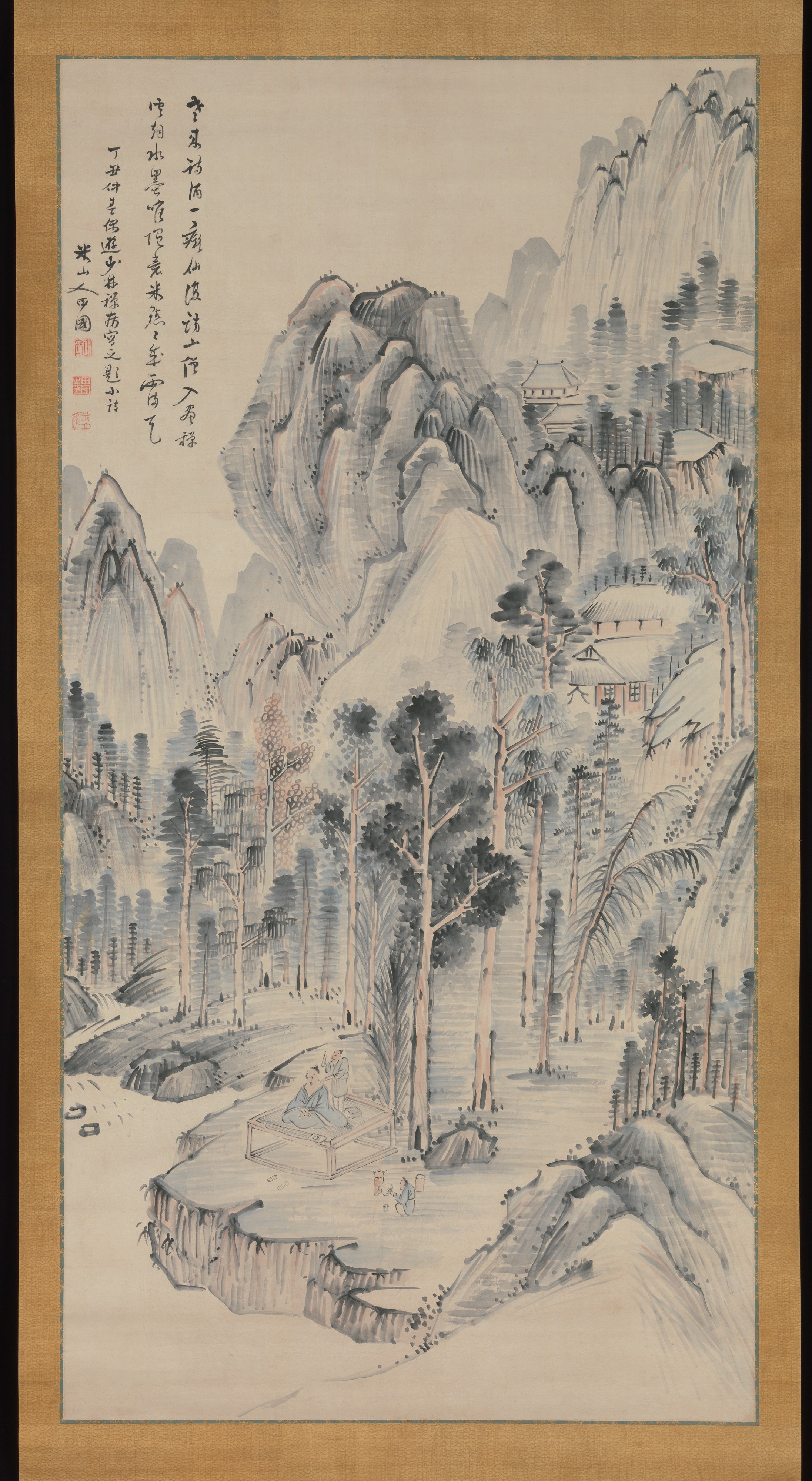
Shorinji Temple
1817
Hanging scroll; ink and color on paper