
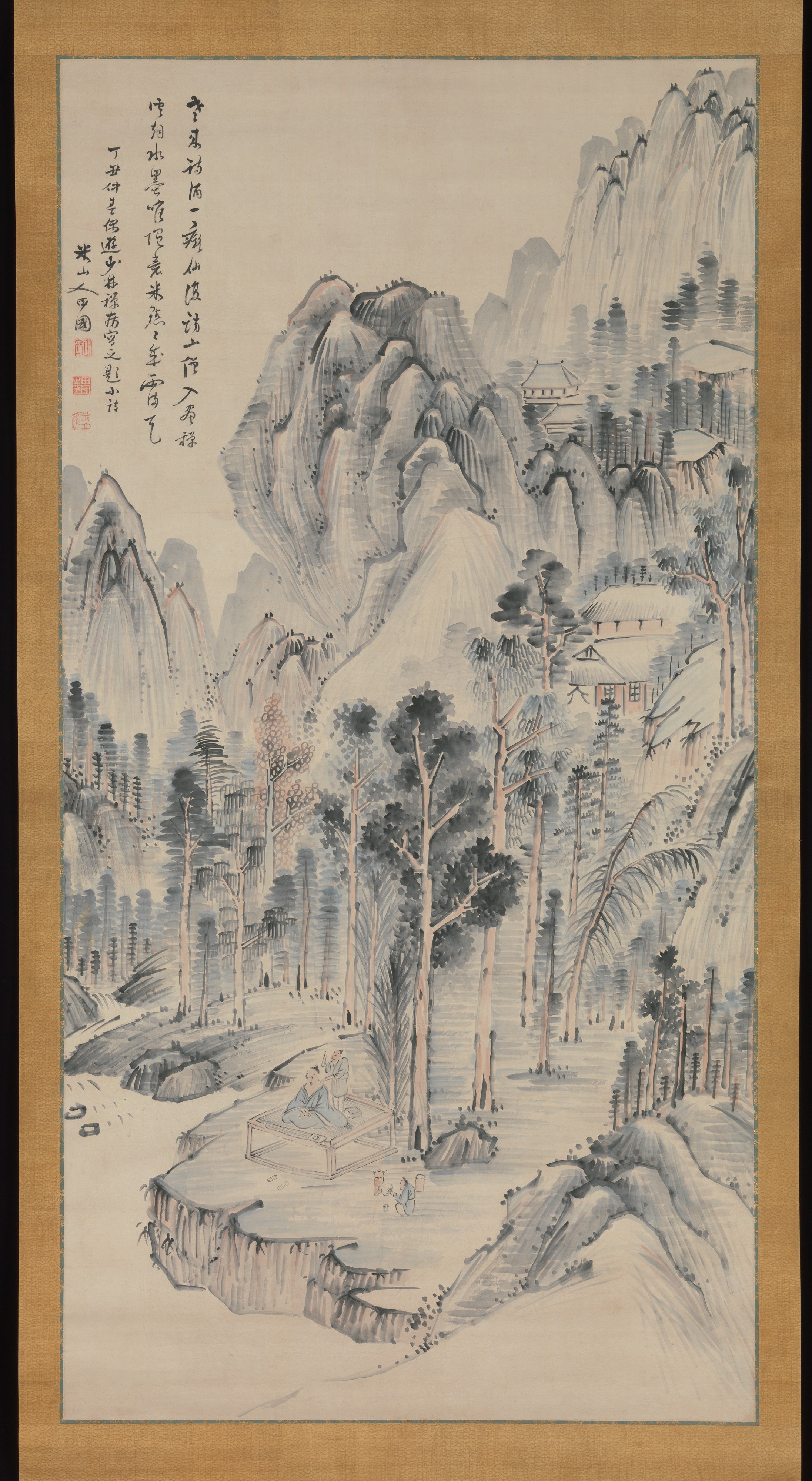
A Tale of Mom and Dad in Olden Times
- Date:
- 1793
- Medium:
- Hanging scroll, ink and color on paper
- Source:
- Minneapolis Institute of Art
Description
A Tale of Mom and Dad in Olden Times, dated 1793, is an early work by the Osaka nanga painter Okada Beisanjin (岡田米山人, 1744-1820), held by the Minneapolis Institute of Art (accession recorded at https://collections.artsmia.org/art/117058). The 1793 date places the painting in Beisanjin's late forties, well before the works of the 1810s on which much of his modern reputation rests and during the long period in which he was forming his distinctive self-taught manner as a rice merchant turned literati painter in Osaka. The anecdotal, vernacular flavor of the title — evoking a homely story remembered from earlier times — is consistent with a strand of Edo and Kansai literati practice in which Chinese scholarly idioms could be turned to local, domestic, or even gently humorous subjects. The bunjinga tradition the Okada circle revered was capacious enough to accept narrative and vernacular themes alongside the canonical literati landscape and bird-and-flower repertoires; earlier Japanese nanga masters such as Yosa Buson (1716-1784) had already shown how the literati brush could be turned toward haiku-flavored homely subjects without losing scholarly dignity. As a foundational figure of Osaka bunjinga, Beisanjin shaped his manner from imported Chinese painting manuals and scrolls and from the company of Kansai scholar-painters; the deliberate unpolish of his brushwork — a virtue rather than a deficiency in the literati system of value, signaling the cultivated amateur's hand — suits a narrative theme rendered without academic decorum. By 1793 Beisanjin was already in correspondence (through Nagasaki) with the imported Chinese painting culture that would shape the rest of his career, and his son Okada Hankō (1782-1846) was a small child being raised within that household of brush and books. The Minneapolis source provides the firm attribution and the 1793 date.
More Prints by Okada Beisanjin


Frequently Asked Questions
A Tale of Mom and Dad in Olden Times was created by Okada Beisanjin (岡田米山人) in 1793.