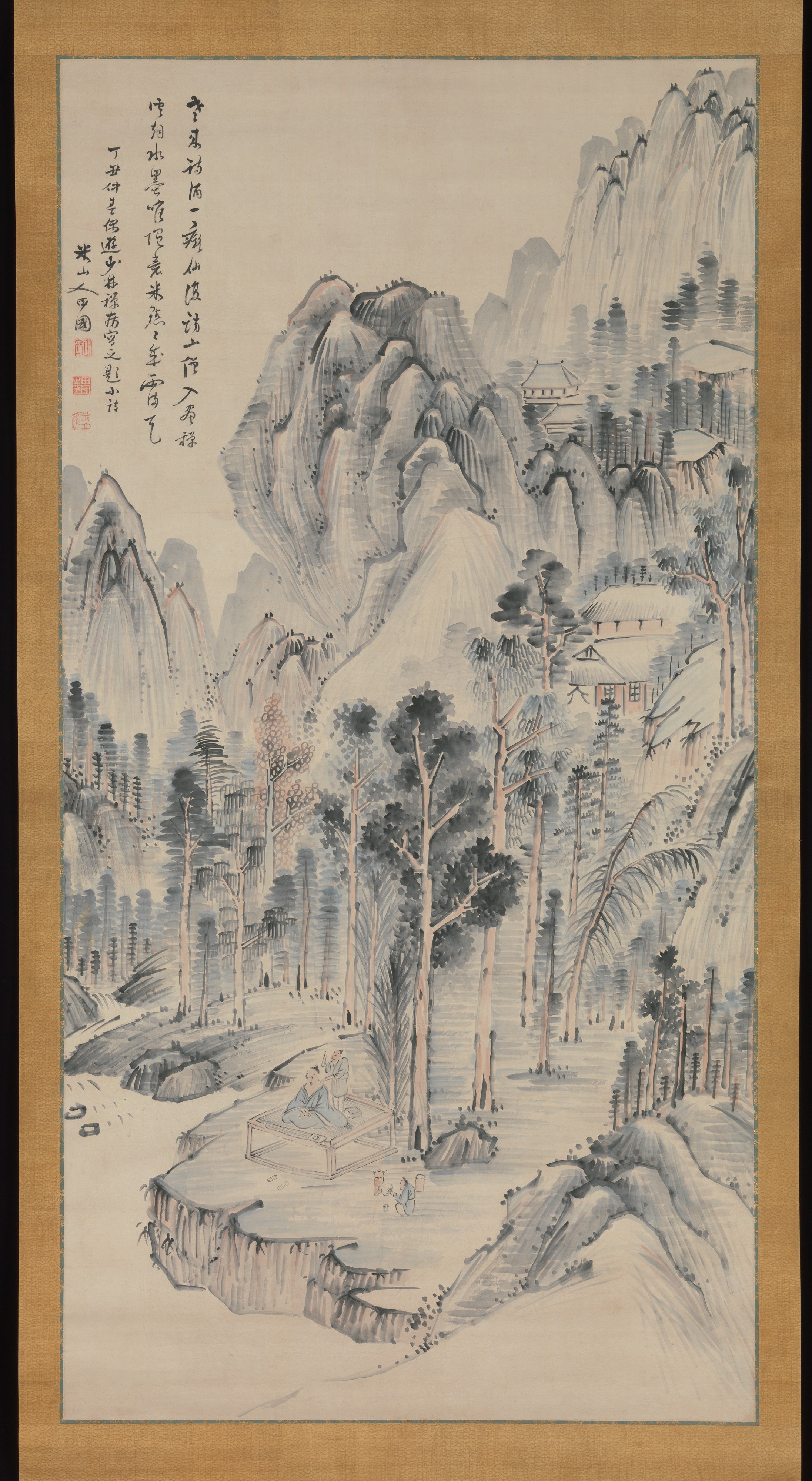
Shorinji Temple
- Date:
- 1817
- Medium:
- Hanging scroll; ink and color on paper
- Source:
- Metropolitan Museum of Art
Description
Shorinji Temple, dated 1817, is a hanging-scroll painting by Okada Beisanjin (岡田米山人, 1744-1820), held by the Metropolitan Museum of Art (accession recorded at https://www.metmuseum.org/art/collection/search/45426). The title refers to the famous Chinese monastic site associated with Chan (Zen) lineage — Shaolinsi at the foot of Mount Song in Henan — and with the long iconography of mountain temples in Chinese painting; for an Edo-period Japanese literati painter, Shorinji (in Chinese, Shaolinsi) functioned as a culturally charged subject through which Chinese religious geography could be invoked without firsthand travel. The mountain-temple motif belongs to a continuous strand of Chinese landscape painting in which a glimpse of monastery roofs amid pines and crags acts as a moral and atmospheric punctuation: the temple anchors the mountain, the mountain elevates the temple, and the viewer is invited into a contemplative geography that Japanese bunjin painters had been studying for generations through imported scrolls and printed albums. Beisanjin, a self-trained Osaka rice merchant who became a foundational figure of Kansai bunjinga, drew his knowledge of such Chinese sites from imported Ming and Qing scrolls and from woodblock-printed albums that circulated through Nagasaki; he had no possibility of direct travel to the continent but could (and did) build a serious painted engagement with Chinese cultural geography from his Osaka studio. The 1817 date places the painting in the final three years of his life, when his son Okada Hankō (1782-1846) was already an established literati painter in his own right and the most important transmitter of the Beisanjin manner. The Shaolin theme is treated through the deliberately untutored, slightly awkward brushwork that Beisanjin cultivated as the mark of the literati amateur — a manner more concerned with the rhythm of the brush and the spirit of the subject than with academic polish.
More Prints by Okada Beisanjin

Landscape
19th century
Hanging scroll, ink and color on paper

A Tale of Mom and Dad in Olden Times
1793
Hanging scroll, ink and color on paper

Rocks and Flowers
1817
Hanging scroll, ink and color on paper

Landscape with Pines in the Manner of Wang Hui
first half 19th century
Hanging scroll, ink and color on paper
Frequently Asked Questions
Shorinji Temple was created by Okada Beisanjin (岡田米山人) in 1817.