
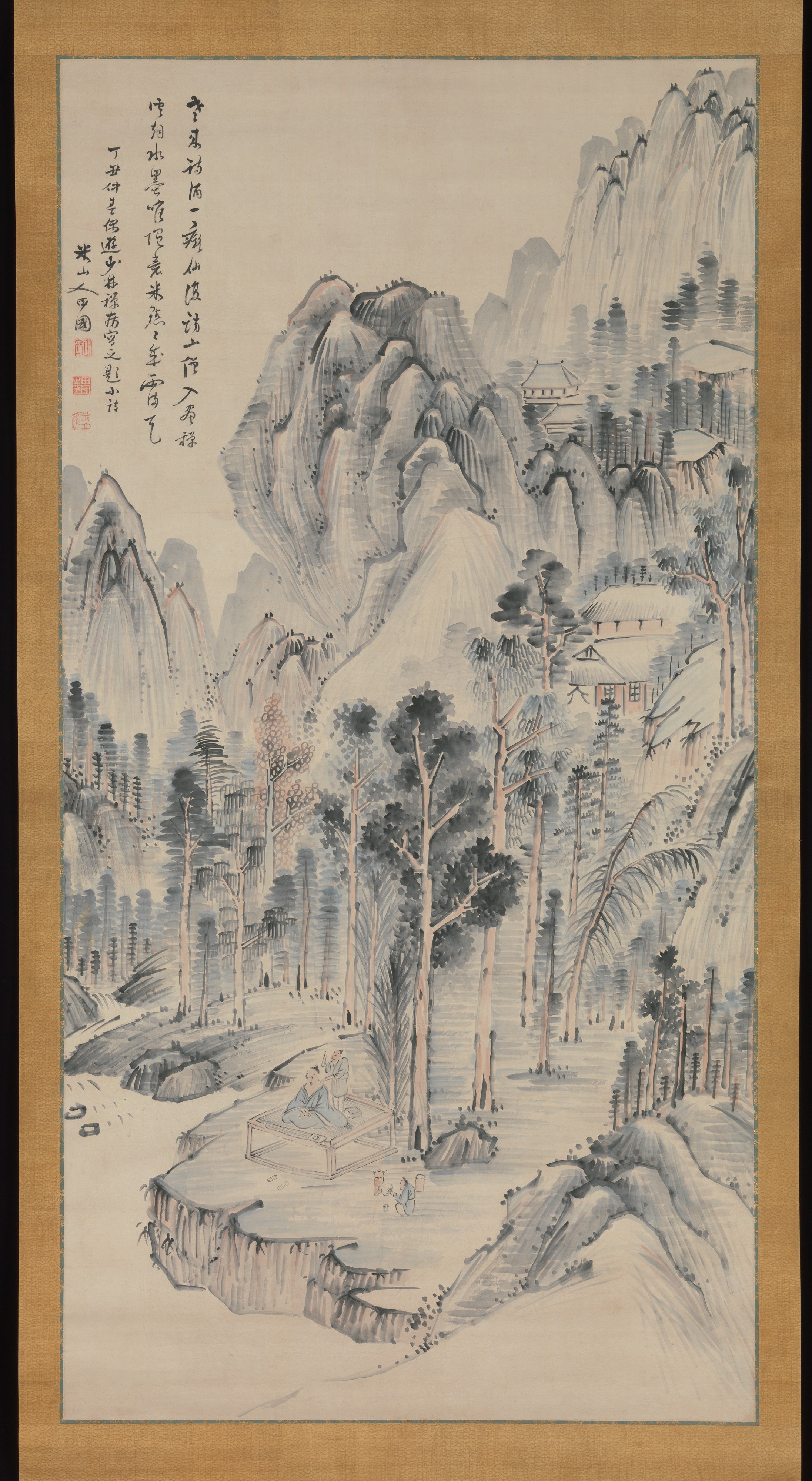
Landscape with Pines in the Manner of Wang Hui
- Date:
- first half 19th century
- Medium:
- Hanging scroll, ink and color on paper
- Source:
- Minneapolis Institute of Art
Description
Landscape with Pines in the Manner of Wang Hui, dated 1815, is a hanging-scroll landscape by Okada Beisanjin (岡田米山人, 1744-1820), held by the Minneapolis Institute of Art (accession recorded at https://collections.artsmia.org/art/117957). The title's explicit invocation of Wang Hui (1632-1717) — one of the Six Masters of the early Qing, celebrated for his synthesizing landscape style — locates the sheet within the deeply self-conscious citational practice of literati painting. To paint 'in the manner of' a chosen master was, in the Chinese and Japanese bunjin traditions alike, less an act of copying than of declared lineage: it inscribed the artist within a chosen scholarly genealogy and demonstrated his absorption of a model's brush idiom. The reference to Wang Hui in particular is striking: as the chief synthesizer of the orthodox landscape tradition under the Kangxi emperor, Wang Hui represented for an Osaka literati painter a relatively recent and historically prestigious model, accessible through the printed albums and imported Qing scrolls that reached Japan through Nagasaki. Beisanjin, a self-trained Osaka rice merchant who became a foundational figure of Kansai bunjinga, would have known Wang Hui's manner through those woodblock-printed Chinese painting manuals and imported scrolls; the 1815 date places the painting in the mature period in which he was most assured in such citations. The pine landscape — pines being a canonical literati subject, associated with longevity, rectitude, and the steadiness of the cultivated character — is treated with the deliberately untutored brush that the literati ideal prized as the mark of the amateur scholar's hand. The Minneapolis source confirms attribution and date.
More Prints by Okada Beisanjin


Frequently Asked Questions
Landscape with Pines in the Manner of Wang Hui was created by Okada Beisanjin (岡田米山人) in first half 19th century.