
Biography
Hashimoto Okiie (橋本興家, 1899–1993) devoted the better part of his life to woodblock printmaking, producing a body of architectural subjects — temples, castle towers, pagodas, farmhouses, urban streetscapes — that made him one of the most recognizable architectural printmakers within the sosaku-hanga movement, and he is especially remembered for his prints of Japanese castles. Born on October 4, 1899, in Yazu, Tottori Prefecture, he graduated from the Tottori Prefectural Normal School in 1920 and then completed a teacher-training course at the Tokyo School of Fine Arts, graduating in 1924. In 1936 he attended a woodblock workshop led by the prominent sosaku-hanga printmaker Un'ichi Hiratsuka, and in that medium he found a means to unite his structural sensibility with the sosaku-hanga ideal of the artist as sole creator.
He committed fully to the sosaku-hanga principle of designing, carving, and printing every block himself. Where many sosaku-hanga artists gravitated toward abstraction or expressionism, Hashimoto stayed anchored to the observable world, choosing as his subjects the wooden temples, stone-walled castles, thatched-roof farmhouses, and tile-roofed merchant quarters that constituted Japan's built heritage. His compositions balanced Western linear perspective with the flattened spatial conventions of traditional Japanese art, creating images that read simultaneously as precise architectural records and as meditations on the geometry of traditional construction.
The prints themselves reveal a deliberate tension between exactitude and atmosphere. Hashimoto carved his subjects with the precision of an architectural draftsman — every bracket, beam, and balustrade rendered with structural fidelity — yet he surrounded these crisp forms with atmospheric effects achieved through subtle overprinting and bokashi gradation. Snow softened the hard edges of castle ramparts; autumn foliage framed temple gates in warm rust and gold; rain dissolved the sharp geometry of city streets into shimmering reflections. His palette favored the natural tones of aged timber, weathered stone, and ceramic tile, punctuated by the vermillion of shrine gates and the deep green of cryptomeria groves.
Hashimoto first exhibited with the Nihon Hanga Kyokai (Japan Print Association) in 1937 and remained closely associated with it for the rest of his career, eventually serving as its president in 1974; his work entered museum collections in Japan and abroad, including the British Museum, the Harvard Art Museums, and the Philadelphia Museum of Art. His prints of castles, temples, and pagodas documented structures that in some cases have since been altered or lost, giving his oeuvre an archival dimension beyond its aesthetic value.
He continued printing into old age, sustained by steady hands and an apparently inexhaustible inventory of architectural subjects, and died in Tokyo on August 18, 1993, at the age of ninety-three.
Key Facts
- Active Period
- 1899–1993
- Nationality
- 🇯🇵Japan
- Movement
- Sōsaku-hanga
- Works Indexed
- 168
Frequently Asked Questions
Hashimoto Okiie (橋本興家, 1899–1993) devoted the better part of his life to woodblock printmaking, producing a body of architectural subjects — temples, castle towers, pagodas, farmhouses, urban streetscapes — that made him one of the most recognizable architectural printmakers within the sosaku-hanga movement, and he is especially remembered for his prints of Japanese castles. Born on October 4, 1899, in Yazu, Tottori Prefecture, he graduated from the Tottori Prefectural Normal School in 1920 and then completed a teacher-training course at the Tokyo School of Fine Arts, graduating in 1924. In 1936 he attended a woodblock workshop led by the prominent sosaku-hanga printmaker Un'ichi Hiratsuka, and in that medium he found a means to unite his structural sensibility with the sosaku-hanga ideal of the artist as sole creator.
Okiie Hashimoto was active from 1899 to 1993. They were associated with the Sōsaku-hanga movement.
Okiie Hashimoto's work was shaped by the Sōsaku-hanga tradition in Japanese woodblock printmaking. Sōsaku-hanga: ## What is sōsaku-hanga? Sōsaku-hanga (創作版画, "creative prints") was a twentieth-century Japanese print movement defined by a single commitment: the artist must design, carve, and print every work alone.
Okiie Hashimoto's prints frequently feature castles, gardens, rivers & lakes, landscapes, autumn foliage, architecture.
Original prints by Okiie Hashimoto can be found in collections including Honolulu Museum of Art, Harvard Art Museum, Art Institute of Chicago, wbp.
Series by Okiie Hashimoto
Woodblock Prints by Okiie Hashimoto (168)
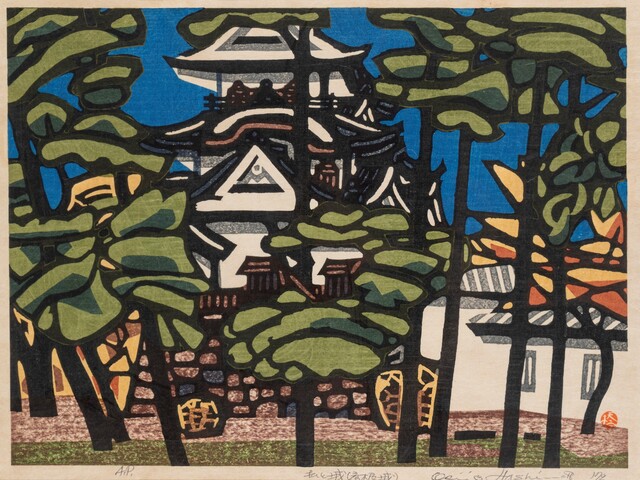
Pagoda with the trees
1972
Woodcut in colours

Garden in Ryuanji (Ryuanji niwa)
1973
Color woodblock print; edition 56/150

Iris (Shobu), No. 2 from the series "Flowers of Japan Series (Nihon no hana rensaku)"
1974
Color woodblock print; edition 1/80
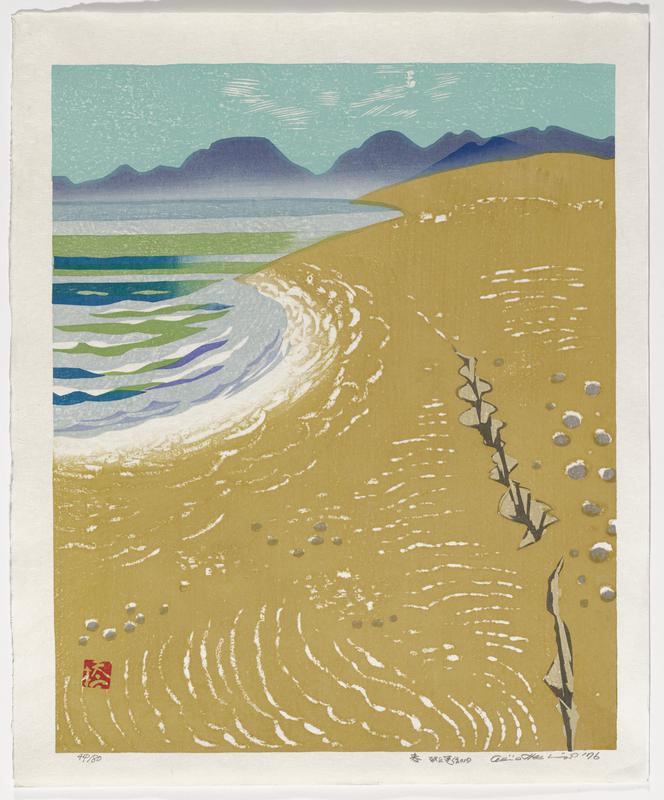
Spring
1976
Woodblock print, ink and color on paper
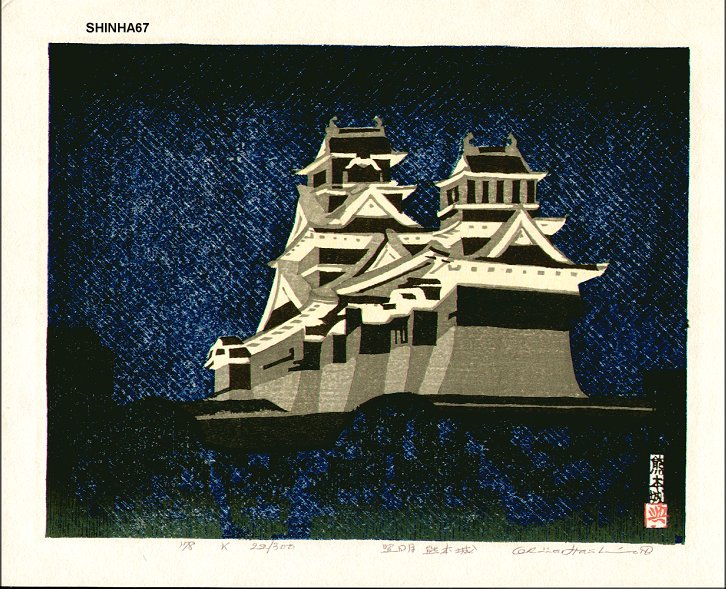
Castle in the moon
22/300, 1978
Woodblock print
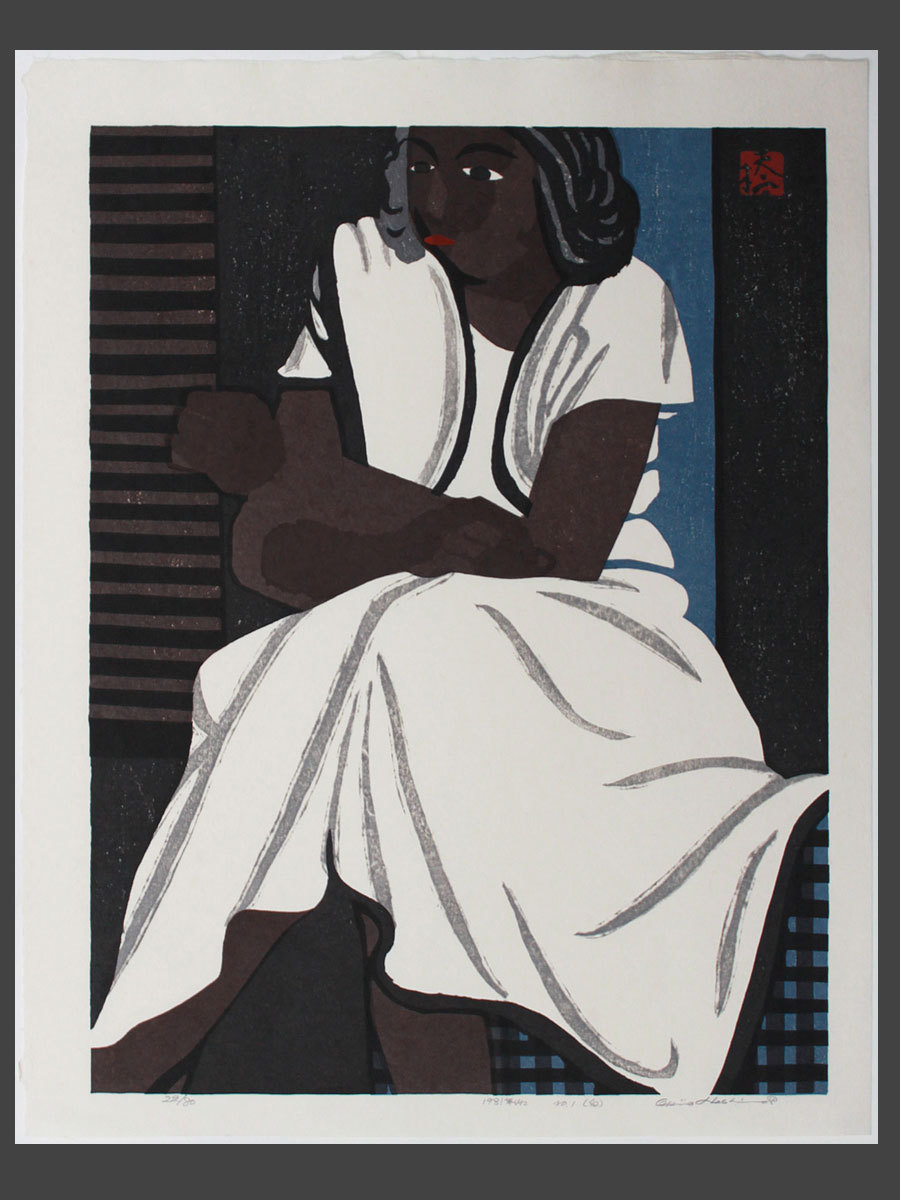
Work No.1 White (Woman in White) 22/80
1981
Woodblock print

Morning Mist II
1985
Woodblock print, ink and color on paper

Maple garden
Mokuhanga (Japanese woodblock)

Beronite Showa Shinzan
Mokuhanga (Japanese woodblock)
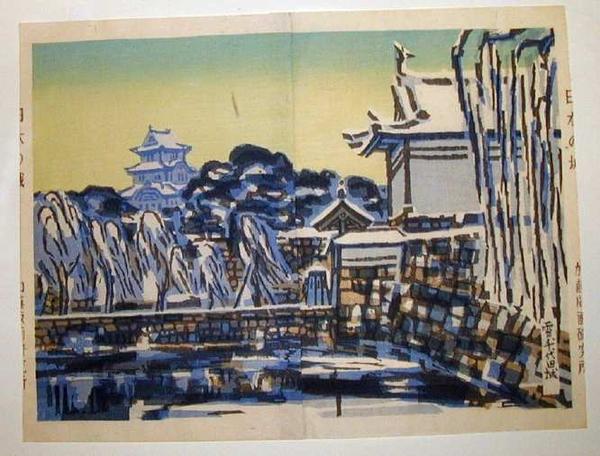
Chiyoda Castle in Snow
Woodblock print
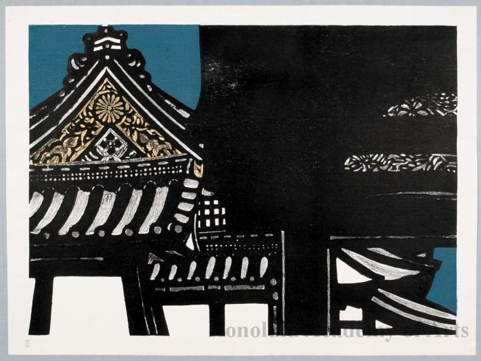
Nijo Castle
Woodblock print

Stone Bridge (Ishibashi), Shôwa period, dated 1960
Woodblock print

Bamboo forest and garden of Shisendo pavilion in Kyoto
Mokuhanga (Japanese woodblock)

Dune, early spring, Tottori
Mokuhanga (Japanese woodblock)

Clear autumn day
Mokuhanga (Japanese woodblock)
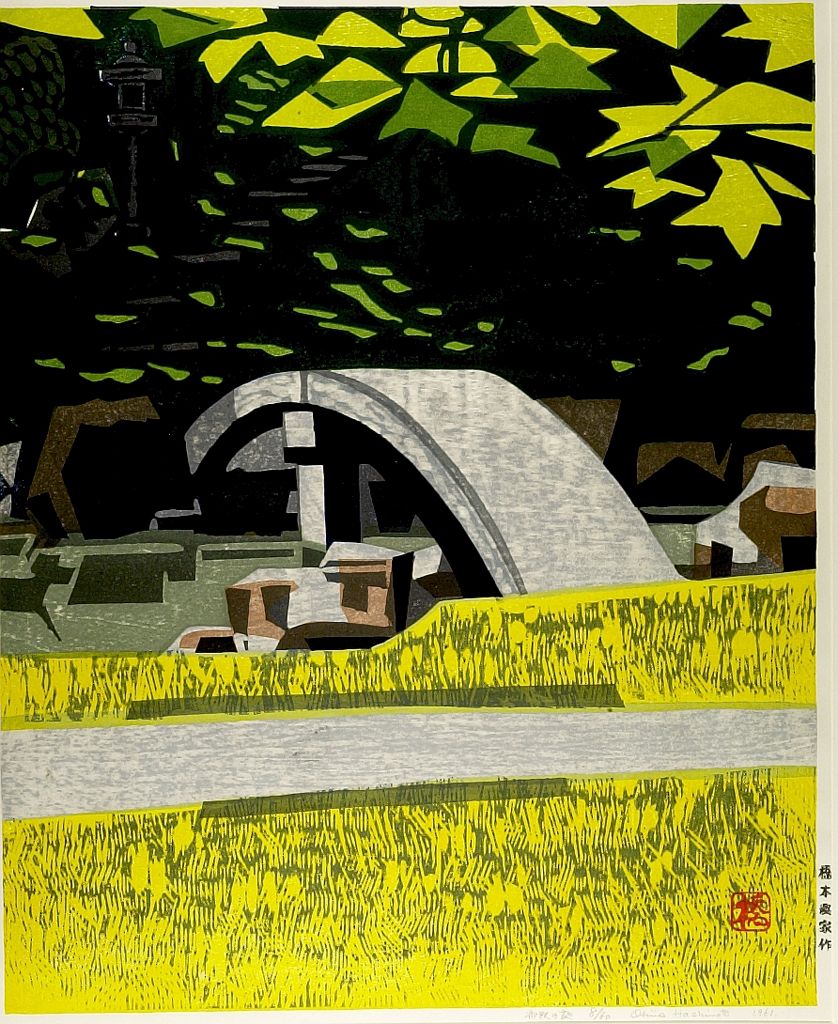
Stone Bridge, Shôwa period, dated 1961
Woodblock print

Late autumn in Ôyama (Tottori)
Mokuhanga (Japanese woodblock)
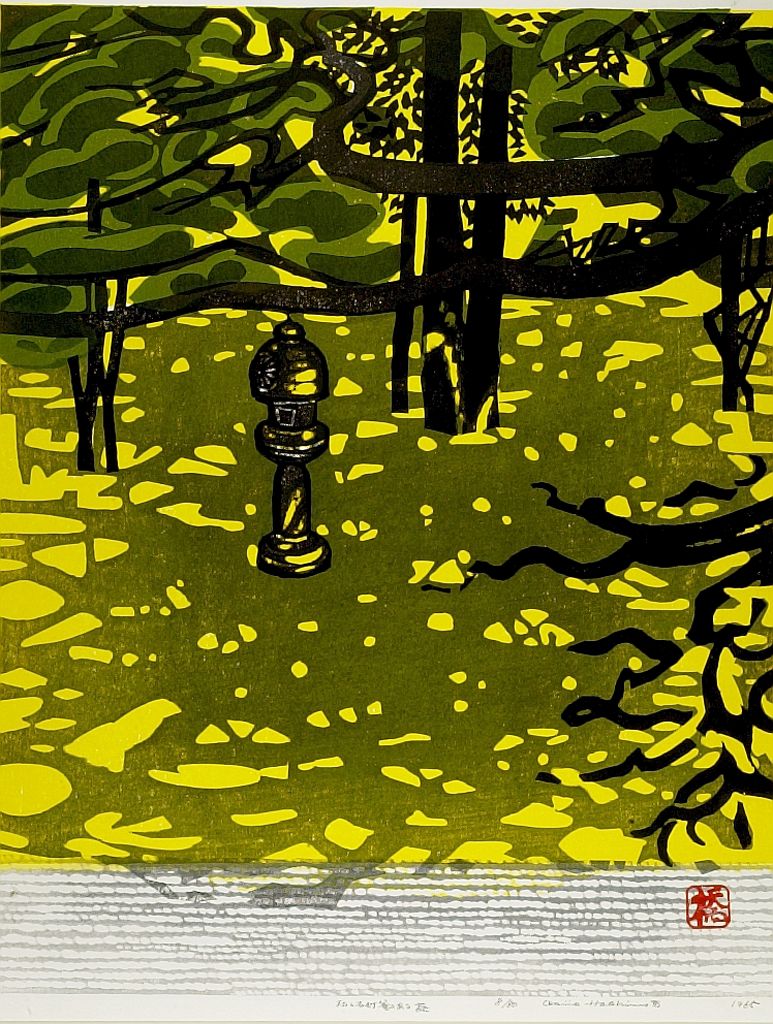
Garden with Stone Lantern, Shôwa period, before 1978
Woodblock print

Osaka castle ruins by moonlight
Mokuhanga (Japanese woodblock)

Nagatoro
Mokuhanga (Japanese woodblock)

Japanese irises (ayame) and young woman
Mokuhanga (Japanese woodblock)

Poetry of the Katsura river I
Mokuhanga (Japanese woodblock)

Niwa No. 19
Mokuhanga (Japanese woodblock)
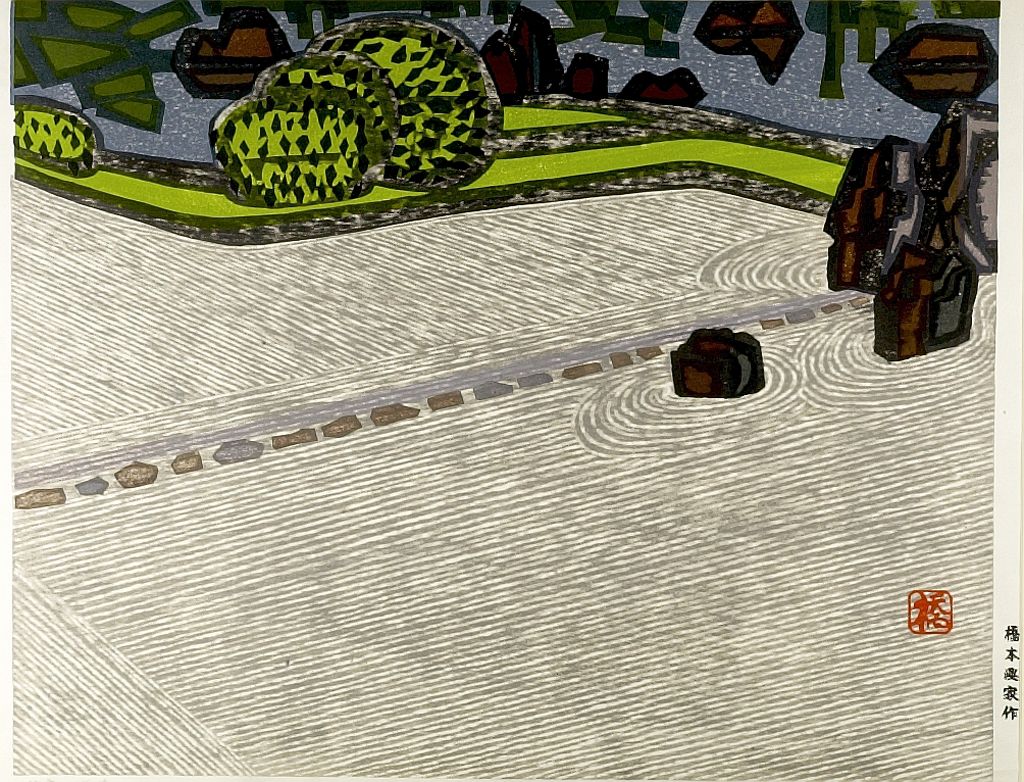
Sand Garden after Rain, Shôwa period, dated 1958
Woodblock print