
Maple garden
- Medium:
- Mokuhanga (Japanese woodblock)
- Image courtesy of
- Saru Gallery
Description
A Japanese stroll garden in maple season offers Hashimoto the chance to work with dense, layered color rather than the cleaner architectural masses that dominate much of his catalogue. The print likely arranges the maples in overlapping canopies of red, orange, and ochre, possibly framed by a stone lantern, path, or pond — the kind of fixed elements that anchor his garden subjects. Hashimoto's technical approach favors discrete color blocks with controlled bokashi at edges, allowing the maples to read as massed foliage rather than as individual leaves. As a sosaku-hanga artist, he cut each block on cherry wood and pulled the impressions himself on washi using a baren. Garden subjects connect his architectural prints — temples, pavilions, teahouses — to the cultivated landscapes that surround them, and this print sits within that broader interest in designed Japanese space.
More Prints by Okiie Hashimoto

More Gardens Prints
![[Garden of] Taj Mahal, No. 1 (Taji Maharu no niwa, dai ichi) by Hiroshi Yoshida](https://www.artic.edu/iiif/2/230993a7-d4f0-c979-c267-127d48e1ef1c/full/843,/0/default.jpg)
[Garden of] Taj Mahal, No. 1 (Taji Maharu no niwa, dai ichi)
Taji Maharu no niwa, dai ichi
1931
Color woodblock print; oban

Kiyozumi Garden in Moonlight
January 1938
Woodblock print, ink and color on paper

Moon over Kiyosumi Garden (Tsuki no Kiyosumien)
1938
Color woodblock print; oban
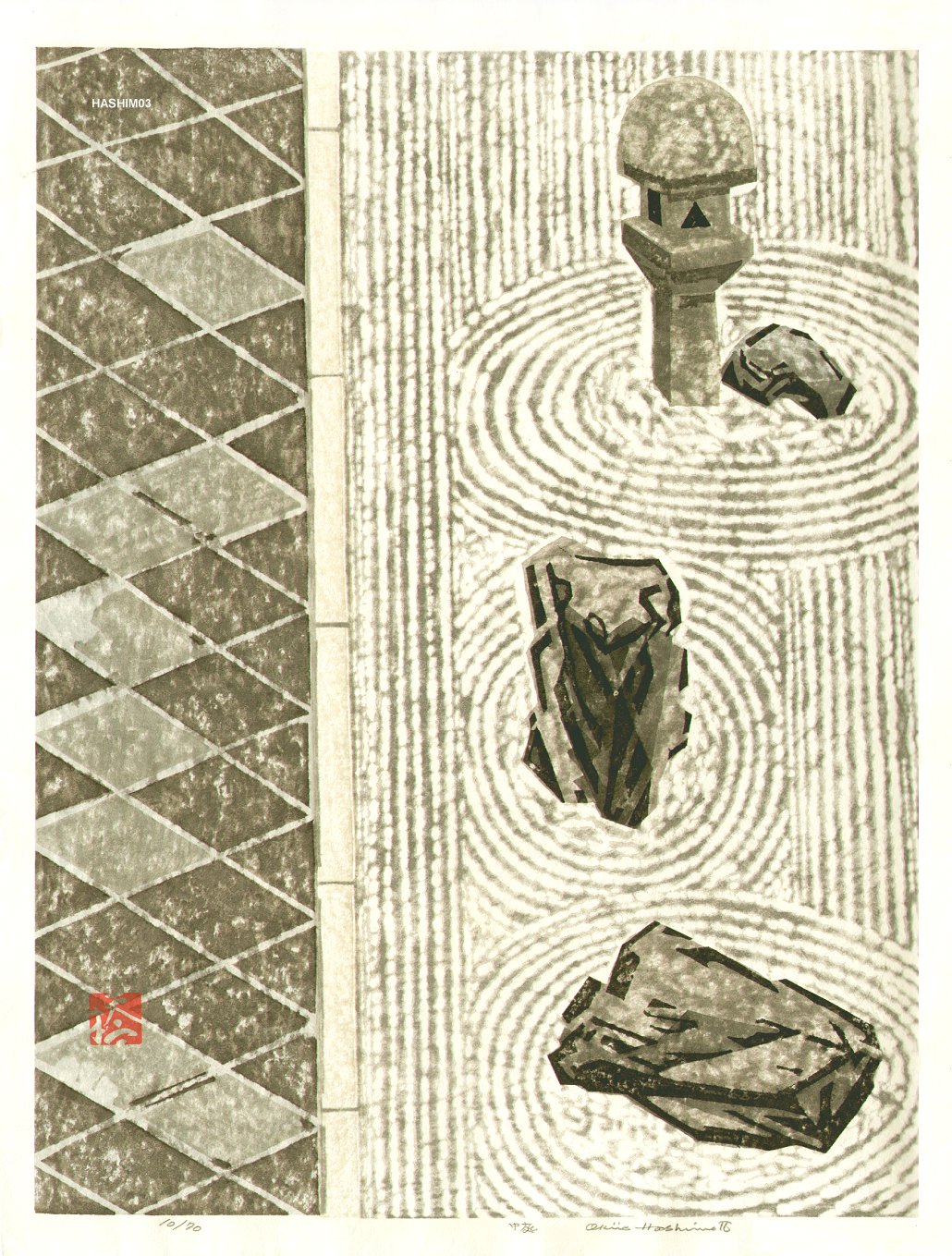
Rock garden
10/70, 1966
Woodblock print
Featured in Collections
Curated cross-cuts that include this print.
Frequently Asked Questions
Maple garden was created by Okiie Hashimoto (橋本興家).
Maple garden depicts gardens and trees.