Biography
Taguchi Beisaku (田口米作, 1864–1903) was a Meiji-period Japanese woodblock print designer best known for his vigorous senso-e (war prints) of the First Sino-Japanese War of 1894–95, a body of work that places him alongside Kobayashi Kiyochika, Mizuno Toshikata, Migita Toshihide, and Ogata Gekko among the most accomplished designers of the genre. A pupil of Kobayashi Kiyochika (1847–1915), Beisaku absorbed his teacher's distinctive fusion of traditional ukiyo-e draftsmanship with modern, Western-influenced techniques of light, atmosphere, and reportorial composition, and he became one of the most visible carriers of the Kiyochika lineage into the senso-e boom that swept Tokyo publishing during the Sino-Japanese War.
Beisaku was born in 1864, in the closing years of the Tokugawa shogunate, in a Japan that within the next four years would experience the Meiji Restoration, the abolition of the samurai class, the dismantling of the bakufu, and a rapid program of industrial and military modernization on Western lines. The son of a rice merchant, he relocated to Tokyo in 1873 as a boy. He came of age in a city that was simultaneously building a new conscript army on Prussian principles, laying down its first ironclad warships in foreign yards, expanding its railway network, and absorbing telegraphy, lithography, and oil painting from European instructors. The ukiyo-e print industry in which he would build his career was itself in transition: the traditional Edo-period genres of bijin-ga (beautiful women), yakusha-e (actor portraits), and meisho-e (famous places) were declining in commercial importance, while new categories—shinbun nishiki-e (newspaper prints), kaika-e (prints of civilization and enlightenment), and senso-e (war prints)—were rising to meet the demands of a modernizing urban readership hungry for visual reportage on the changing world.
Beisaku first trained under the painter Nakamura Banzan, and in 1881 he entered the studio of Kobayashi Kiyochika, by then the leading ukiyo-e designer of the Meiji era and the originator of the so-called kosen-ga or "light-ray pictures" that introduced Western lighting effects—dawn skies, lamplight reflections, gaslight halos, smoke and atmospheric perspective—into the traditional woodblock medium. Kiyochika had absorbed lessons from European lithography and illustration and from the photographic styles that were displacing ukiyo-e in popular illustration. Beisaku inherited from Kiyochika a sober, atmospheric approach to landscape and figure drawing, a willingness to integrate modern subject matter (railroads, steamships, telegraph poles, gas lamps, conscript soldiers) into the print tradition, and above all a commitment to the disciplined rendering of military equipment and modern uniforms that would prove central to his war prints. He remained closely associated with his teacher—succeeding Kiyochika as chief cartoonist of the satirical magazine Marumaru Chinbun in 1892 and, in the mid-1890s, directing Kiyochika's art school—and among Kiyochika's students he became the most committed to the senso-e genre and the most successful at adapting his teacher's atmospheric style to the requirements of battlefield reportage.
When war broke out between Japan and Qing China in July 1894, Tokyo publishers responded with an extraordinary commercial burst of woodblock prints depicting the conflict in oban triptych format. Within months, hundreds of senso-e by dozens of designers were flooding the Tokyo print shops, and the war prints of 1894–95 represent the last great commercial expansion of the woodblock medium before lithography and photographic illustration overtook it as the dominant vehicle of mass visual reportage. Beisaku became one of the most active senso-e designers of the war, producing dozens of triptychs across the campaign—from the naval action off Pungdo Island and the land battle at Seonghwan in late July 1894, through the assault on Pyongyang and the naval Battle of the Yellow Sea in September 1894, and the storming of Lushun (Port Arthur) and the fortifications of the Liaodong Peninsula in November 1894, to the surrender at Weihaiwei in February 1895. His surviving designs include depictions of the capture of Pyongyang, the occupation of Port Arthur, distant views of the Manchurian front, and the scouting exploits and prisoner-of-war episodes that the genre celebrated. His prints were issued by Tokyo publishers as part of the wartime print boom.
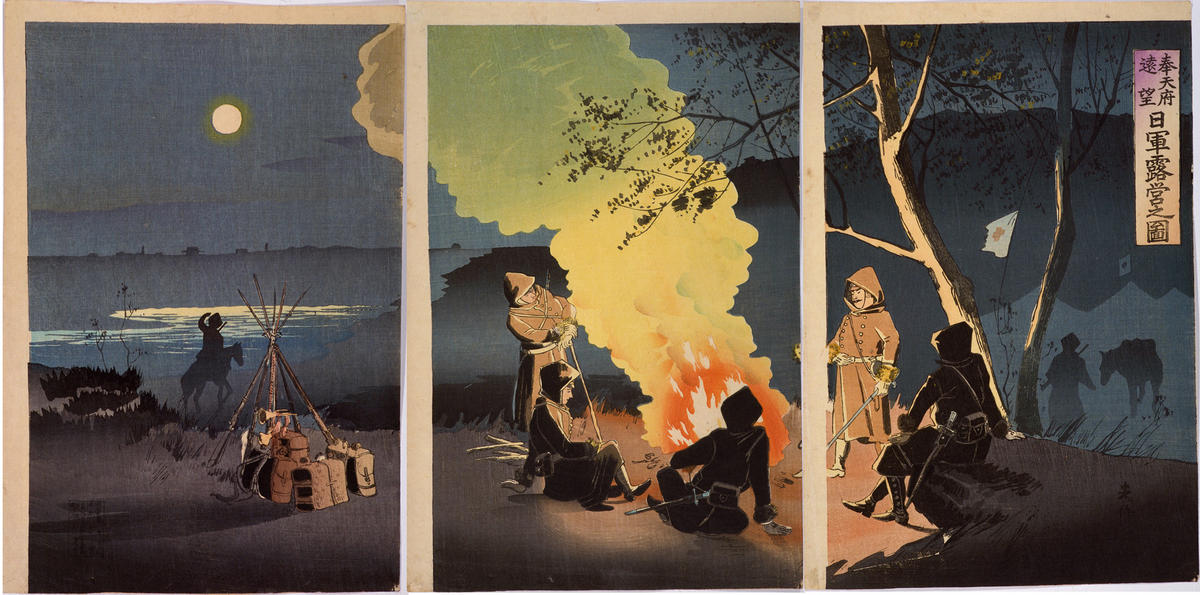
The Sino-Japanese senso-e of 1894–95 were typically produced and sold extremely rapidly, often within weeks of the event they depicted, and they functioned as a hybrid of commercial decoration, patriotic propaganda, and visual journalism. Beisaku's contribution to this output is distinguished by several stylistic features that link him directly to Kiyochika and that set him apart from more conventional senso-e designers. His night scenes and snow scenes, in particular, demonstrate the kosen-ga inheritance of his teacher: searchlights cutting through fog, lanterns illuminating the faces of advancing scouts, snow falling against the dark blue of conscript uniforms, and dawn or dusk skies that establish an atmospheric mood as well as a narrative moment. His battlefield triptychs combine the disciplined rendering of modern military equipment—rifles, bayonets, artillery, naval architecture—with the heroic figure drawing of late Edo-period warrior prints, producing compositions that read as both modern reportage and traditional narrative imagery. He was particularly adept at the scouting and reconnaissance subjects that the senso-e genre celebrated as exemplary acts of individual courage; his scout-hero designs, such as the reconnaissance of Master Scout Takeuchi and the officers braving a heavy snowstorm to scout enemy territory, are among the most accomplished examples of that subgenre.
Beyond his war prints, Beisaku was also active as a caricaturist and illustrator for the Tokyo press. Having succeeded Kiyochika as chief cartoonist of Marumaru Chinbun in 1892, he is credited with an important role in the early development of the Japanese narrative comic strip, producing in 1896 what is often described as the first serialized short narrative cartoon—a six-panel work run across three issues. He contributed illustrations to newspapers and illustrated periodicals and produced occasional prints in other genres, but his output remained dominated by the senso-e genre throughout the brief period of his mature career.
Beisaku's Sino-Japanese War triptychs survive in public and private collections of Meiji war prints, among them the Lavenberg Collection of Japanese Prints at the Jordan Schnitzer Museum of Art, University of Oregon. Western interest in Meiji war prints, which lagged behind the appreciation of Edo-period ukiyo-e for most of the twentieth century, revived from the 1980s—marked by landmark exhibitions such as the Philadelphia Museum of Art's Impressions of the Front: Woodcuts of the Sino-Japanese War (1983)—restoring critical attention to designers of Beisaku's generation, including Migita Toshihide and Mizuno Toshikata.
Beisaku died in 1903 at the age of thirty-nine, on the eve of the Russo-Japanese War of 1904–05, which would produce another major wave of senso-e and which his teacher Kiyochika and his contemporary Toshihide would continue to document. He did not live to design Russo-Japanese War prints, and his career is therefore essentially confined to the Sino-Japanese War period—a body of work concentrated into a few intense years. His name appears in some older Western sources under variant romanizations, including Baisaku.
In the broader history of Meiji print design, Beisaku occupies a distinctive position as one of the Kiyochika school's most committed Sino-Japanese War designers, the artist who most successfully transferred his teacher's atmospheric kosen-ga style to the requirements of battlefield reportage, and one of the small group of late ukiyo-e designers whose collective output between July 1894 and March 1895 produced what may be the most coherent body of visual war reportage in the entire ukiyo-e tradition. His night scenes, snow scenes, and scout subjects in particular show how the techniques of late nineteenth-century Western lighting and atmosphere could be absorbed into the woodblock medium without losing the heroic figure drawing and graphic clarity of the ukiyo-e tradition. Within the visual culture of modernizing Japan, his work documents not only a specific war but the very moment at which ukiyo-e transformed itself, briefly and brilliantly, into a vehicle for the visual representation of imperial military power, before being overtaken by the new media of lithography, halftone reproduction, and photographic illustration that would dominate the twentieth century.
Key Facts
- Active Period
- 1864–1903
- Nationality
- 🇯🇵Japan
- Movement
- Meiji/Taishō Prints
- Works Indexed
- 5
Frequently Asked Questions
Taguchi Beisaku (田口米作, 1864–1903) was a Meiji-period Japanese woodblock print designer best known for his vigorous senso-e (war prints) of the First Sino-Japanese War of 1894–95, a body of work that places him alongside Kobayashi Kiyochika, Mizuno Toshikata, Migita Toshihide, and Ogata Gekko among the most accomplished designers of the genre. A pupil of Kobayashi Kiyochika (1847–1915), Beisaku absorbed his teacher's distinctive fusion of traditional ukiyo-e draftsmanship with modern, Western-influenced techniques of light, atmosphere, and reportorial composition, and he became one of the most visible carriers of the Kiyochika lineage into the senso-e boom that swept Tokyo publishing during the Sino-Japanese War.
Taguchi Beisaku was active from 1864 to 1903. They were associated with the Meiji/Taishō Prints movement.
Taguchi Beisaku's work was shaped by the Meiji/Taishō Prints tradition in Japanese woodblock printmaking. Meiji/Taishō Prints: Meiji and Taishō era prints (1868–1926) bridge the transition from traditional ukiyo-e to the modern shin-hanga and sosaku-hanga movements.
Original prints by Taguchi Beisaku can be found in collections including Honolulu Museum of Art, Edo-Tokyo Museum, ukiyo-e.org, Austrian Museum of Applied Arts (MAK), Vienna.
Woodblock Prints by Taguchi Beisaku (5)
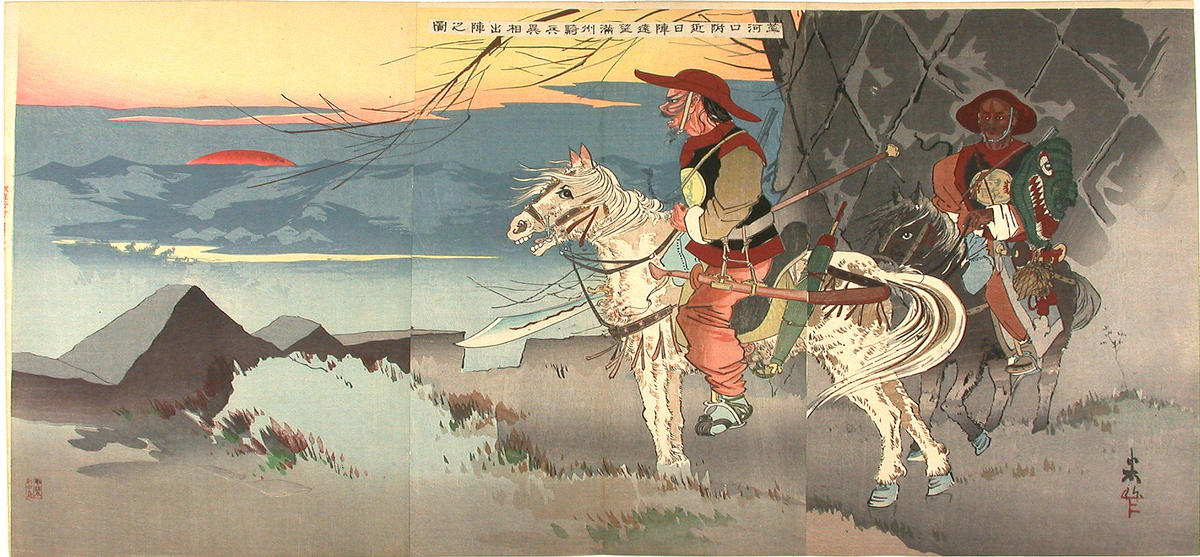
On the Estuary of the Soka River, Manchurian Raiders Spy on the Japanese Camp
1894/95
Color woodblock print; oban triptych

Master Scout Takeuchi
1894/95
Color woodblock print; oban triptych
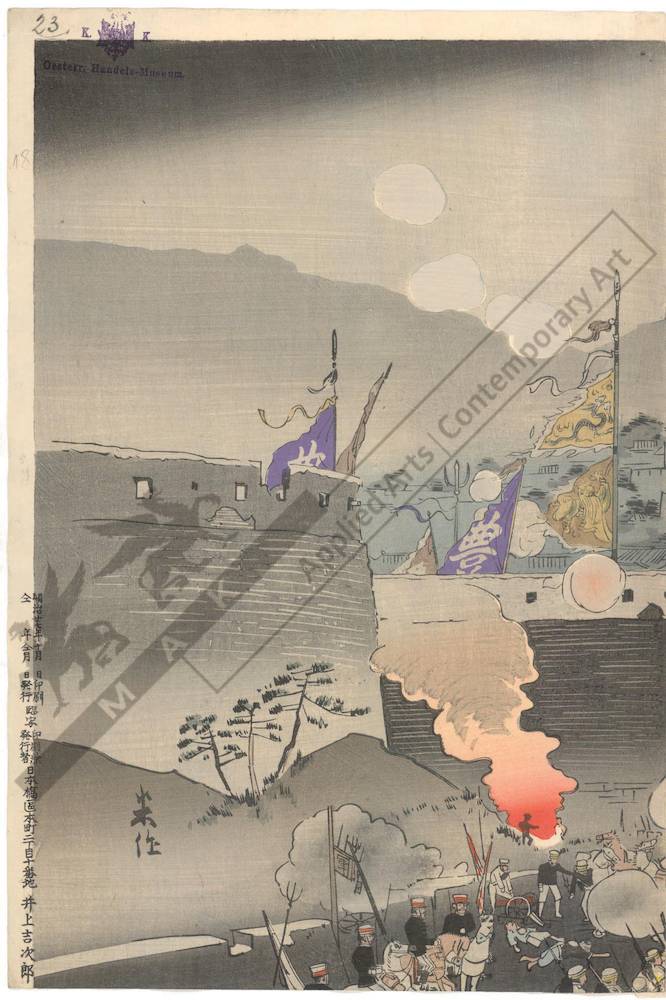
First Soldiers at the Genbu Gate in Pyongyang
1894
Color woodblock print; oban triptych
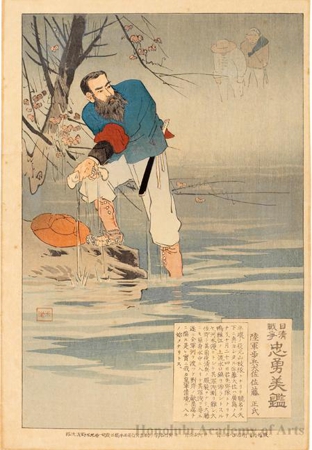
Infantryman Sato Tadashi
1895
Color woodblock print
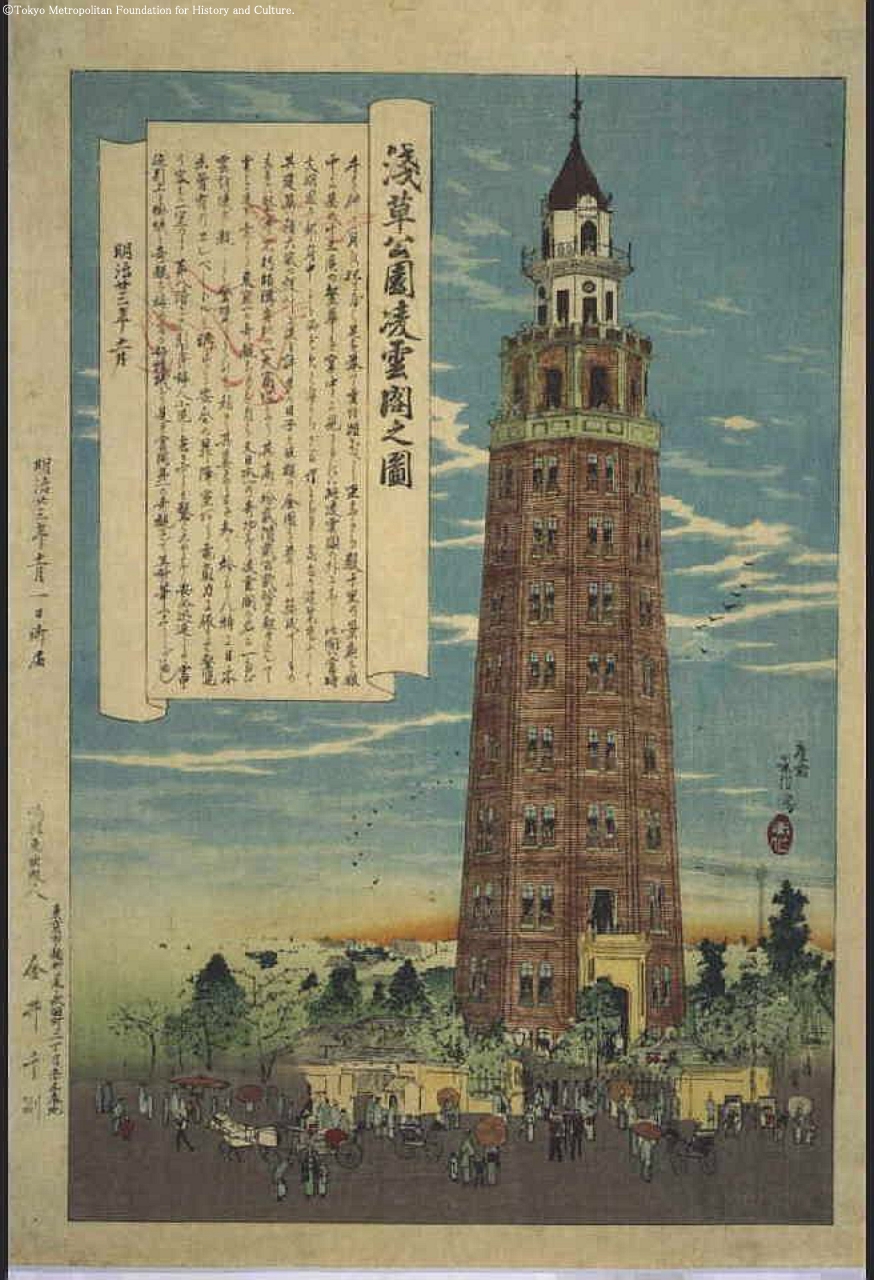
Picture of Asakusa Park and the Ryounkaku Building
Color woodblock print