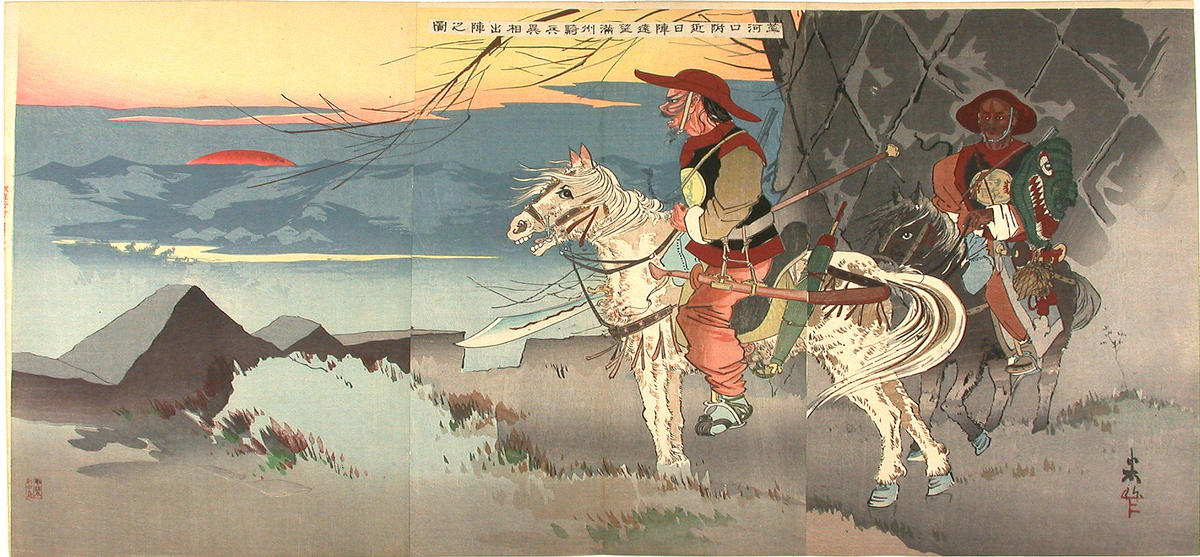
On the Estuary of the Soka River, Manchurian Raiders Spy on the Japanese Camp
- Date:
- 1894/95
- Medium:
- Color woodblock print; oban triptych
- Source:
- ukiyo-e.org
Description
On the Estuary of the Soka River, Manchurian Raiders Spy on the Japanese Camp is a color woodblock oban triptych by Taguchi Beisaku from the Sino-Japanese War period of 1894-95, accessible through the Japanese Art Open Database. The print depicts an episode of asymmetric warfare during the Japanese campaign in Manchuria: Manchurian irregular raiders—mounted Chinese cavalry operating outside the regular Qing military structure—surveying the Japanese encampment from the estuary of a Manchurian river, looking for opportunities for ambush or harassment. The composition reverses the usual senso-e perspective by placing the Chinese figures in the foreground and the Japanese camp in the distance, a narrative choice that Beisaku used in several of his Sino-Japanese War triptychs to vary the visual rhythm of his battlefield reportage and to give the genre a broader range of subject matter than the standard frontal assault formula provided. The mounted Manchurian figures—long coats, fur-edged caps, traditional bows alongside modern firearms—are rendered with the precise attention to military equipment that distinguished Beisaku among the senso-e designers, while the distant Japanese camp is built up in the atmospheric pale tonality that he had absorbed from his teacher Kobayashi Kiyochika. The print is part of his significant body of Manchurian-campaign senso-e and demonstrates the visual variety he brought to the war-print genre.
More Prints by Taguchi Beisaku

Frequently Asked Questions
On the Estuary of the Soka River, Manchurian Raiders Spy on the Japanese Camp was created by Taguchi Beisaku (田口米作) in 1894/95.