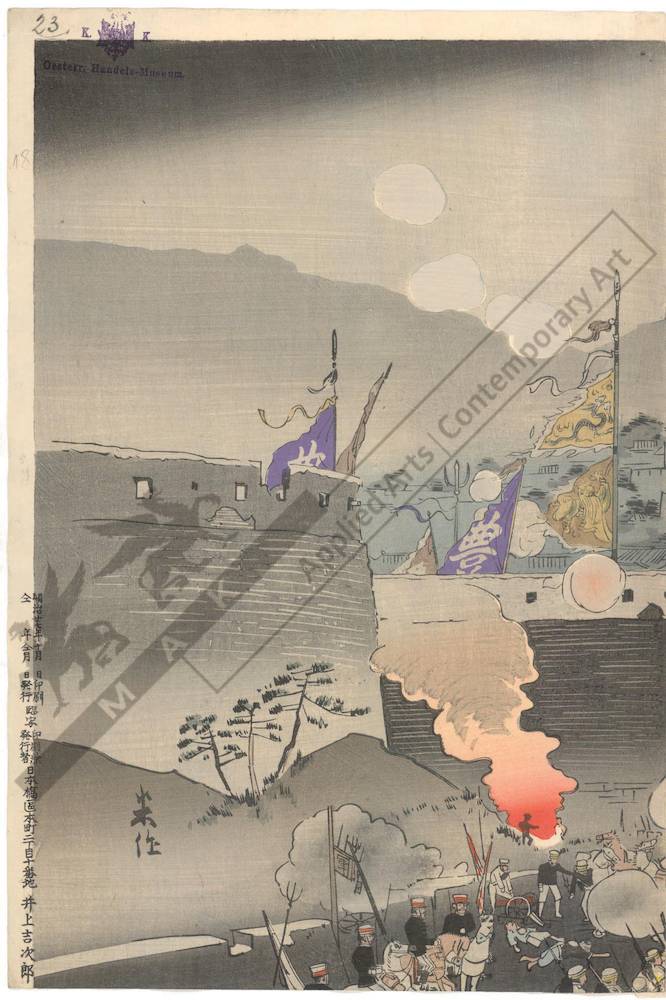
First Soldiers at the Genbu Gate in Pyongyang
- Date:
- 1894
- Medium:
- Color woodblock print; oban triptych
Description
First Soldiers at the Genbu Gate in Pyongyang is a color woodblock oban triptych by Taguchi Beisaku dated 1894, held by the Austrian Museum of Applied Arts (Museum fur angewandte Kunst, MAK) in Vienna and accessible through ukiyo-e.org. The subject is the celebrated Japanese assault on the Genbu Gate of Pyongyang on 15 September 1894, the decisive engagement of the First Sino-Japanese War's land campaign, in which Japanese forces under Field Marshal Yamagata Aritomo broke the Chinese defense of the fortified city and secured a major victory that effectively ended Qing military operations in Korea. The Genbu Gate—the northern gate of the Pyongyang citadel—was the focal point of the assault, and the soldier Harada Jukichi was widely credited as the first man through, an act of individual heroism that the Tokyo war-print industry celebrated in dozens of designs. Beisaku stages the breach with Japanese infantry storming the gate under fire, the leading soldier raising his rifle or sword while his comrades surge behind him, Chinese defenders falling back through the smoke and confusion. The composition uses the strong red, blue, and white palette characteristic of senso-e of the season, and the careful rendering of military equipment and gate architecture reflects the disciplined draftsmanship that Beisaku had inherited from the Kiyochika school. The MAK Vienna collection preserves an important group of Beisaku triptychs assembled at the end of the nineteenth century and constitutes one of the most significant European holdings of his work.
More Prints by Taguchi Beisaku
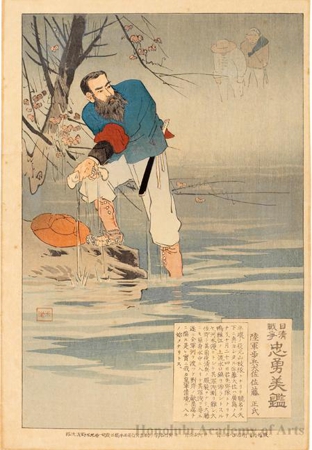
Infantryman Sato Tadashi
1895
Color woodblock print
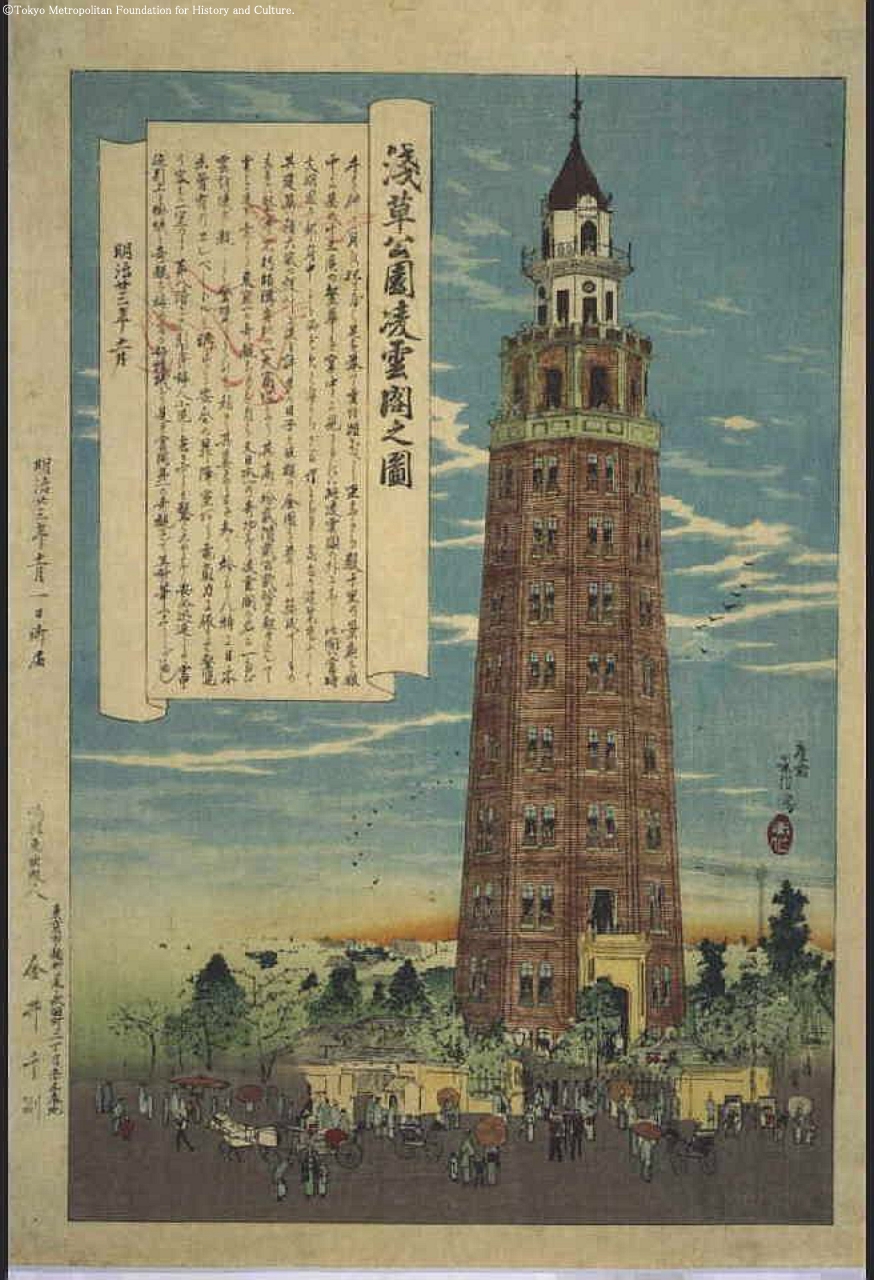
Picture of Asakusa Park and the Ryounkaku Building
Color woodblock print
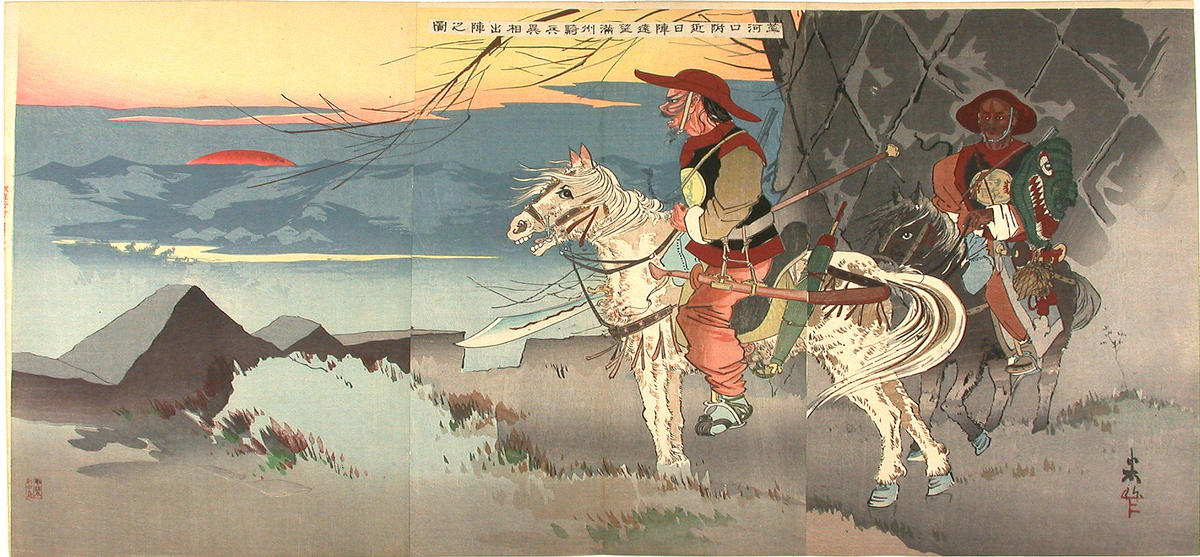
On the Estuary of the Soka River, Manchurian Raiders Spy on the Japanese Camp
1894/95
Color woodblock print; oban triptych

Master Scout Takeuchi
1894/95
Color woodblock print; oban triptych
Frequently Asked Questions
First Soldiers at the Genbu Gate in Pyongyang was created by Taguchi Beisaku (田口米作) in 1894.