Biography
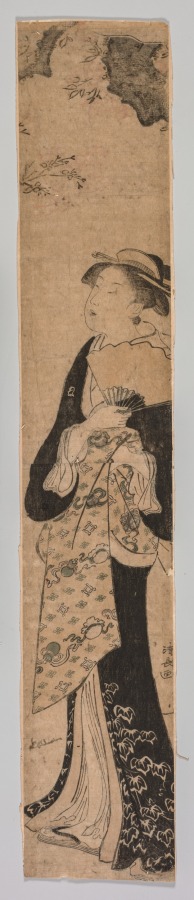
Torii Kiyonaga (1752-1815) stands as the defining master of Edo bijin-ga in the 1780s and the figure who, more than any other artist of his generation, established the visual ideal of the tall, dignified Japanese beauty that would shape ukiyo-e for the remainder of the eighteenth century. As the fourth head of the Torii school and the principal designer of bijin prints in the years immediately preceding the rise of Kitagawa Utamaro, Kiyonaga occupies a pivotal position in the history of Japanese woodblock printmaking. His mature work synthesized the elegance of Suzuki Harunobu, the structural clarity of Kitao Shigemasa, and the theatrical heritage of the Torii lineage into a unified style of unprecedented grandeur, producing a large and influential body of designs that remain among the most sought-after sheets in the canon of Edo prints.
Kiyonaga was born Sekiguchi Shinsuke in 1752, the son of an Edo bookseller — a background of modest urban commerce that gave him early access to print culture without binding him to a hereditary craft. By his mid-teens he had become a pupil of Torii Kiyomitsu (1735-1785), the third head of the Torii school and a leading designer of kabuki theater signboards and actor prints in mid-eighteenth-century Edo. The Torii school had been founded by Torii Kiyonobu around 1700 specifically to produce kabuki advertising, and its hereditary role in supplying theatrical billboards (kanban) shaped the institutional context of Kiyonaga's entire career.
Kiyonaga's earliest surviving prints date from the late 1760s and show him working in the established Torii idiom of actor portraits (yakusha-e) and hosoban-format theatrical prints. Through the 1770s his style evolved rapidly under the influence of two contemporaries who were transforming bijin-ga in Edo: Suzuki Harunobu (1725-1770), whose delicate full-color nishiki-e established a new vocabulary of slender, doll-like beauties, and Kitao Shigemasa (1739-1820), who introduced a sturdier, more naturalistic figure type into the genre. Kiyonaga absorbed both influences but moved beyond them. By the late 1770s his beauties had begun to grow taller and more substantial, their proportions approaching the eight-heads-high canon of classical figure drawing, and his compositions had begun to extend laterally across diptychs and triptychs in ways that gave his figures room to breathe and his settings genuine spatial depth.
The peak of Kiyonaga's career arrived in the early to mid-1780s with a sequence of major series that defined Edo bijin-ga for a generation. His best-known work, the series "Minami jūnikō" ("Twelve Months in the South," also rendered as scenes of the southern pleasure quarter), issued around 1783-1784, depicts beauties in the Shinagawa district at the southern entrance to Edo across the twelve months of the year. Tall, naturalistic figures are set in carefully observed seasonal surroundings, and the series remains the single most celebrated achievement of Kiyonaga's career. Its imagery ranges across New Year observances, cherry-blossom outings, boating parties, and intimate scenes drawn from the milieu of fashionable Edo townswomen and pleasure-quarter beauties.
What distinguished Kiyonaga's 1780s bijin-ga from everything that had come before was its monumentality. Where Harunobu's beauties had been small, intimate figures in compressed interiors, Kiyonaga's were tall, statuesque presences who commanded the full height of the oban sheet and the full width of the multi-sheet composition. He arranged them in pairs, trios, and processional groups, often shown in profile or three-quarter view, their elongated proportions giving them a quality of unhurried elegance that contemporary viewers immediately recognized as a new ideal of feminine beauty. His triptychs depicting beauties at picnics, at famous Edo locations, and at the cherry-blossom-viewing sites of the city established the multi-sheet bijin composition as a major format and influenced virtually every bijin-ga designer who followed.
In 1787, two years after Kiyomitsu's death, Kiyonaga formally succeeded his teacher as the fourth head of the Torii school. The appointment came with significant institutional responsibility: as Torii head, Kiyonaga was now charged with designing the kabuki signboards and theatrical advertising that the Torii had long supplied to the Edo theaters. Over the late 1780s and 1790s he gradually withdrew from bijin-ga production and devoted his energies to Torii-school theatrical work and to training his successor, Torii Kiyomine, who would eventually become the fifth Torii head. The shift was partly institutional duty and partly generational: by 1790 Kitagawa Utamaro had begun to publish the okubi-e bust portraits and large-head bijin prints that would dominate the genre through the 1790s, and Kiyonaga, having defined the bijin-ga of one decade, appears to have ceded the field to the next master.
Kiyonaga's influence on Utamaro was direct. Utamaro's bijin-ga of the late 1780s and early 1790s — before he developed his signature large-head format — borrow Kiyonaga's tall proportions, his processional groupings, and his integration of figure and setting. Through Utamaro the Kiyonaga ideal of the tall, dignified beauty passed into the work of Eishi, Eishō, and the broader bijin-ga school of the Kansei era, and it remains visible in the prints of Utagawa Toyokuni and the early Utagawa school at the turn of the nineteenth century. Kiyonaga's compositional vocabulary — the multi-sheet processional, the figure-in-landscape triptych, the paired beauty in domestic interior — became standard equipment for ukiyo-e designers for the remainder of the Edo period.
Kiyonaga lived on for more than two decades after stepping back from bijin-ga, continuing to design Torii signboards and occasional figure prints into the last years of his life; his final known prints date from around 1813. He died on June 28, 1815, at the age of sixty-three, and is buried at the Ekō-in temple in Edo. Major museum collections — the Museum of Fine Arts, Boston; the Metropolitan Museum of Art in New York; the Art Institute of Chicago; and the British Museum — preserve impressions of the great 1780s series in fresh, well-printed states that allow modern viewers to see why his contemporaries regarded him as a supreme master of Edo bijin-ga. His prints continue to anchor major museum surveys of eighteenth-century Japanese printmaking and remain a foundational reference for the study of the late-Edo woodblock tradition.
Key Facts
- Active Period
- 1752–1815
- Nationality
- 🇯🇵Japan
- Movement
- Ukiyo-e
- Works Indexed
- 208
Frequently Asked Questions
Torii Kiyonaga (1752-1815) stands as the defining master of Edo bijin-ga in the 1780s and the figure who, more than any other artist of his generation, established the visual ideal of the tall, dignified Japanese beauty that would shape ukiyo-e for the remainder of the eighteenth century. As the fourth head of the Torii school and the principal designer of bijin prints in the years immediately preceding the rise of Kitagawa Utamaro, Kiyonaga occupies a pivotal position in the history of Japanese woodblock printmaking. His mature work synthesized the elegance of Suzuki Harunobu, the structural clarity of Kitao Shigemasa, and the theatrical heritage of the Torii lineage into a unified style of unprecedented grandeur, producing a large and influential body of designs that remain among the most sought-after sheets in the canon of Edo prints.
Torii Kiyonaga was active from 1752 to 1815. They were associated with the Ukiyo-e movement.
Torii Kiyonaga's work was shaped by the Ukiyo-e tradition in Japanese woodblock printmaking. Ukiyo-e: ## What is ukiyo-e? Ukiyo-e ([浮世絵](/glossary/ukiyo-e)) — literally "pictures of the floating world" — is the Edo-period Japanese print and painting tradition that flourished from roughly 1660 to 1868, depicting the pleasures of urban life in Edo (modern Tokyo): courtesans, kabuki actors, sumo wrestlers, famous landscapes, and seasonal beauties.
Torii Kiyonaga's prints frequently feature children, birds & flowers, spring, sumo, autumn foliage, winter.
Original prints by Torii Kiyonaga can be found in collections including Art Institute of Chicago, ukiyo-e.org.
Woodblock Prints by Torii Kiyonaga (208)

Women Coming Ashore from a Pleasure Boat on the Sumida River
c. 1785
Color woodblock print; oban triptych

Matsuchi Hill after Snowfall
c. 1785
Color woodblock print; oban diptych

The Poet Sojo Henjo, from the series "Six Immortal Poets (Rokkasen)"
c. 1785
Color woodblock print; koban

Evening Rain at Shukaku - the actor Nakamura Nakazo as Sadakuro, from an untitled series of actor prints
1780
Color woodblock print; chuban

Admiring the wisteria at the Kameido Shrine
c. 1786
Color woodblock print; oban diptych

Women Viewing a Snowy Garden from a Parlor
c. 1786
Color woodblock print; right sheet of oban diptych

A Fan Peddler Passing Beneath a Balcony
c. 1786
Color woodblock prints; vertical oban diptych

Snowy Morning in the Pleasure Quarters (Seiro yuki no ashita)
c. 1789
Color woodblock print; left sheet of oban diptych

A visit to a shrine, from the series "Twelve Scenes of Popular Customs (Fuzoku juni tsui)"
c. 1786
Color woodblock print; koban

Women Crossing Nihonbashi Bridge
c. 1786
Color woodblock print; oban diptych

A Party Viewing the Moon Across the Sumida River
c. 1787
Color woodblock print; oban triptych

Cherry Blossom Viewing at Asuka Hill
c. 1787
Color woodblock print; right sheet of oban triptych
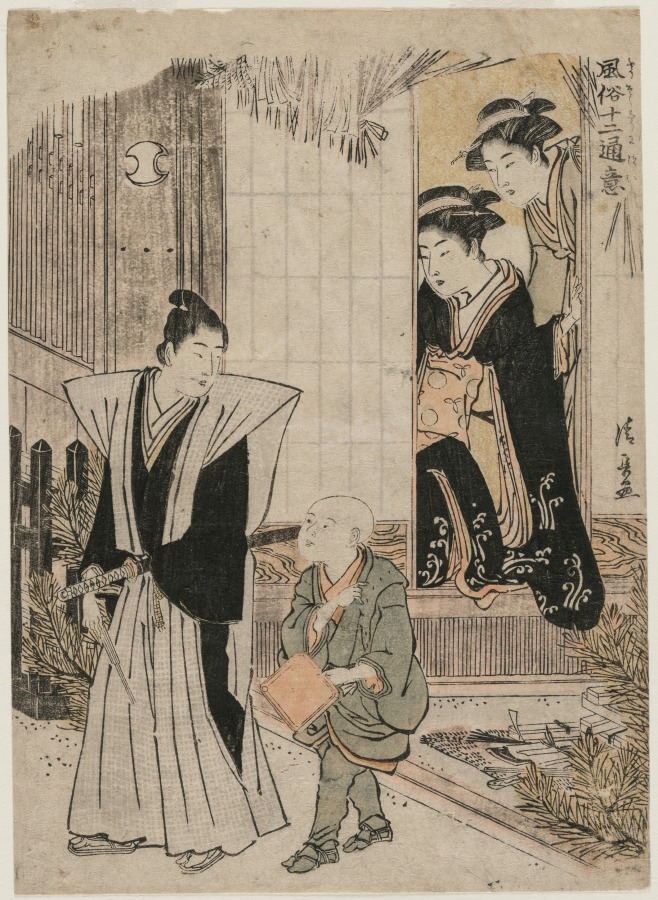
The First Month (from the series Popular Presentations)
1782
color woodblock print
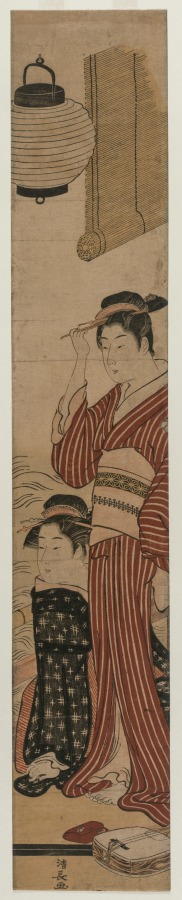
Two Geisha on a Balcony
1782
color woodblock print

Spring Outing to Mukojima
c. 1787
Color woodblock print; right sheet of oban triptych

Courtesans of Yoshiwara and their attendants viewing the peonies on Nakanocho
c. 1787
Color woodblock print; center and right sheets of oban triptych

The First Calligraphy of the New Year (Kissho hajime), from the illustrated book "Colors of the Triple Dawn (Saishiki mitsu no asa)"
c. 1787
Color woodblock print; oban, page from an illustrated book

The Courtesan Maizumi of the Daimonjiya with Her Attendants Shigeki and Naname, from the series "Models for Fashion: New Designs as Fresh as Young Leaves (Hinagata wakana no hatsu moyo)"
1782
Color woodblock print; oban

A Ferry on the Sumida River
c. 1787
Color woodblock print; center sheet of oban triptych

Takata, from the series "Ten Summer Scenes in Edo (Edo natsu jikkei)"
c. 1787
Color woodblock print; chuban

The Actor Ichikawa Danjuro V and his family, from an untitled series of four prints showing Actors in private life
c. 1783/84
Color woodblock print; oban

The Actors Bando Matakuro IV as Chubei, Osagawa Tsuneyo II as Umegawa, and Nakamura Katsugoro as Magoemon, in the play "Keisei Koibikyaku," performed at the Morita Theater in the fifth month, 1783
1783
Color woodblock print; oban

Parody of Princess Joruri and Ushiwakamaru
c. 1788
Color woodblock print; left sheet of chuban triptych

Women and Children on the Causeway at Shinobazu Pond
c. 1788
Color woodblock print; right sheet of oban triptych
Signature Techniques
Mokuhanga techniques most associated with Torii Kiyonaga.
Compare With
Kiyonaga's elongated bijin-ga proportions directly influenced Utamaro and the next generation of beauty-print artists.