
Women Crossing Nihonbashi Bridge
- Date:
- c. 1786
- Medium:
- Color woodblock print; oban diptych
- Source:
- Art Institute of Chicago
Description
Women Crossing Nihonbashi Bridge, dated to about 1781 and held by the Art Institute of Chicago, places Torii Kiyonaga's tall, idealized beauties on the most symbolic span in Edo. Nihonbashi was the central bridge of the city, the starting point of the Tokaido and the meeting place of merchants, fishmongers, and travelers from across the country, and Kiyonaga uses it as a stage for a procession of women whose calm bearing turns a busy commercial site into an elegant tableau. The composition runs the bridge's railing diagonally across the sheet, organizing the figures in a graceful frieze while glimpses of warehouses and the river suggest the surrounding city. As head of the Torii school, Kiyonaga had inherited a workshop strongly associated with kabuki signboards, and one can see in this print how he applied that experience of theatrical staging to the open city, making each figure read clearly while contributing to a unified group. The block printing uses restrained color to keep the costumes and parasols crisp without overpowering the architectural setting. Kiyonaga's Edo bijin-ga of the early 1780s consistently emphasizes the integration of figures with environment, and this Nihonbashi sheet is among the more legible examples - one in which the bridge is not merely a backdrop but an explicit emblem of urban centrality. Its presence in the Art Institute of Chicago documents the depth of his contribution to Edo's image of itself.
More Prints by Torii Kiyonaga

Watching the Water Festival from Azuma Bridge, from the series "Eight Precincts of the Kinryuzan Temple in Asakusa (Asakusa Kinruzan hakkei)"
c. 1782
Color woodblock print; chuban

Courtesans of Yoshiwara and their attendants viewing the peonies on Nakanocho
c. 1787
Color woodblock print; center and right sheets of oban triptych

A visit to a shrine, from the series "Twelve Scenes of Popular Customs (Fuzoku juni tsui)"
c. 1786
Color woodblock print; koban

A Party Viewing the Moon Across the Sumida River
c. 1787
Color woodblock print; oban triptych
More Bridges Prints
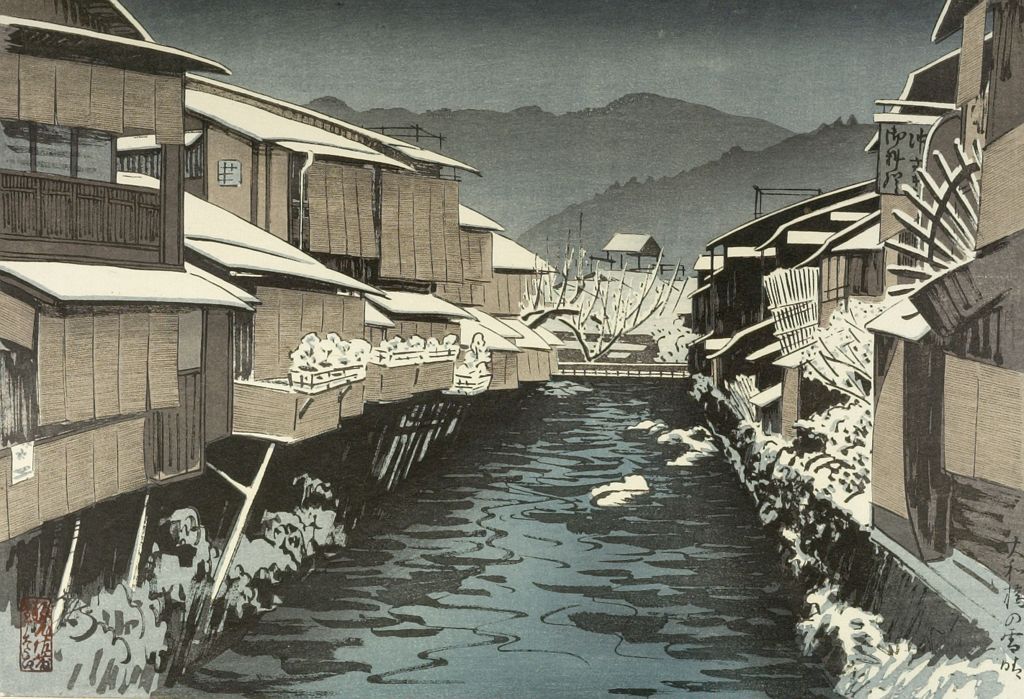
Fair Weather After Snow at Yamato Bridge, Kyoto (Yamato bashi no yukibare), Taishô period, dated 1924
Woodblock print
![Mount Fuji on a Moonlit Night, Kawai Bridge (Tsukiyo no Fuji [Kawaibashi]), from the series "Selection of Views of the Tokaido (Tokaido fukei senshu)" by Kawase Hasui](https://www.artic.edu/iiif/2/d0960668-1e73-339a-b182-fb995a54bff0/full/843,/0/default.jpg)
Mount Fuji on a Moonlit Night, Kawai Bridge (Tsukiyo no Fuji [Kawaibashi]), from the series "Selection of Views of the Tokaido (Tokaido fukei senshu)"
1947
Color woodblock print; oban

Shin Ohashi Bridge (Shin Ohashi), from the series "Twenty View of Tokyo (Tokyu nijukkei)"
1926
Color woodblock print; oban

Sacred Bridge in Nikko (Nikko Shinkyo)
1930
Color woodblock print; oban
Frequently Asked Questions
Women Crossing Nihonbashi Bridge was created by Torii Kiyonaga (鳥居清長) in c. 1786.
Women Crossing Nihonbashi Bridge depicts bridges.