Biography
Torii Kiyosada (鳥居清貞, 1844-1901) was a Meiji-period designer of kabuki actor prints and the head of the Torii school in the closing decades of the nineteenth century, the era in which the Torii family's two-hundred-year monopoly on Edo theatrical publicity passed through its final transformation under the pressures of Meiji modernisation. Born in Edo as Saitō Chōhachi and originally of the Watanabe family, he was adopted into the Torii lineage as a pupil of Torii Kiyomine (later Torii Kiyomitsu II, 1787-1868), who as the fifth head of the school had succeeded the great Torii Kiyonaga. On Kiyomine's death in 1868 - the year of the Meiji Restoration - Kiyosada took over the headship of the Torii workshop as its sixth head and inherited the family's long-standing contractual relationships with the kabuki theatres of Edo, which the new government had already begun to call Tokyo.
The Torii school's institutional foundation - the exclusive right to design kanban billboards, banzuke programs, and actor prints for the licensed Edo theatres - had survived two centuries of dynastic change within the family, but it now faced an unprecedented challenge from outside. The Meiji transformation of Japan after 1868 brought the dismantling of the Tokugawa entertainment regulations, the rise of photography as the dominant medium of theatrical publicity, and the gradual decline of the woodblock print market as Western mechanical printing technologies entered the Japanese commercial landscape. Within this environment Kiyosada continued to design actor prints throughout his career, sustaining the Torii house style of bold contour lines, full-length single-figure compositions, and minute documentary identification of actor, role, play, theatre, and date that had characterised the school's output since the seventeenth century.
Kiyosada's most consequential project, undertaken in 1895-1896 in collaboration with his son and successor Torii Kiyotada VII (1875-1941), was a series of eighteen large-format actor portraits documenting Ichikawa Danjūrō IX (1838-1903) in the eighteen canonical aragoto roles of the Ichikawa family repertoire, the Kabuki Jūhachi-ban. The Kabuki Eighteen had been established by Ichikawa Danjūrō VII as the Ichikawa lineage's claim to a distinct kabuki tradition - a set of bravura male-role pieces, mostly drawn from the family's repertoire of demon-quelling and warrior plays, that the Ichikawa house had performed across generations. By the 1890s Danjūrō IX, the leading kabuki actor of the Meiji period and the figure most closely associated with the modernisation of the kabuki stage, was approaching the end of his career, and Kiyosada's series functioned as both a celebratory tribute and an authoritative pictorial record of the actor's interpretation of the family canon.
The Kabuki Jūhachi-ban series, issued in colour woodblock prints over 1895 and 1896 with a title page (mokuroku) and eighteen individual actor portraits, drew on the Torii school's traditional yakusha-e visual vocabulary while accommodating the more elaborate polychrome printing of the late Meiji period. Each sheet identifies the actor, the role, and the specific play, and the eighteen plays - Shibaraku, Kanjinchō, Sukeroku, Kenuki, Kagekiyo, Narukami, Uwanari, Kamahige, Fuwa, Jayanagi, Zōhiki, Uirō Uri, Yanone, Nanatsumen, Kan'u, Oshimodoshi, Gedatsu, and Fudō - together constitute the canonical Ichikawa repertoire as understood at the close of the nineteenth century. The series provided the last great pictorial codification of the Ichikawa family's kabuki tradition before Danjūrō IX's death in 1903.
Kiyosada also contributed to a second documentary project of the late 1890s, the series Annual Events of the Theatre in Edo (Ō-Edo shibai nenjū-gyōji), published by Hasegawa Sumi in 1897. That series - a record of the ritual calendar of the pre-Meiji kabuki year, preserving ceremonies and seasonal customs that had largely fallen away under the modernising pressures of the Meiji period - was designed for the most part by Adachi Ginkō, with Kiyosada supplying only a small number of the designs, among them the Okina-watashi, the ceremonial passing of the auspicious Okina mask. Like the Kabuki Eighteen, the series functioned as much as a work of historical memory as a contemporary publication - an attempt to fix in print a body of theatrical practice that the new era was rapidly transforming.
Kiyosada died in 1901, two years before Ichikawa Danjūrō IX himself. His son Torii Kiyotada VII succeeded him as the seventh head of the Torii school and continued the family's involvement in kabuki publicity well into the twentieth century. Kiyosada's surviving work is held by the Museum of Fine Arts, Boston, and the Lavenberg Collection of Japanese Prints, as well as major Japanese collections including the Tokyo Metropolitan Library, the Tsubouchi Memorial Theatre Museum at Waseda University, and the Edo-Tokyo Museum. His prints constitute the principal pictorial record of late Meiji kabuki at the moment when the form was being reformulated for the modern Japanese theatrical landscape, and they preserve the Torii school's distinctive visual signature - bold contour, restrained colour, full-length single-figure composition - in its final fully traditional Edo iteration.
Key Facts
- Active Period
- 1844–1901
- Nationality
- 🇯🇵Japan
- Movements
- Meiji/Taishō PrintsUkiyo-e
- Works Indexed
- 10
Frequently Asked Questions
Torii Kiyosada (鳥居清貞, 1844-1901) was a Meiji-period designer of kabuki actor prints and the head of the Torii school in the closing decades of the nineteenth century, the era in which the Torii family's two-hundred-year monopoly on Edo theatrical publicity passed through its final transformation under the pressures of Meiji modernisation. Born in Edo as Saitō Chōhachi and originally of the Watanabe family, he was adopted into the Torii lineage as a pupil of Torii Kiyomine (later Torii Kiyomitsu II, 1787-1868), who as the fifth head of the school had succeeded the great Torii Kiyonaga. On Kiyomine's death in 1868 - the year of the Meiji Restoration - Kiyosada took over the headship of the Torii workshop as its sixth head and inherited the family's long-standing contractual relationships with the kabuki theatres of Edo, which the new government had already begun to call Tokyo.
Torii Kiyosada was active from 1844 to 1901. They were associated with the Meiji/Taishō Prints and Ukiyo-e movements.
Torii Kiyosada's work was shaped by the Meiji/Taishō Prints and Ukiyo-e traditions in Japanese woodblock printmaking. Meiji/Taishō Prints: Meiji and Taishō era prints (1868–1926) bridge the transition from traditional ukiyo-e to the modern shin-hanga and sosaku-hanga movements. Ukiyo-e: ## What is ukiyo-e? Ukiyo-e ([浮世絵](/glossary/ukiyo-e)) — literally "pictures of the floating world" — is the Edo-period Japanese print and painting tradition that flourished from roughly 1660 to 1868, depicting the pleasures of urban life in Edo (modern Tokyo): courtesans, kabuki actors, sumo wrestlers, famous landscapes, and seasonal beauties.
Original prints by Torii Kiyosada can be found in collections including Museum of Fine Arts, Boston, British Museum.
Woodblock Prints by Torii Kiyosada (10)
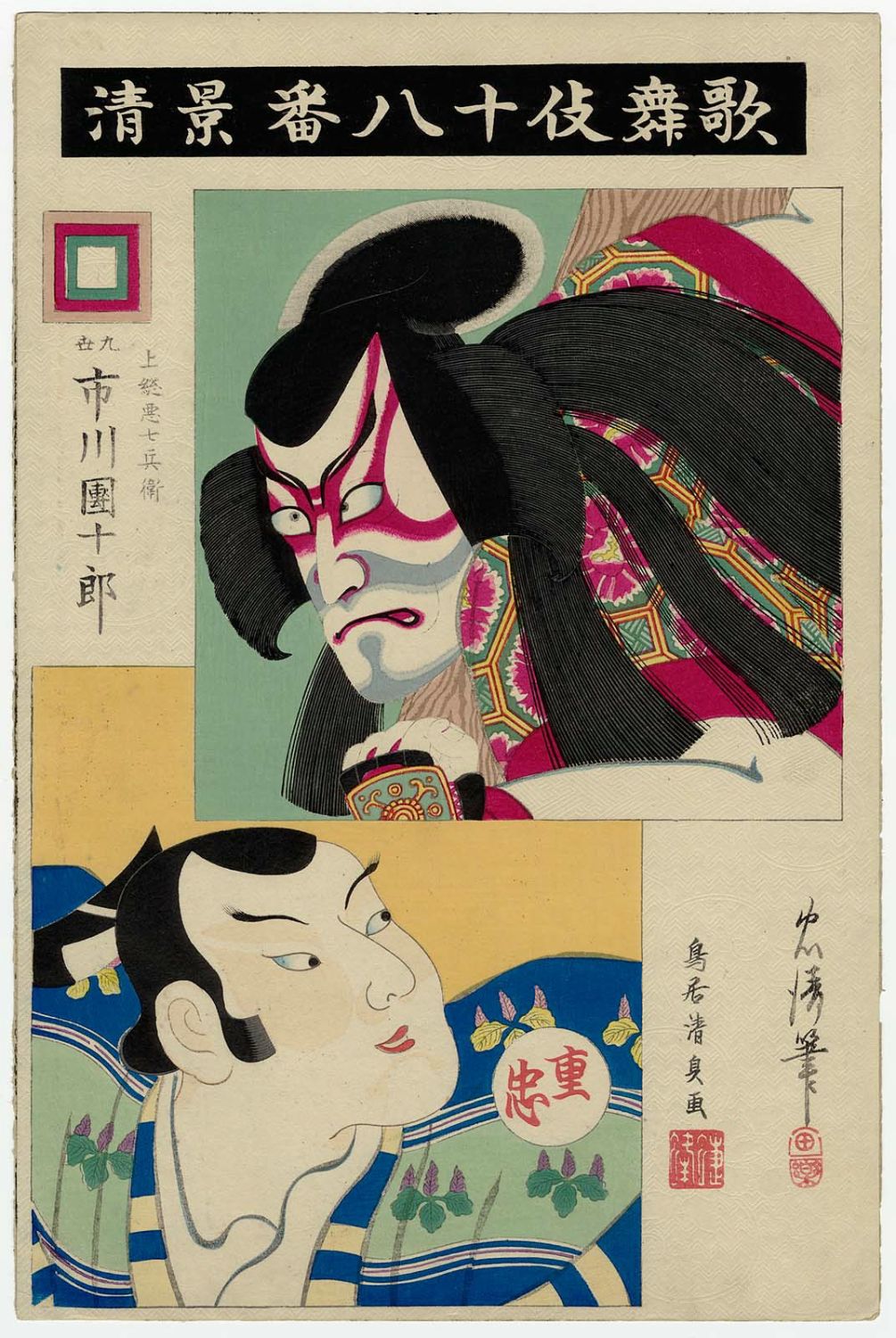
Actor Ichikawa Danjūrō IX as Kazusa Akushichibyōe in Kagekiyo, from the series The Eighteen Great Kabuki Plays (Kabuki Jūhachi-ban)
歌舞伎十八番 景清
1895
Woodblock print (nishiki-e); ink and color on paper
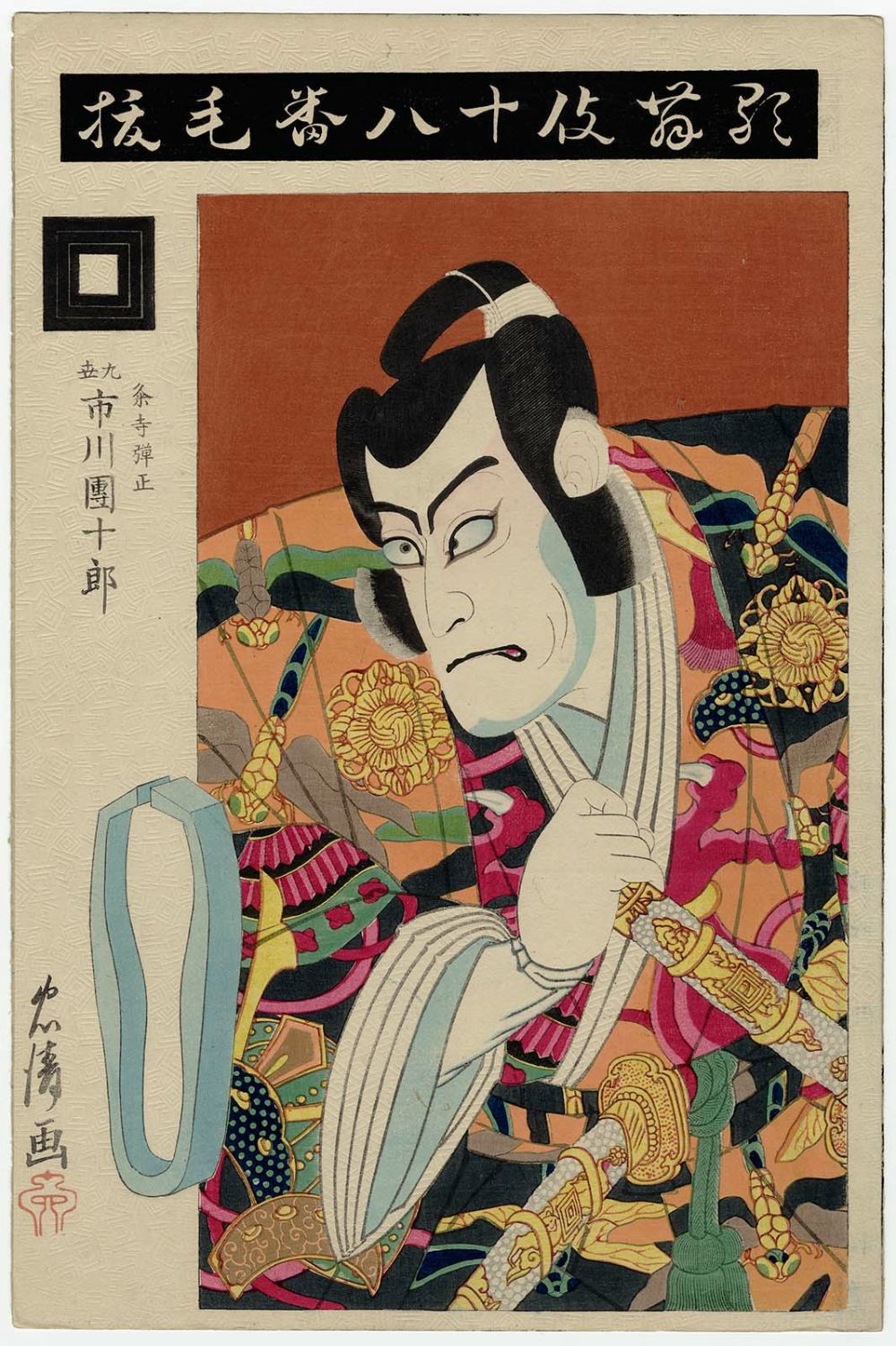
Actor Ichikawa Danjūrō IX as Kumedera Danjō in Kenuki, from the series The Eighteen Great Kabuki Plays (Kabuki Jūhachi-ban)
歌舞伎十八番 毛抜
1895
Woodblock print (nishiki-e); ink and color on paper
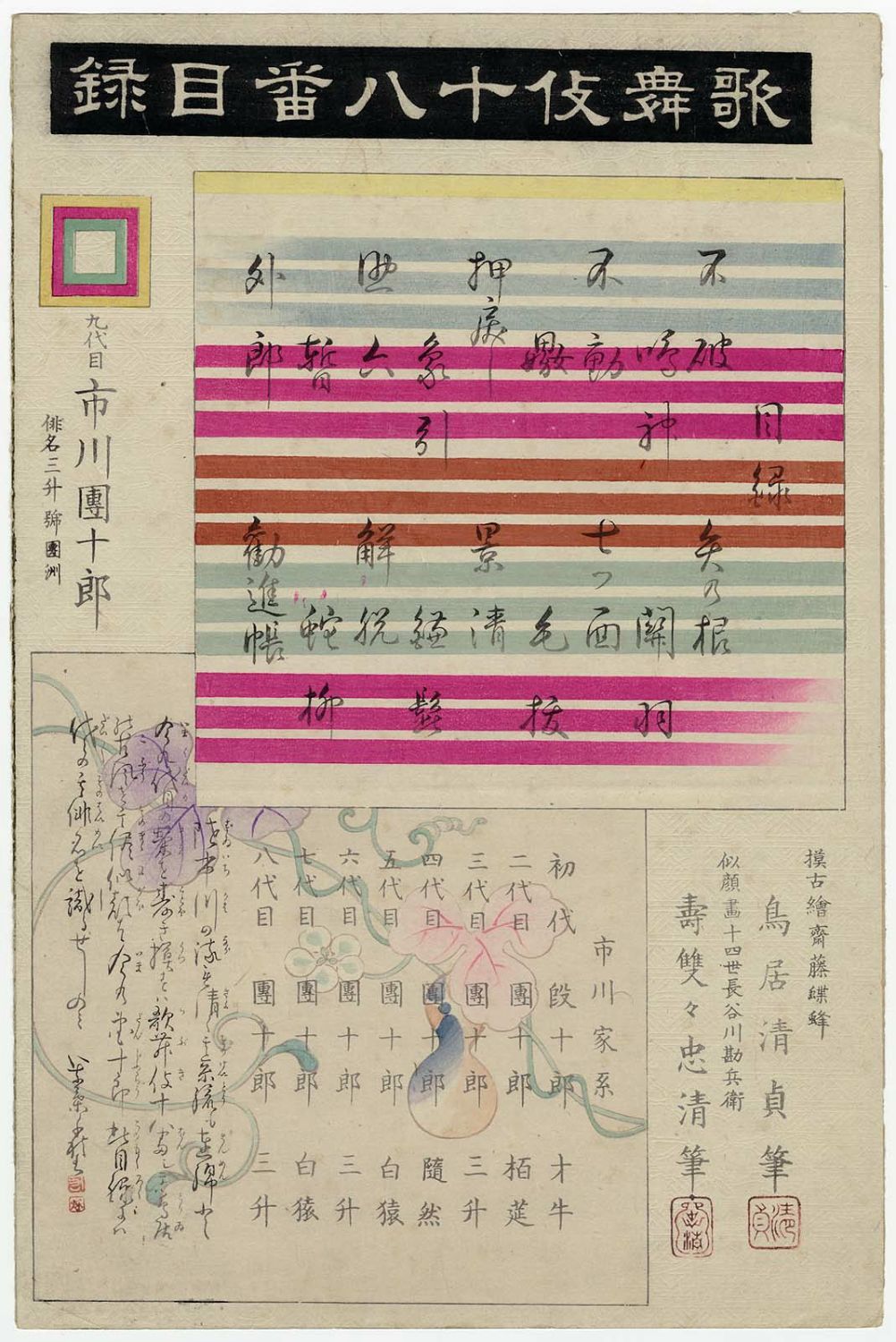
Title page (Mokuroku) for the series The Eighteen Great Kabuki Plays (Kabuki Jūhachi-ban)
歌舞伎十八番 目録
1895
Woodblock print (nishiki-e); ink and color on paper
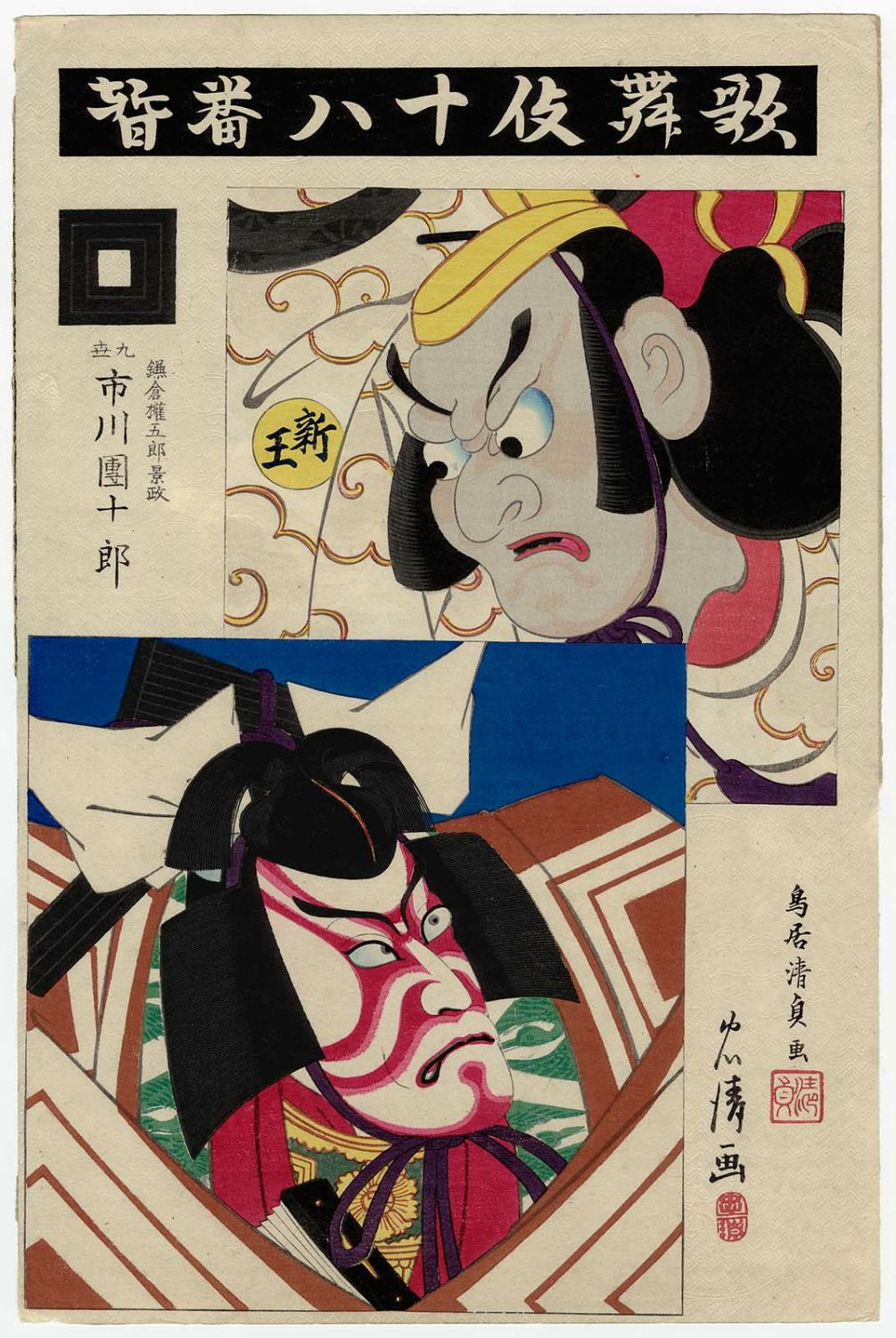
Actor Ichikawa Danjūrō IX as Kamakura Gongorō Kagemasa in Shibaraku, from the series The Eighteen Great Kabuki Plays (Kabuki Jūhachi-ban)
歌舞伎十八番 暫
1895
Woodblock print (nishiki-e); ink and color on paper

Actor Ichikawa Danjūrō IX as Sōma Masakado in Kamahige, from the series The Eighteen Great Kabuki Plays (Kabuki Jūhachi-ban)
歌舞伎十八番 鎌髭
1895
Woodblock print (nishiki-e); ink and color on paper

Actor Ichikawa Danjūrō IX as Suhama Sōzu in Jayanagi, from the series The Eighteen Great Kabuki Plays (Kabuki Jūhachi-ban)
歌舞伎十八番 蛇柳
1896
Woodblock print (nishiki-e); ink and color on paper
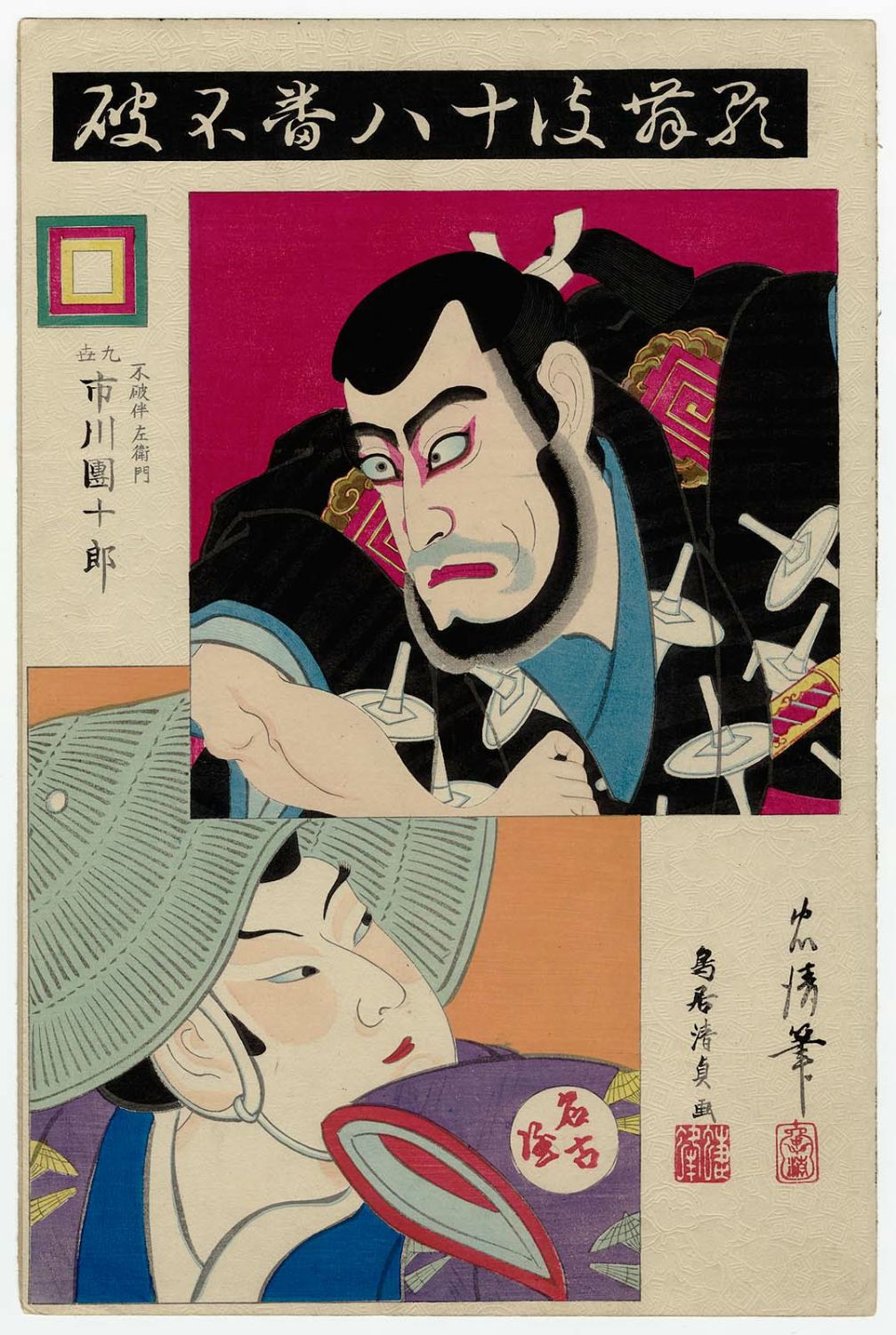
Actor Ichikawa Danjūrō IX as Fuwa Banzaemon in Fuwa, from the series The Eighteen Great Kabuki Plays (Kabuki Jūhachi-ban)
歌舞伎十八番 不破
1896
Woodblock print (nishiki-e); ink and color on paper
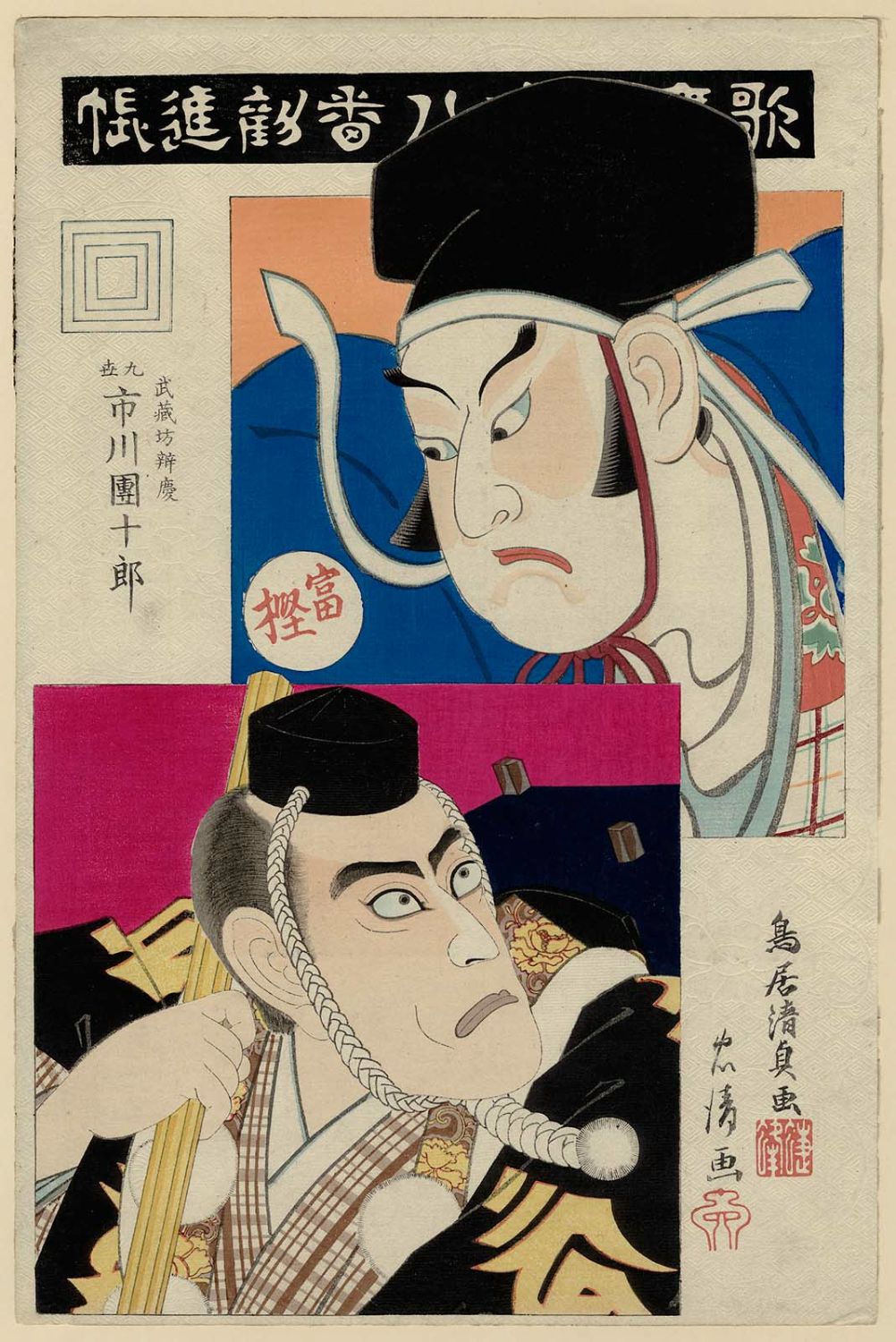
Actor Ichikawa Danjūrō IX as Musashibō Benkei in Kanjinchō, from the series The Eighteen Great Kabuki Plays (Kabuki Jūhachi-ban)
歌舞伎十八番 勧進帳
1896
Woodblock print (nishiki-e); ink and color on paper
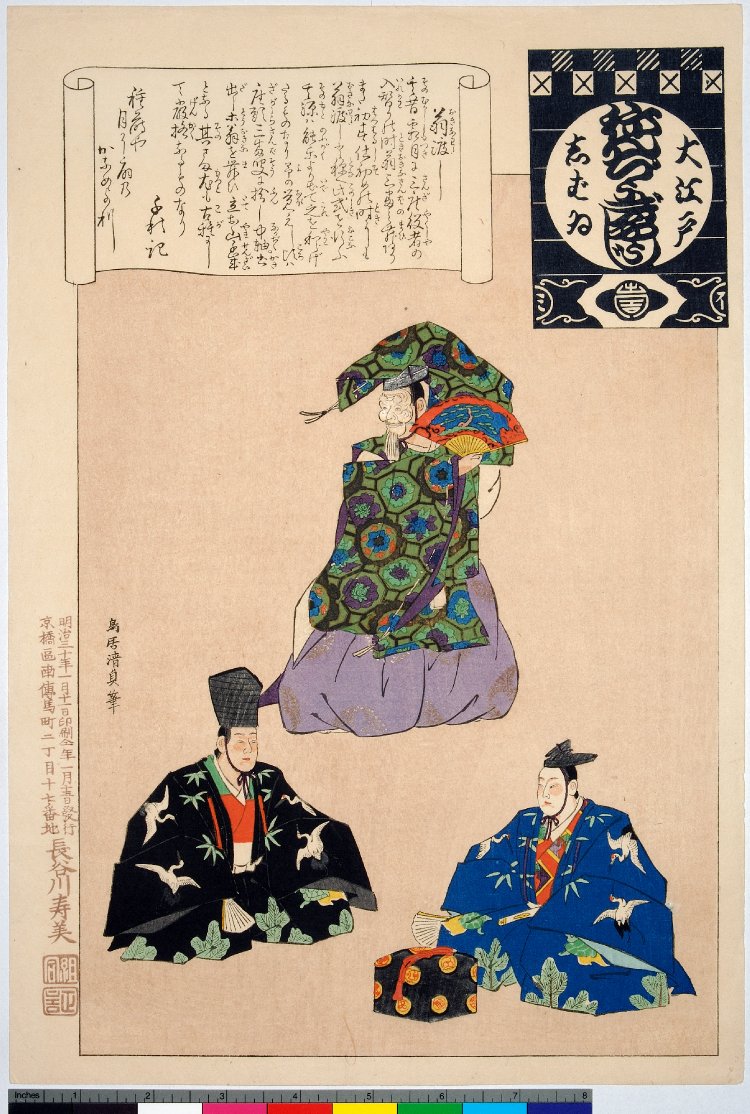
Okina-watashi, from the series Annual Events of the Theater in Edo (Ōedo shibai nenjū-gyōji)
大江戸しばゐねんぢうぎやうじ 翁渡し
1897
Woodblock print (nishiki-e); ink and color on paper
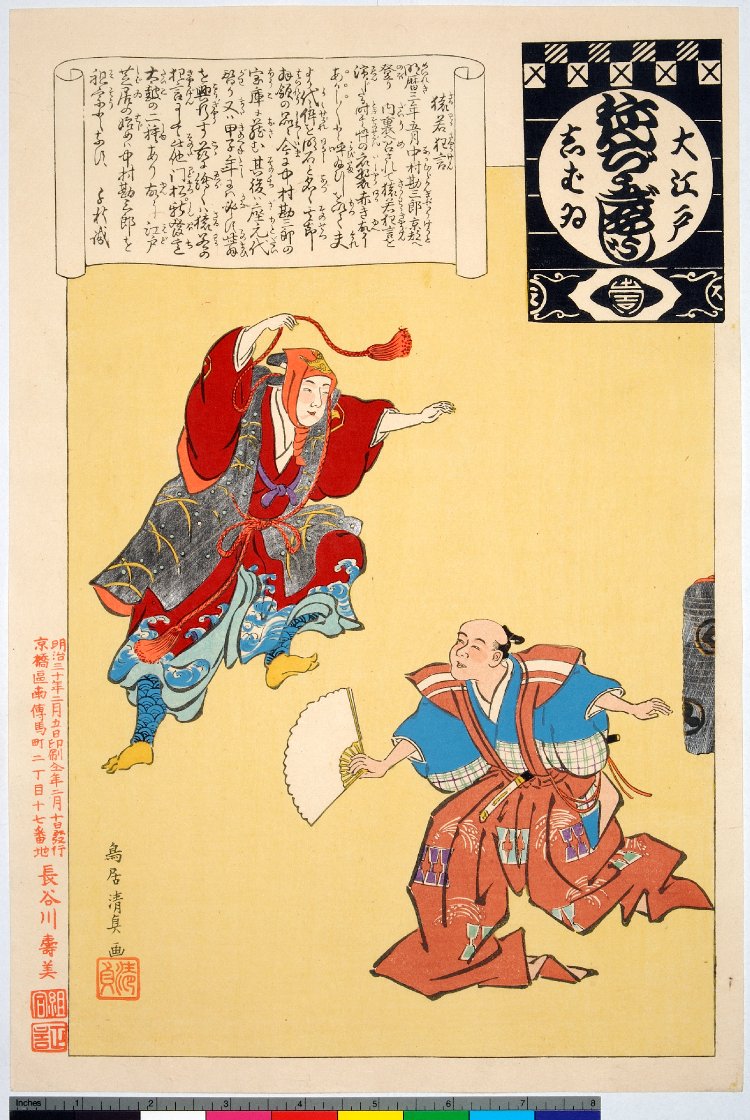
Saruwaka Kyōgen, from the series Annual Events of the Theater in Edo (Ōedo shibai nenjū-gyōji)
大江戸しばゐねんぢうぎやうじ 猿若狂言
1897
Woodblock print (nishiki-e); ink and color on paper