Biography
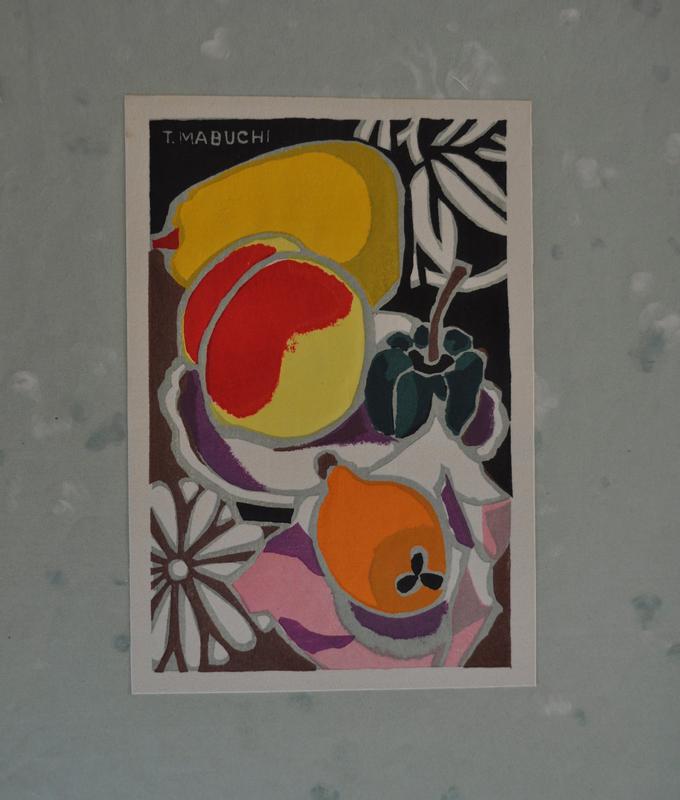
Toru Mabuchi (馬渕徹, 1920–1994) was a sosaku-hanga printmaker who built a contemplative body of work centered on the Japanese landscape, rendered in a style that merged folk-art warmth with modernist abstraction. Born in 1920, he came of age during the prewar flowering of the creative-print movement and committed himself to the sosaku-hanga principle of designing, carving, and printing his own work.
Mabuchi's prints characteristically depicted rural and semi-rural scenes — rice paddies under gray skies, clusters of farmhouses, temple roofs above treelines, and harbors with small fishing boats. His compositions tended toward simplified, almost geometric arrangements of natural forms, with broad areas of flat color separated by strong carved outlines. The palette leaned toward earth tones, muted greens, and soft blues, punctuated by occasional passages of vermillion or deep indigo. This restrained color sense, combined with the visible texture of the woodblock grain, gave his prints a tactile quietness that distinguished them from the more vivid or expressionistic work of some sosaku-hanga contemporaries.
He exhibited regularly with the Nihon Hanga Kyokai and participated in print exhibitions both domestically and abroad during the decades when Japanese creative prints were gaining international recognition. While he never attained the global celebrity of a Munakata or a Saito, his work represented the steady, dedicated practice that formed the backbone of the sosaku-hanga movement — artists for whom printmaking was not a career strategy but a daily discipline pursued over a lifetime.
Mabuchi continued printing through the 1980s and died in 1994 at the age of seventy-four. His prints appear in specialist galleries and auctions devoted to postwar Japanese printmaking.
Key Facts
- Active Period
- 1920–1994
- Nationality
- 🇯🇵Japan
- Movement
- Sōsaku-hanga
Frequently Asked Questions
Toru Mabuchi (馬渕徹, 1920–1994) was a sosaku-hanga printmaker who built a contemplative body of work centered on the Japanese landscape, rendered in a style that merged folk-art warmth with modernist abstraction. Born in 1920, he came of age during the prewar flowering of the creative-print movement and committed himself to the sosaku-hanga principle of designing, carving, and printing his own work.
Toru Mabuchi was active from 1920 to 1994. They were associated with the Sōsaku-hanga movement.
Toru Mabuchi's work was shaped by the Sōsaku-hanga tradition in Japanese woodblock printmaking. Sōsaku-hanga: ## What is sōsaku-hanga? Sōsaku-hanga (創作版画, "creative prints") was a twentieth-century Japanese print movement defined by a single commitment: the artist must design, carve, and print every work alone.
Toru Mabuchi's prints frequently feature still life, birds & flowers, spring, autumn foliage, fish, food & drink.
Original prints by Toru Mabuchi can be found in collections including ukiyo-e.org, Ohmi Gallery, Art Gallery of Greater Victoria, wbp.
Toru Mabuchi is an established printmaker with a significant body of work. As a deceased artist, the finite supply supports steady pricing. Prices range from $200 for smaller works to $8,000 for major compositions. Most prints sell in the $720–$3000 range. The sosaku-hanga market has been strengthening as collectors appreciate the artistic integrity of self-created prints. Condition and impression quality are important factors.


