Biography
Toyohara Chikayoshi (豊原周美) was a Meiji-era woodblock print designer active in Tokyo during the 1870s and 1880s, and the one female pupil of Toyohara Kunichika (1835–1900), a leading actor-print designer of the early Meiji period. According to the accounts that survive, she also became Kunichika's partner in his later years. Her prints, signed Chikayoshi or Toyohara Chikayoshi, place her within the late Utagawa school lineage that dominated commercial print publishing in the new capital after the Meiji Restoration, and her output centers on the two genres that defined her teacher's market: yakusha-e (kabuki actor prints) and fūzoku-ga (scenes of contemporary customs and manners), worked competently and fluidly in the Utagawa idiom.
Biographical details for Chikayoshi remain sparse. Her birth and death dates have not been recovered, and she is largely absent from the standard reference literature on Meiji print designers. What is known of her is reconstructed from the small body of signed prints that survive in public and private collections, which include kabuki actor subjects and a Kanadehon Chūshingura design. Together these works document a designer who moved between the actor and beauty genres and worked in the period when experimentation with red and aniline pigments was reshaping the visual register of Meiji prints.
Chikayoshi's place in the Utagawa school must be understood against the unusual position women occupied within commercial print publishing in nineteenth-century Japan. Female designers were exceedingly rare in the Edo period — Katsushika Ōi, the daughter of Hokusai, is the principal celebrated exception — and remained scarce through the Meiji era despite the general expansion of women's roles in education, illustration, and the professions. Within the late Utagawa lineage, the handful of female pupils whose names are recorded has until recently received only marginal scholarly attention. The renewed interest in Meiji-period women artists, driven both by feminist art history and by the broader reassessment of the Utagawa school as a collective workshop tradition, has begun to recover their work, and Chikayoshi's prints are now occasionally cited as examples of the school's accommodation of women practitioners.
Stylistically, Chikayoshi's signed prints follow the late Kunichika idiom with considerable fidelity: dense compositions filled with named kabuki figures or fashionable contemporary women, strong outlines in a heavy black keyblock, and the saturated reds and purples characteristic of the 1870s Meiji palette, in the multi-sheet formats that Tokyo publishers favored for theatrical and seasonal subjects.
Chikayoshi must be distinguished carefully from Toyohara Chikanobu (1838–1912), the far more prolific Meiji designer who used a closely related name. The two share the Toyohara surname and the kanji 周 (chika) in their art names but were not the same person: Chikanobu was a male designer trained in the Utagawa school who produced thousands of triptychs of court ladies and historical subjects that fill museum collections worldwide, whereas Chikayoshi was a far more limited presence whose small body of work remained tied to the Kunichika studio. The recovery of her name and a coherent group of designs is one of the modest gains of recent Meiji-period print scholarship, and her prints are now increasingly catalogued under her own name rather than absorbed into the broader Kunichika or Chikanobu corpora as had once been common.
No definitive death date for Chikayoshi has been established. Her latest documented prints date to the mid-1880s, after which her name disappears from the publishing record, and the standard assumption among current cataloguers is that she ceased active design work around the end of the decade. What survives is a small but distinctive body of work that documents an unusual presence in the late Utagawa school and offers one of the few specific footholds for studying women's participation in commercial woodblock print design during the high Meiji period.
Key Facts
- Nationality
- 🇯🇵Japan
- Movements
- Meiji/Taishō PrintsUkiyo-e
- Subjects
- MoonlightSpringBirds & Flowers
- Works Indexed
- 6
Frequently Asked Questions
Toyohara Chikayoshi (豊原周美) was a Meiji-era woodblock print designer active in Tokyo during the 1870s and 1880s, and the one female pupil of Toyohara Kunichika (1835–1900), a leading actor-print designer of the early Meiji period. According to the accounts that survive, she also became Kunichika's partner in his later years. Her prints, signed Chikayoshi or Toyohara Chikayoshi, place her within the late Utagawa school lineage that dominated commercial print publishing in the new capital after the Meiji Restoration, and her output centers on the two genres that defined her teacher's market: yakusha-e (kabuki actor prints) and fūzoku-ga (scenes of contemporary customs and manners), worked competently and fluidly in the Utagawa idiom.
Toyohara Chikayoshi's work was shaped by the Meiji/Taishō Prints and Ukiyo-e traditions in Japanese woodblock printmaking. Meiji/Taishō Prints: Meiji and Taishō era prints (1868–1926) bridge the transition from traditional ukiyo-e to the modern shin-hanga and sosaku-hanga movements. Ukiyo-e: ## What is ukiyo-e? Ukiyo-e ([浮世絵](/glossary/ukiyo-e)) — literally "pictures of the floating world" — is the Edo-period Japanese print and painting tradition that flourished from roughly 1660 to 1868, depicting the pleasures of urban life in Edo (modern Tokyo): courtesans, kabuki actors, sumo wrestlers, famous landscapes, and seasonal beauties.
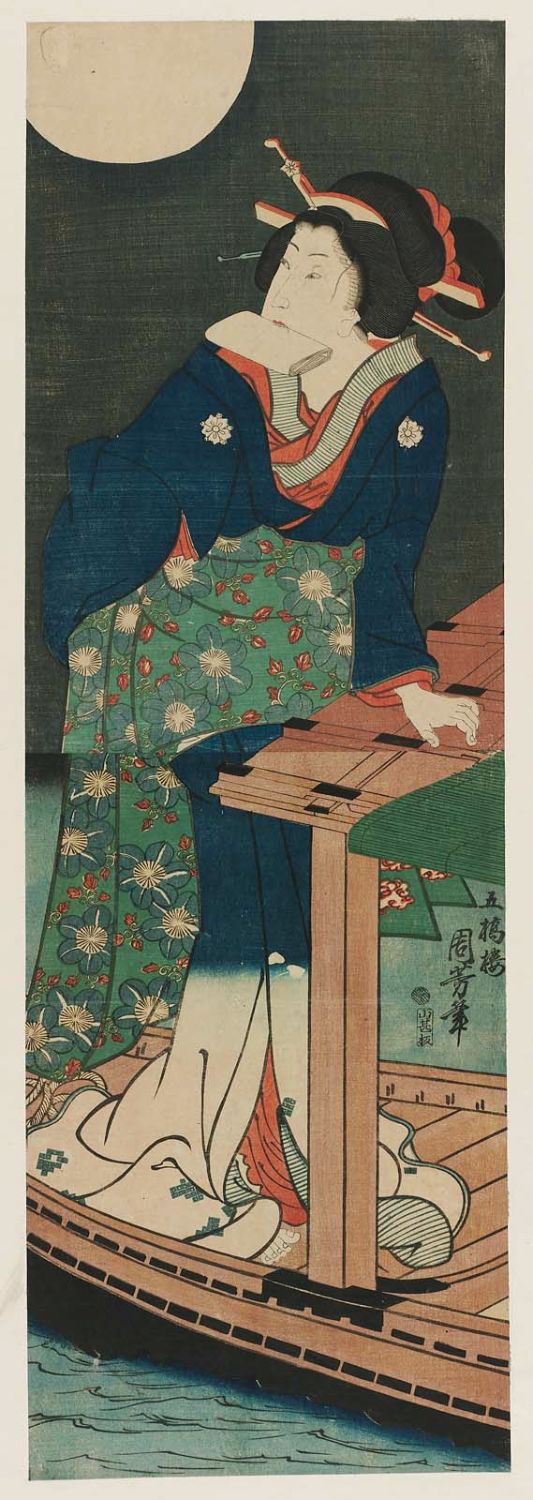
Toyohara Chikayoshi's prints frequently feature moonlight, spring, birds & flowers.
Original prints by Toyohara Chikayoshi can be found in collections including Edo-Tokyo Museum, Japanese Art Open Database, Museum of Fine Arts, Boston.
Woodblock Prints by Toyohara Chikayoshi (6)
Woman in Boat under Full Moon
1871
Color woodblock print
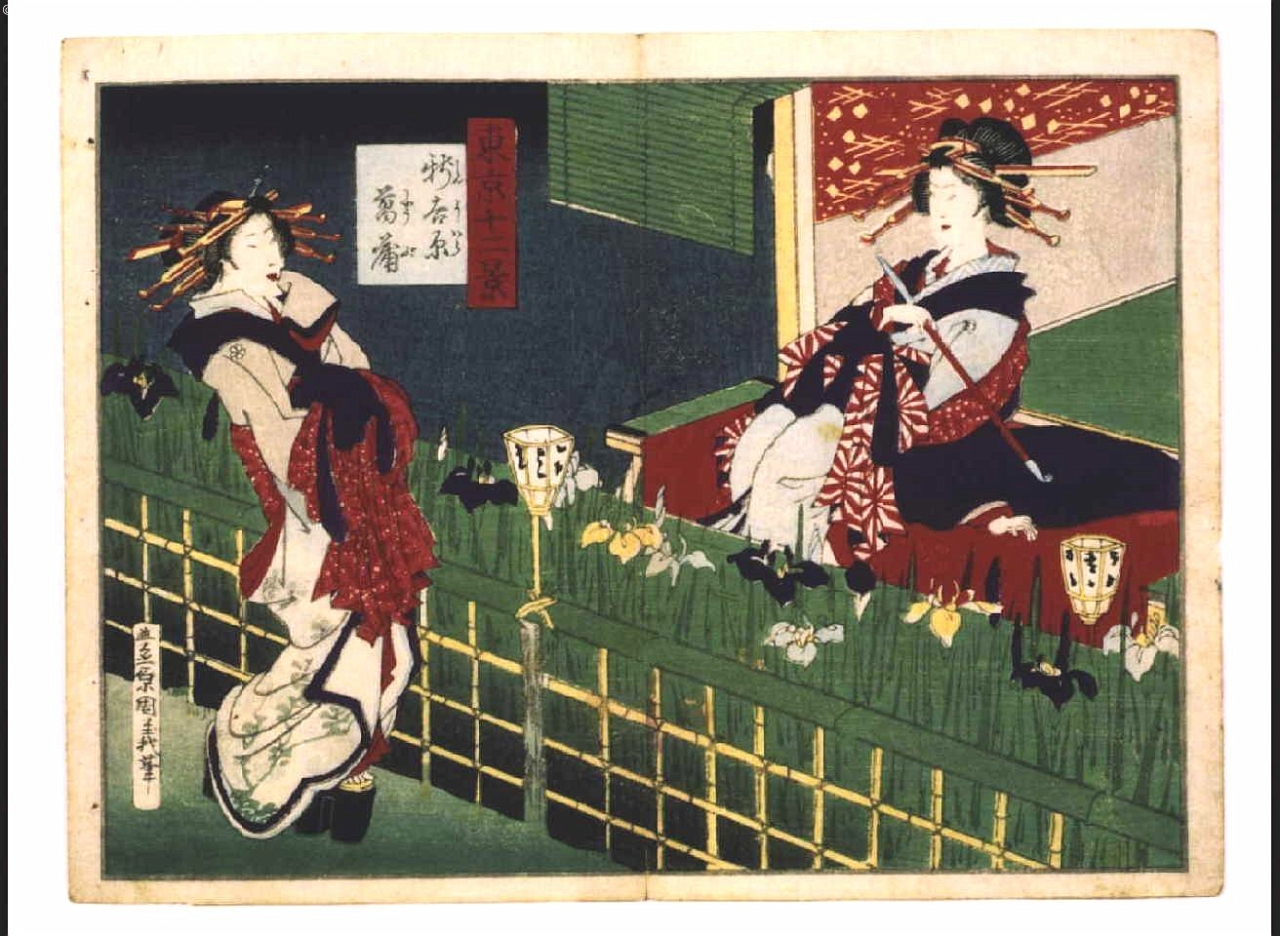
Twelve Views of Tokyo: Iris Field, Shin-Yoshiwara Licensed Quarter
東京十二景 新吉原遊郭 菖蒲園
early 1880s
Color woodblock print; oban triptych
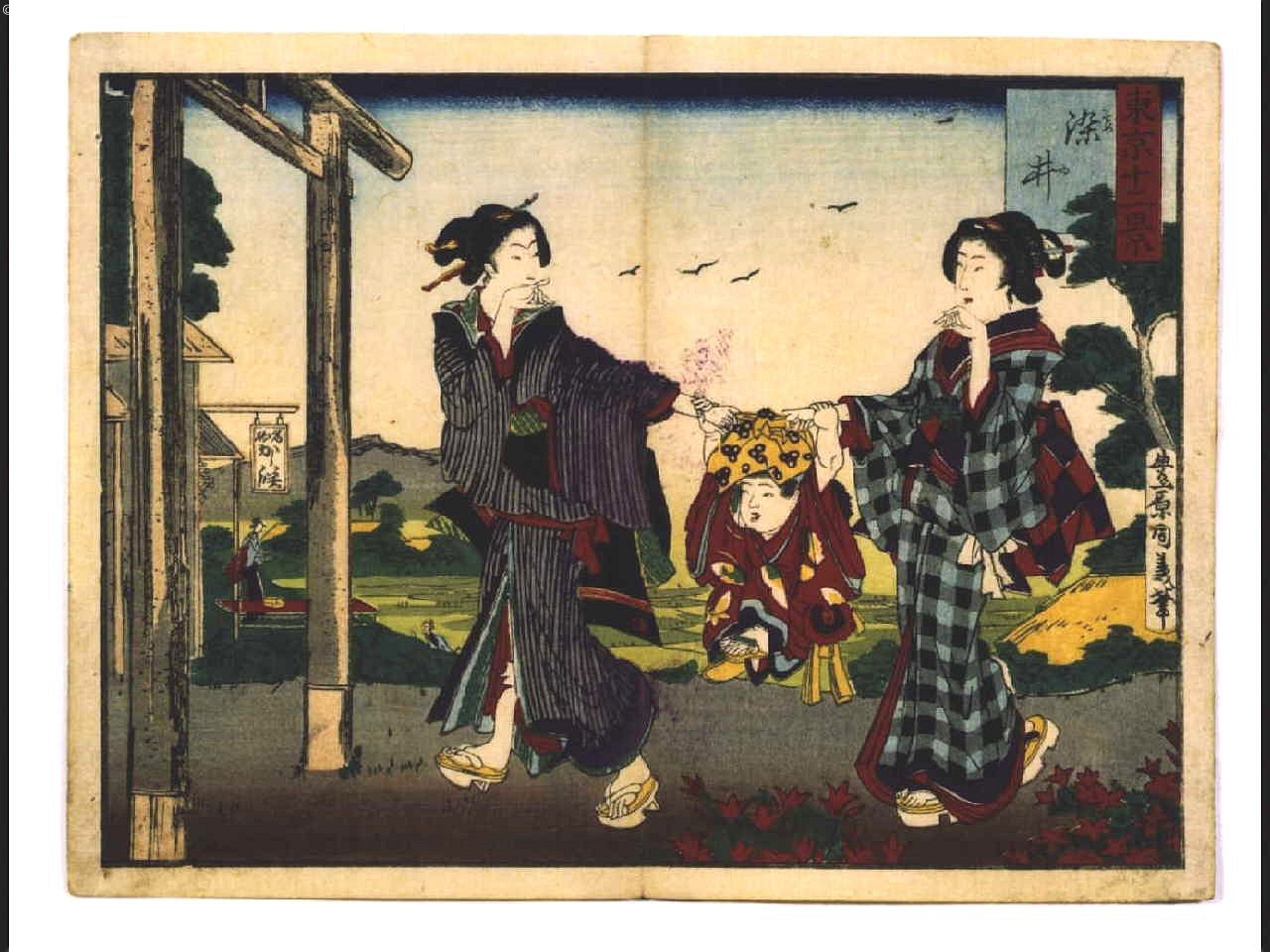
Twelve Views of Tokyo: Somei
東京十二景 染井
early 1880s
Color woodblock print; oban triptych
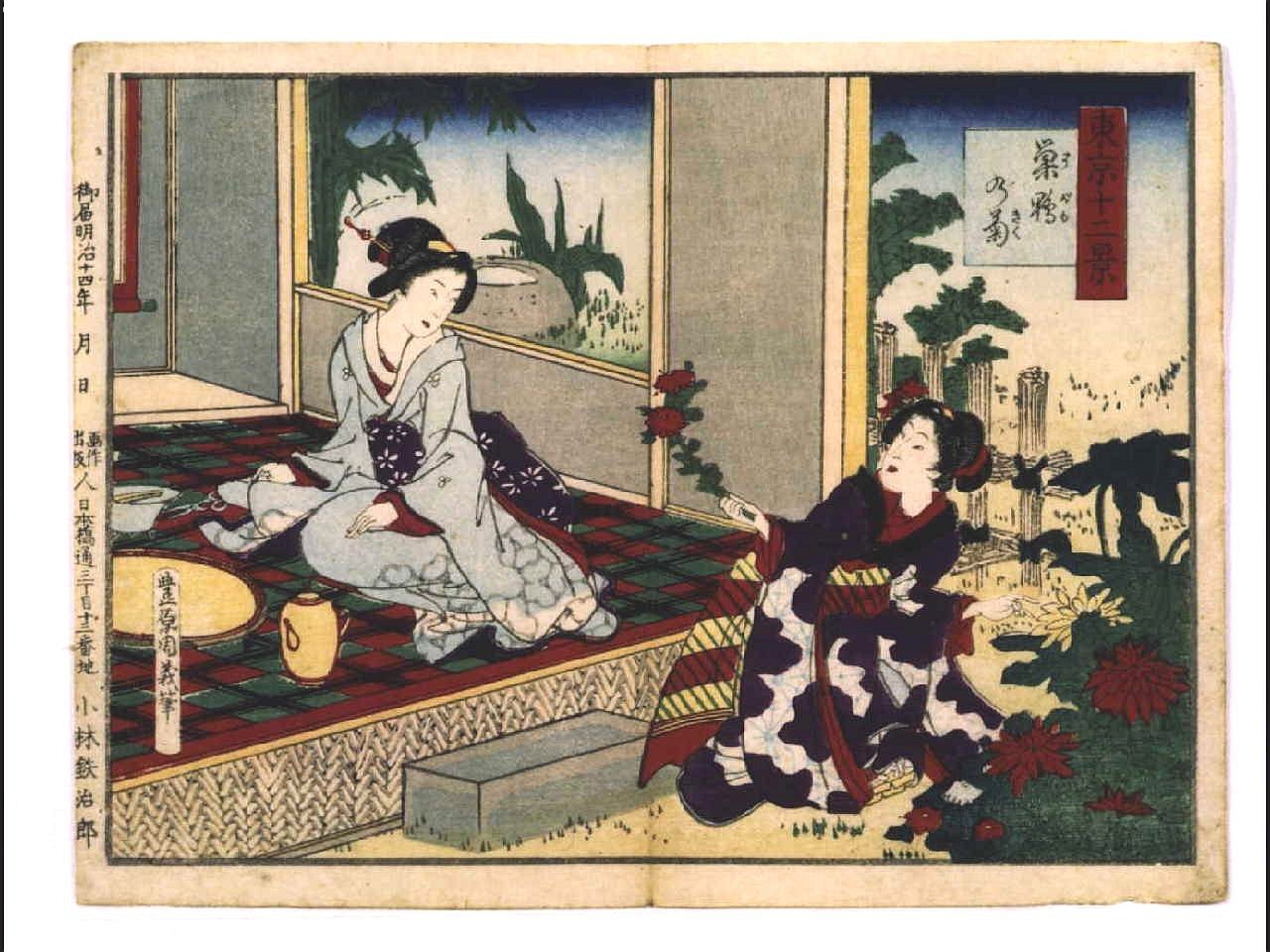
Twelve Views of Tokyo: Chrysanthemums at Sugamo
東京十二景 巣鴨の菊
early 1880s
Color woodblock print; oban triptych
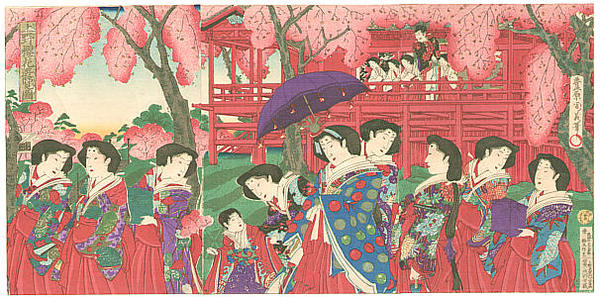
Viewing Cherry Blossoms in Ueno Park
上野桜遊覧之図
early 1880s
Color woodblock print; oban triptych; published by Asano Eizo
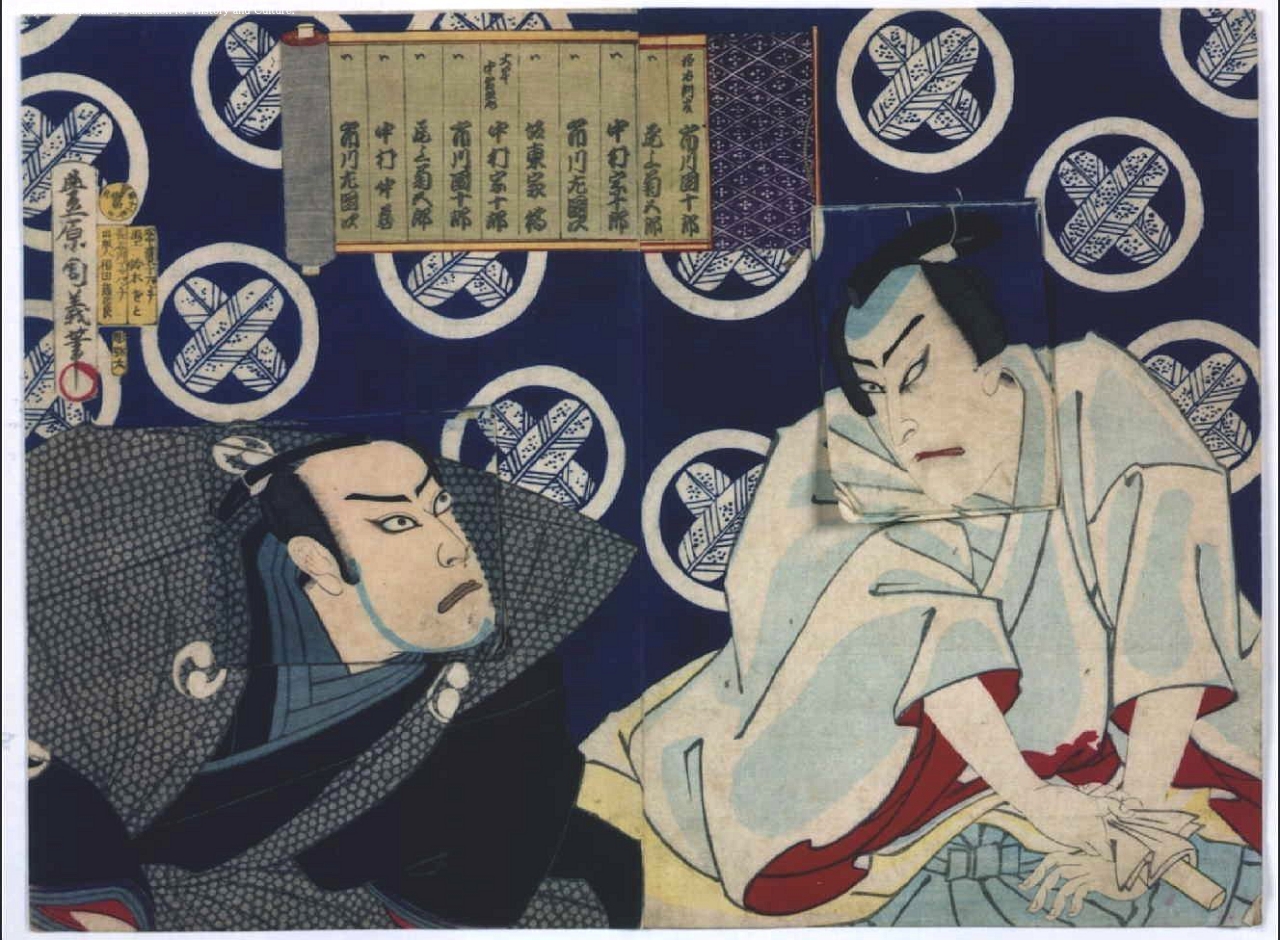
Chushingura
忠臣蔵
1880s
Color woodblock print; oban triptych