
Biography
Utagawa Hiroshige II (二代目歌川広重, 1826-1869), born Suzuki Chinpei (鈴木鎮平), was the chief pupil and successor of Utagawa Hiroshige I. He inherited his master's name in 1858, sustained the meisho-e (famous-views) landscape genre through the closing years of the Tokugawa shogunate and the first years of the Meiji Restoration, and produced — under three successive names (Shigenobu, Hiroshige II, and Risshō) — a body of landscape, Yokohama-e, and Edo views that occupies an unusually difficult attributional space between two of the most heavily collected names in nineteenth-century Japanese printmaking.
Born in Edo in 1826, Chinpei entered the studio of Andō Hiroshige (1797-1858) in the 1840s and received the artist name Shigenobu (重宣), drawn by long Utagawa convention from his master's own gō. Working in the Hiroshige studio he produced landscapes, fan prints, surimono, and book illustrations through the 1850s, closely modeled on his master's idiom of long horizontal vistas, gradated bokashi skies, and quietly populated road and harbor scenes. By the mid-1850s he was working closely alongside his master, a relationship that complicates the attribution of a number of late Hiroshige I-signed prints — including designs from the celebrated One Hundred Famous Views of Edo (Meisho Edo hyakkei, 1856-1859), a series brought to completion only after the master's death in the ninth month of 1858.
When Hiroshige I died in the cholera epidemic of 1858, Shigenobu married his master's daughter Otatsu (お辰) and was permitted to succeed to his gō, becoming Utagawa Hiroshige II. The new Hiroshige signed prints with the master's name, used the toshidama (jewel-of-the-year) cartouche of the Utagawa school, and inherited Hiroshige I's relationships with major Edo publishers. His most consequential project under the new name was Shokoku meisho hyakkei (諸国名所百景, One Hundred Famous Views of the Provinces), issued in 1859-1861 by the publisher Uoya Eikichi — the same house that had published the One Hundred Famous Views of Edo. The series surveyed celebrated sites across the Japanese provinces, from the harbor of Nagasaki to the cool of the Shijō riverbank in Kyoto, in the tall, narrow ōban tate-e format that Hiroshige I had used so effectively in his Edo views. Hiroshige II's compositions are characteristically vertical, dominated by a single dramatic motif — a bridge, a waterfall, a wave, a temple gate — thrust into the foreground while the famous view spreads behind.
The second Hiroshige's career was also shaped by the new pressures of the Bakumatsu years. After the opening of Yokohama in 1859, he became a prominent designer of Yokohama-e — the genre depicting the foreign settlement and its American, British, French, Dutch, and Russian inhabitants — producing ambitious triptychs such as his views of the Gankirō tea house in Yokohama (Yokohama Gankirō no zu) and A Picture of Prosperity: America (Amerika shin no zu, 1861), which place the new mercantile city and an imagined America in the visual language of Edo meisho-e. His Yokohama-e are among the founding documents of a brief but historically vital genre that registered, in print form, the political and commercial transformation of late Tokugawa Japan.
The domestic side of his career broke apart in 1865. Hiroshige II and Otatsu divorced, and the second Hiroshige left Edo for Yokohama. There he relinquished the inherited Hiroshige gō, took the studio name Kisai Risshō (喜斎立祥) — often shortened to Risshō (立祥) — and continued as a designer of prints and commercial work for the Yokohama export trade. The Hiroshige name itself passed to a third generation: Hiroshige I's other pupil Shigemasa took it as Hiroshige III and in his turn married Otatsu. Risshō died in 1869, leaving a body of late work signed with his new gō that includes bird-and-flower and landscape designs.
Attribution of Hiroshige II's work has become one of the central technical problems of Japanese print scholarship. Because he signed as Shigenobu before 1858, as Hiroshige between 1858 and 1865, and as Risshō from 1865 onward, and because he had worked so closely with his master in the years before the succession, a substantial group of prints once catalogued simply as 'Hiroshige' is now assigned to him: the Shokoku meisho hyakkei series, much of his Yokohama-e, and a number of unsigned or ambiguously signed landscapes from the late 1850s. His work is held by the Metropolitan Museum, the Art Institute of Chicago, the Cleveland Museum of Art, the Museum of Fine Arts, Boston, the British Museum, and the Honolulu Museum of Art.
Key Facts
- Active Period
- 1826–1869
- Nationality
- 🇯🇵Japan
- Movement
- Ukiyo-e
- Works Indexed
- 6
Frequently Asked Questions
Utagawa Hiroshige II (二代目歌川広重, 1826-1869), born Suzuki Chinpei (鈴木鎮平), was the chief pupil and successor of Utagawa Hiroshige I. He inherited his master's name in 1858, sustained the meisho-e (famous-views) landscape genre through the closing years of the Tokugawa shogunate and the first years of the Meiji Restoration, and produced — under three successive names (Shigenobu, Hiroshige II, and Risshō) — a body of landscape, Yokohama-e, and Edo views that occupies an unusually difficult attributional space between two of the most heavily collected names in nineteenth-century Japanese printmaking.
Utagawa Hiroshige II was active from 1826 to 1869. They were associated with the Ukiyo-e movement.
Utagawa Hiroshige II's work was shaped by the Ukiyo-e tradition in Japanese woodblock printmaking. Ukiyo-e: ## What is ukiyo-e? Ukiyo-e ([浮世絵](/glossary/ukiyo-e)) — literally "pictures of the floating world" — is the Edo-period Japanese print and painting tradition that flourished from roughly 1660 to 1868, depicting the pleasures of urban life in Edo (modern Tokyo): courtesans, kabuki actors, sumo wrestlers, famous landscapes, and seasonal beauties.
Utagawa Hiroshige II's prints frequently feature landscapes, famous places (meisho-e), bridges.
Original prints by Utagawa Hiroshige II can be found in collections including Art Institute of Chicago, Cleveland Museum of Art.
Series by Utagawa Hiroshige II
Woodblock Prints by Utagawa Hiroshige II (6)

Hase Temple, Yamato Province (Yamato Hasedera), from the series One Hundred Famous Views in the Various Provinces (Shokoku meisho hyakkei)
諸国名所百景 大和初瀬寺
1859
Color woodblock print

Tsūten-kyō Bridge, Tōfuku Temple, Kyoto (Kyōto Tōfukuji Tsūtenkyō bashi), from the series One Hundred Famous Views in the Various Provinces (Shokoku meisho hyakkei)
諸国名所百景 京都東福寺通天橋
1859
Color woodblock print

Mount Yoshino, Yamato Province (Yamato Yoshinoyama), from the series One Hundred Famous Views in the Various Provinces (Shokoku meisho hyakkei)
諸国名所百景 大和吉野山
1859
Color woodblock print

The Interior of the Gankirō in Yokohama (Yokohama Gankirō mikomi no zu)
横浜岩亀楼見込之図
1860
Color woodblock print; ōban triptych
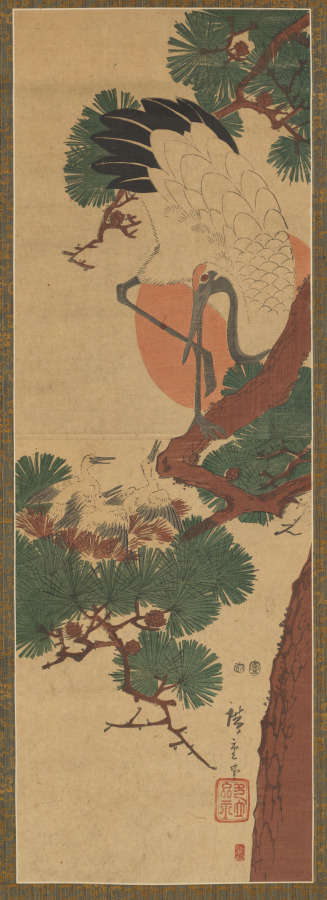
Stork, Sun, and Pine
鶴日松図
c. 1839–1864
Color woodblock print

A Picture of Prosperity: America (Amerika shin no zu)
亜墨利加州の図
1861
Color woodblock print; ōban triptych