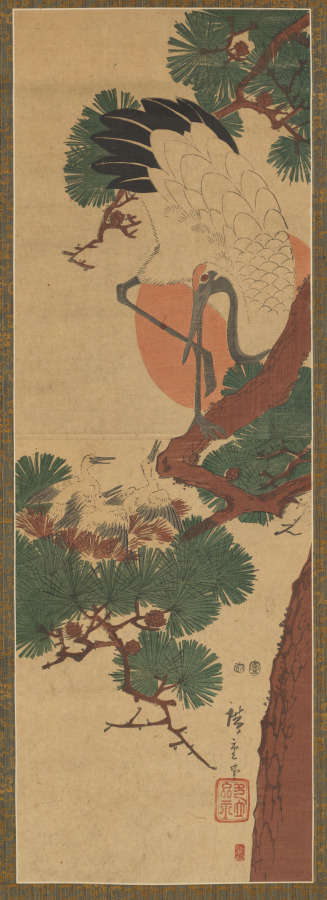
Stork, Sun, and Pine
鶴日松図
- Date:
- c. 1839–1864
- Medium:
- Color woodblock print
- Source:
- Cleveland Museum of Art
Description
Stork, Sun, and Pine is a vertical color woodblock print by Utagawa Hiroshige II, dated to the early Bunkyū or Genji era and held by the Cleveland Museum of Art (accession 1920.275). The composition combines three of the most powerful auspicious motifs in East Asian visual culture: the crane or stork (tsuru), an emblem of longevity associated with the Daoist immortals; the rising or setting sun (hi), an emblem of imperial authority and renewal; and the old pine (matsu), an emblem of endurance and marital fidelity celebrated in the Noh play Takasago and in the kachō-e tradition. The grouping was a standard subject for New Year and birthday compositions throughout the Edo period and was particularly favored in kakemono-e — vertical prints intended to be hung in the same way as a hanging-scroll painting. Hiroshige II's design uses the long vertical sheet to set the white silhouette of the stork against the red disc of the sun, with the pine branch arching across the upper register. The Cleveland impression is one of the substantial holdings of Hiroshige II prints in American institutions, given by Ralph King in 1920 and now available under a CC0 open-access license.
More Prints by Utagawa Hiroshige II

Hase Temple, Yamato Province (Yamato Hasedera), from the series One Hundred Famous Views in the Various Provinces (Shokoku meisho hyakkei)
諸国名所百景 大和初瀬寺
1859
Color woodblock print

The Interior of the Gankirō in Yokohama (Yokohama Gankirō mikomi no zu)
横浜岩亀楼見込之図
1860
Color woodblock print; ōban triptych

Tsūten-kyō Bridge, Tōfuku Temple, Kyoto (Kyōto Tōfukuji Tsūtenkyō bashi), from the series One Hundred Famous Views in the Various Provinces (Shokoku meisho hyakkei)
諸国名所百景 京都東福寺通天橋
1859
Color woodblock print

A Picture of Prosperity: America (Amerika shin no zu)
亜墨利加州の図
1861
Color woodblock print; ōban triptych
More Landscapes Prints

Lake Kugushi in Wakasa Province (Wakasa Kugushiko), from the series Souvenirs of Travel I (Tabi miyage dai isshu)"
Wakasa Kugushiko
1920
Color woodblock print; oban
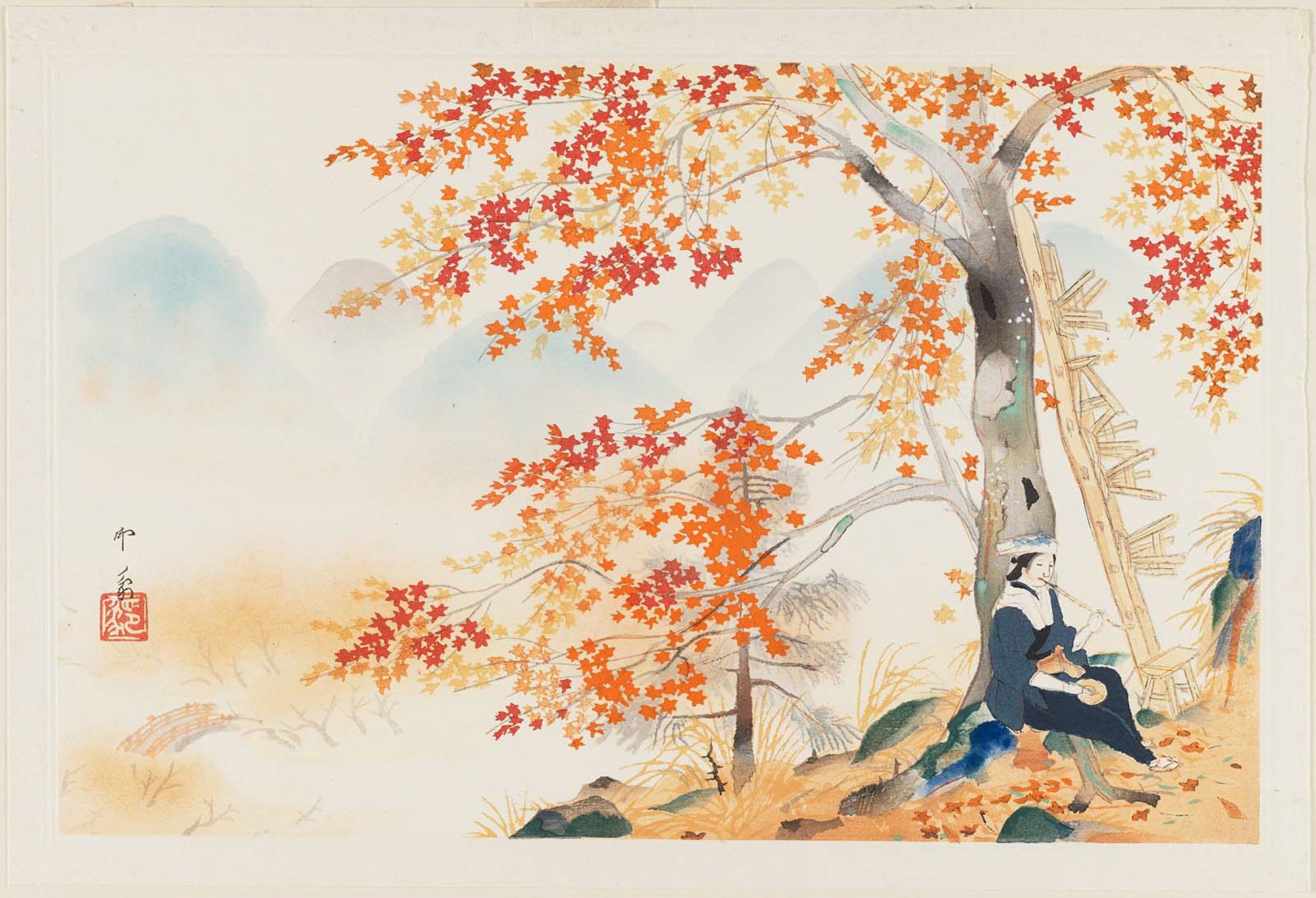
Autumn Maple Leaves at Takao, from the album Eight Views of Kyoto (Kyôto hakkei)
Woodblock print

The Beach at Kaiganji in Sanuki Province (Sanuki Kaiganji no hama), from the series "Collection of Views of Japan II, Kansai Edition (Nihon fukei shu II Kansai hen)"
1934
Color woodblock print; oban

Tea Kettle, section of a sheet from the series "Mirror of Stone Rubbings of Views of the Provinces" (Kohon meihitsu ishizuri kagami)
n.d.
Woodblock print; ishizuri-e, section of harimaze sheet
Featured in Collections
Curated cross-cuts that include this print.
Frequently Asked Questions
Stork, Sun, and Pine (鶴日松図) was created by Utagawa Hiroshige II (二代目歌川広重) in c. 1839–1864.
Stork, Sun, and Pine depicts landscapes.