
Utagawa Hiroshige
歌川広重
Also known as: Hiroshige, Ando Hiroshige, Ichiryusai, Utashige, 安藤広重
1797–1858
Biography
Utagawa Hiroshige (歌川広重), born Ando Tokutaro in 1797 in the Yaesu district of Edo (modern-day Tokyo), is widely regarded as the last great master of the ukiyo-e tradition and one of the most influential landscape artists in the history of Japanese art. Over a career spanning nearly four decades, Hiroshige transformed the woodblock print from a medium associated primarily with portraits of courtesans and kabuki actors into a vehicle for poetic, atmospheric depictions of the Japanese landscape. His work captured the changing seasons, the moods of weather, and the quiet rhythms of travel with a sensitivity that resonated deeply with his contemporaries and, decades later, with artists on the other side of the world.
Hiroshige was born into a family of minor samurai serving the Tokugawa shogunate. His father, Ando Gen'emon, held the hereditary post of fire warden responsible for the Yayosu Quay district of Edo, a modest but respectable position within the shogunate's firefighting apparatus. The fire wardens guarded their assigned districts from the conflagrations that periodically devastated the city — Edo, built overwhelmingly of wood and paper, was notoriously vulnerable to fire. Tragedy struck the family early: Hiroshige's mother died in early 1809, and his father followed later that same year, leaving the young boy orphaned. Hiroshige inherited his father's fire warden post, a duty that carried a small stipend but demanded relatively little of his time, affording him the freedom to pursue artistic training. He would retain this nominal position for years, eventually resigning it in the 1830s when his artistic career was firmly established.
Around 1811, at the age of thirteen or fourteen, Hiroshige sought entry to the studio of Utagawa Toyokuni, the most commercially successful ukiyo-e master of the era and head of the powerful Utagawa school. Toyokuni's studio was too full to accept new pupils, and the young Hiroshige was redirected to Toyokuni's colleague Utagawa Toyohiro, a respected artist known for his graceful depictions of beautiful women and gentle landscapes. It was under Toyohiro's tutelage that the young artist received the professional name Utagawa Hiroshige, marking his formal entry into the prestigious Utagawa lineage, the dominant artistic school of the late Edo period. He also worked under the art names Ichiyusai and, from around 1832, Ichiryusai. Scholars have speculated that had Hiroshige been accepted by Toyokuni, he might have spent his career producing the actor and beauty prints that were Toyokuni's stock in trade, and the great landscape tradition of Japanese printmaking might never have developed in the way it did.
Hiroshige's earliest published works, appearing in the late 1810s, followed the commercial conventions of the day. He produced bijin-ga (pictures of beautiful women), yakusha-e (portraits of kabuki actors), and illustrations for popular fiction. These early prints were competent but largely unremarkable, showing the influence of his teacher Toyohiro without yet displaying the distinctive sensibility that would emerge later. During this period, Hiroshige also experimented with bird-and-flower compositions (kacho-e), a genre in which he would demonstrate considerable skill throughout his career, bringing a delicate naturalism to his depictions of birds, insects, and plants that owed something to his study of the Shijo school of painting.
The turning point came in the early 1830s, likely spurred by the enormous success of Hokusai's Thirty-six Views of Mount Fuji, which demonstrated that landscape subjects could achieve tremendous commercial popularity. In 1832, Hiroshige traveled along the Tokaido, the great coastal road connecting Edo to Kyoto, having accepted an invitation to join an official procession to Kyoto — by tradition, one delivering horses as a shogunal gift to the imperial court. Whether or not the journey unfolded precisely as tradition holds, it provided the inspiration for the masterwork that would transform his career.
Published by Hoeido beginning in 1833, "The Fifty-three Stations of the Tokaido" (Tokaido Gojusan-tsugi) was an immediate and resounding success. The series of fifty-five prints — one for each of the fifty-three post stations plus the starting point of Nihonbashi in Edo and the terminus at Kyoto — presented the landscape not as a static backdrop but as a living, breathing environment shaped by weather, light, and season. Rain lashes travelers at Shono in one of the most celebrated depictions of rainfall in all of art; snow blankets the mountain pass at Kanbara in hushed, luminous silence; mist gathers at Numazu in the fading light of evening. Where Hokusai had approached landscape with bold geometry and an almost cosmic grandeur, Hiroshige brought intimacy, mood, and a deep empathy for the human figures who populate his scenes — the porters struggling up muddy hills, the pilgrims crossing bridges, the merchants resting at teahouses. The Hoeido Tokaido established Hiroshige as the foremost landscape artist in Japan and remained the benchmark against which all subsequent travel print series were measured.
Hiroshige's mastery of atmospheric effects owed much to his sophisticated use of printing techniques, particularly bokashi — the method of applying gradated color to the woodblock by hand to create smooth transitions from dark to light. His printers were among the most skilled in Edo, and Hiroshige designed his compositions to exploit their abilities. The technique called ichimonji bokashi, a straight-line gradation typically applied to the top of the image to represent sky, became a signature element of his work. He also made extensive use of Prussian blue (bero-ai), the imported synthetic pigment that offered a more vivid and lightfast blue than traditional Japanese dyes. The cool, luminous blues that pervade his landscape prints — evening skies, distant mountains, moonlit rivers — became inseparable from his artistic identity.
Emboldened by the success of the Hoeido Tokaido, Hiroshige embarked on an extraordinarily prolific period of production that lasted for the remaining quarter-century of his life. He created numerous additional Tokaido series for various publishers, each reimagining the famous route with different formats, perspectives, and moods. He also turned his attention to other celebrated routes: "The Sixty-nine Stations of the Kiso Kaido" (Kisokaido Rokujukyu-tsugi), a collaboration with Keisai Eisen begun around 1835, depicted the inland mountain route between Edo and Kyoto. Hiroshige eventually took over the project from Eisen, designing forty-six of the seventy prints and bringing the series to completion. "Famous Views of the Sixty-odd Provinces" (Rokujuyoshu Meisho Zue), published between 1853 and 1856, presented a famous view from each of Japan's historical provinces plus Edo, for a total of seventy prints in a striking vertical format — documenting a traditional provincial geography that would soon be swept away by the Meiji Restoration.
Throughout the 1830s, 1840s, and 1850s, Hiroshige produced landscapes of remarkable range and consistency. He depicted famous scenic spots (meisho), celebrated bridges, shrines, waterfalls, and seasonal festivals with unfailing freshness of observation. His bird-and-flower prints from this period are among the finest ever produced in the ukiyo-e tradition, combining delicate botanical accuracy with atmospheric poetry. These kacho-e designs, often issued in the narrow tanzaku or chuban formats, depicted egrets in snow, swallows over wisteria, cranes above breaking waves, and other subjects from the natural world with an economy of line and a sensitivity to seasonal mood that rivaled any specialist in the genre. Modern scholars estimate that he produced more than eight thousand individual prints and designs over the course of his career, making him one of the most prolific artists in the history of Japanese printmaking.
Hiroshige also produced notable work in other formats, including fan prints (uchiwa-e), surimono, illustrated books, and paintings on silk and paper. His illustrated books of famous places — including volumes on Kyoto, Osaka, and Edo — combined topographic accuracy with the atmospheric poetry of his print work and served as guidebooks for armchair travelers. He also designed prints for the burgeoning market in board-game prints (sugoroku) and toy prints (omocha-e), demonstrating a versatility that enabled him to work across the full commercial range of the Edo print industry. His paintings, though less well known than his prints, show a facility with ink wash and color that confirm his abilities extended well beyond the woodblock medium.
The Tempo Reforms of 1841–1843 affected Hiroshige's output, as they did that of all ukiyo-e artists. The government's restrictions on prints depicting actors, courtesans, and luxury subjects had less direct impact on landscape artists than on those specializing in beauty and actor prints, but the general climate of austerity and censorship constrained the industry as a whole. Hiroshige adapted by increasing his focus on landscape and nature subjects, which the authorities considered unobjectionable, and his productivity during and after the reform period remained remarkably high.
In his final years, Hiroshige undertook what many consider his most visually daring work: "One Hundred Famous Views of Edo" (Meisho Edo Hyakkei), published between 1856 and 1858. The series, comprising 118 landscape prints plus a title page, depicted the streets, bridges, shrines, rivers, and gardens of his beloved home city across the four seasons. The compositions are striking for their bold use of close-up foreground elements — a branch of plum blossoms, a cat on a windowsill, the cables of a ferry, a fireman's standard, an eagle's talons — that frame distant views, creating a dramatic sense of depth and an almost cinematic quality unprecedented in Japanese printmaking. The vertical format and radical cropping of these compositions represented a significant departure from the horizontal panoramas of the Tokaido series, showing that Hiroshige was still innovating at the end of his career.
Hiroshige took on numerous pupils and followers during his career, establishing a lineage that continued to produce work well into the Meiji period. His pupil Suzuki Chinpei, who married Hiroshige's daughter and took the name Hiroshige II, completed designs for the One Hundred Famous Views of Edo after the master's death and went on to produce his own landscape series. Hiroshige III (born Goto Torakichi) continued the line further, producing Yokohama-e and other Meiji-era subjects. While neither successor matched the master's genius, their work ensured that the Hiroshige name remained active in the print world for decades after his death.
Hiroshige's rivalries and relationships with other artists shaped the landscape of late Edo printmaking. His primary competitor was Hokusai, whose Thirty-six Views had both inspired and challenged him. Where Hokusai's landscapes were dramatic, geometric, and almost cosmically scaled, Hiroshige's were intimate, atmospheric, and emotionally nuanced — a distinction that contemporaries and later critics have characterized as the difference between the sublime and the lyrical. He also worked alongside Kunisada (Toyokuni III), the dominant figure in the Utagawa school, who specialized in actor and beauty prints and was commercially more successful but never rivaled Hiroshige's mastery of landscape.
In 1856, Hiroshige took the tonsure and entered Buddhist monkhood. This step, common among Japanese artists in their later years, signaled a withdrawal from worldly concerns even as he remained artistically productive. He continued to work on the One Hundred Famous Views of Edo until the very end of his life, and the series stands as both his artistic testament and a portrait of a city on the brink of transformation — many of the sites Hiroshige depicted would be altered or destroyed in the upheavals that followed the opening of Japan to Western trade.
Hiroshige died on October 12, 1858, during a devastating cholera epidemic that swept through Edo. He was sixty-one years old. According to tradition, he composed a farewell death poem: "Leaving my brush on the road to the east, I shall go to see the famous views of the Western Paradise." The epidemic that killed him was itself a consequence of the opening of Japan's ports to international shipping — a bitter irony, given that Hiroshige's prints were about to travel those same sea routes to captivate audiences in Europe and America.
When Japan opened to international trade in the late 1850s and 1860s, Hiroshige's landscapes were among the most eagerly collected Japanese artworks in Europe. Vincent van Gogh became a passionate devotee, acquiring some 660 Japanese prints from a Paris dealer over the winter of 1886–87. He copied at least two of Hiroshige's prints directly in oil: "Flowering Plum Orchard" (after Hiroshige's Plum Park in Kameido) and "The Bridge in the Rain" (after Hiroshige's Sudden Shower over Shin-Ohashi Bridge and Atake), both painted in 1887 and now in the Van Gogh Museum, Amsterdam. Van Gogh's copies were not mere reproductions but personal reinterpretations — he added decorative borders, altered colors, and incorporated his own sense of complementary contrasts, using the Japanese compositions as vehicles for his evolving artistic vision. James McNeill Whistler's "Nocturne: Blue and Gold — Old Battersea Bridge" (c. 1872–75) was inspired by Hiroshige's tall, narrow compositions of bridges, and Whistler depicted a young woman studying Japanese prints in his painting "Caprice in Purple and Gold: The Golden Screen." The flattened perspectives, cropped compositions, and emphasis on atmosphere in Hiroshige's work left a lasting imprint on Impressionism and Post-Impressionism. Claude Monet and Paul Cezanne were among the many European artists who admired Japanese prints, and the influence of Japanese woodblock design is visible in the composition of works by Toulouse-Lautrec, Pierre Bonnard, and others.
Hiroshige's works are held in major museum collections worldwide. The Art Institute of Chicago possesses one of the finest collections of his prints outside Japan, including superb impressions of both the Tokaido and the One Hundred Famous Views of Edo. The British Museum, the Metropolitan Museum of Art, the Museum of Fine Arts Boston, the Library of Congress, the Rijksmuseum, the Van Gogh Museum, and the Bibliothèque nationale de France all hold significant holdings. In Japan, the Hiroshige Museum of Art in Tendo, Yamagata Prefecture, and the Ota Memorial Museum of Art in Tokyo are dedicated centers for the study and exhibition of his work.
Hiroshige is often described as the last great master of ukiyo-e, an artist who brought the landscape print to its fullest and most expressive realization. In his hands, the woodblock print became a medium capable of evoking the transient beauty of rain, snow, moonlight, and mist with a subtlety that transcends cultural boundaries. His influence extends far beyond the world of fine art — his compositions have inspired textile designers, graphic artists, animators, and photographers. The quiet poetry of his vision, his sympathy for travelers on the road, and his genius for capturing the passing moods of weather and season ensure that his prints continue to speak with undiminished power to audiences more than a century and a half after his death.
Key Facts
- Active Period
- 1797–1858
- Movement
- Ukiyo-e
- Works Indexed
- 812
Frequently Asked Questions
Utagawa Hiroshige (歌川広重), born Ando Tokutaro in 1797 in the Yaesu district of Edo (modern-day Tokyo), is widely regarded as the last great master of the ukiyo-e tradition and one of the most influential landscape artists in the history of Japanese art. Over a career spanning nearly four decades, Hiroshige transformed the woodblock print from a medium associated primarily with portraits of courtesans and kabuki actors into a vehicle for poetic, atmospheric depictions of the Japanese landscape. His work captured the changing seasons, the moods of weather, and the quiet rhythms of travel with a sensitivity that resonated deeply with his contemporaries and, decades later, with artists on the other side of the world.
Utagawa Hiroshige was active from 1797 to 1858. They were associated with the Ukiyo-e movement.
Utagawa Hiroshige's work was shaped by the Ukiyo-e tradition in Japanese woodblock printmaking. Ukiyo-e: ## What is ukiyo-e? Ukiyo-e ([浮世絵](/glossary/ukiyo-e)) — literally "pictures of the floating world" — is the Edo-period Japanese print and painting tradition that flourished from roughly 1660 to 1868, depicting the pleasures of urban life in Edo (modern Tokyo): courtesans, kabuki actors, sumo wrestlers, famous landscapes, and seasonal beauties.
Utagawa Hiroshige's prints frequently feature landscapes, urban scenes, temples & shrines, edo & tokyo, travel scenes, famous places (meisho-e).
Original prints by Utagawa Hiroshige can be found in collections including Art Institute of Chicago, Cleveland Museum of Art, Victoria and Albert Museum, ukiyo-e.org.
External Resources
Series by Utagawa Hiroshige
A Shoal of Fishes (Uo-zukushi)
1832–1834
The Fifty-Three Stations of the Tokaido
1833–1834 · 55 prints
Famous Views of the Eastern Capital
1833–1848
Sixty-nine Stations of the Kisokaidō
1834–1842
Tōkaidō with Comic Poems
1840–1842
Reishō Tōkaidō
1847–1852
Famous Views of the Sixty-odd Provinces
1853–1856 · 70 prints
Famous Sights of the Fifty-three Stations
1855–1855
One Hundred Famous Views of Edo
1856–1858 · 118 prints
Famous Views of Kyoto (Kyoto meisho no uchi)
1 print
Famous Places in the Eastern Capital
1 print
Eight Views of Omi Province (Omi hakkei no uchi)
1 print
The Revenge of the Loyal Retainers (Chushingura)
3 prints
Famous Places in the Various Provinces (Shokoku meisho)
1 print
Eight Views of Omi
1 print
Famous Places in Edo (Koto meisho)
2 prints
One Hundred Satirical Poems (Kyoka neboke hyakushu)
1 print
The Life of Yoshitsune (Yoshitsune ichidaiki no uchi)
2 prints
Twenty-eight Views of the Moon (Tsuki nijuhakkei no uchi)
1 print
Famous Places in Kyoto (Kyoto meisho no uchi)
9 prints
Famous Places in Edo in the Four Seasons (Shiki Koto meisho)
1 print
Woodblock Prints by Utagawa Hiroshige (812)

Shinobazu Pond at Ueno (Ueno Shinobazu no ike), from the series "Famous Places in Edo (Edo meisho)"
1852, third month
Color woodblock print; chu-tanzaku

The Sagami River (Sagamigawa), from the series "Thirty-six Views of Mount Fuji (Fuji sanjurokkei)"
1852
Color woodblock print; chuban

Owari Province: Tenno Festival at Tsushima (Owari, Tsushima Tenno matsuri), from the series "Famous Places in the Sixty-odd Provinces (Rokujuyoshu meisho zue)"
1853
Color woodblock print; oban

Kai Province: Monkey Bridge (Kai, Saruhashi), from the series "Famous Places in the Sixty-odd Provinces (Rokujuyoshu meisho zue)"
1853
Color woodblock print; oban

Nihon Bridge to Edo Bridge (Nihonbashi Edobashi), from the series "Famous Places in Edo (Edo meisho)"
1853
Color woodblock print; oban

Ancient Story of the Old Man Who Made the Trees Blossom
1853
Color woodblock print; uchiwa-e
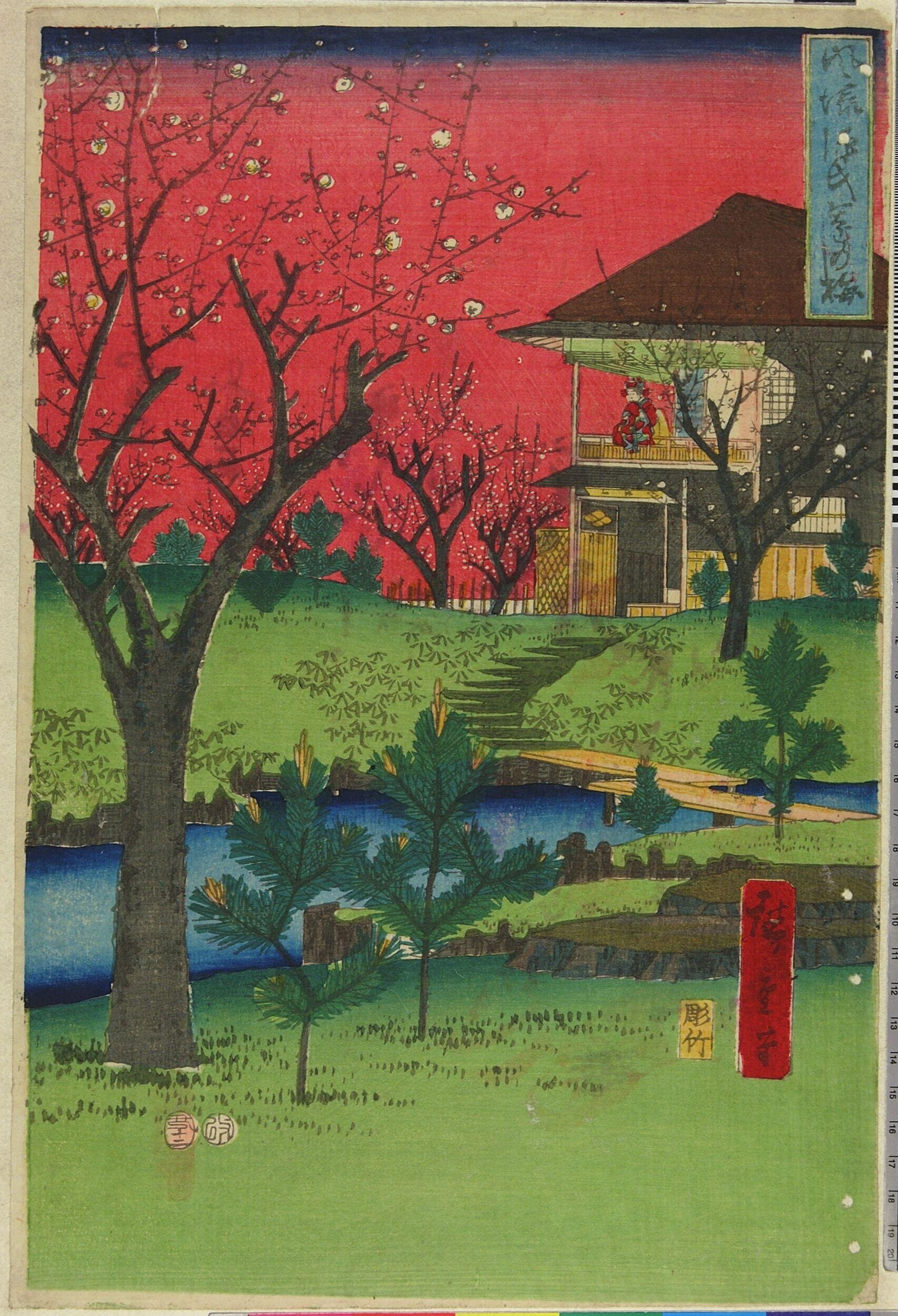
Prince Genji in the Plum Blossom Garden (Fūryū Genji sono ume)
1853
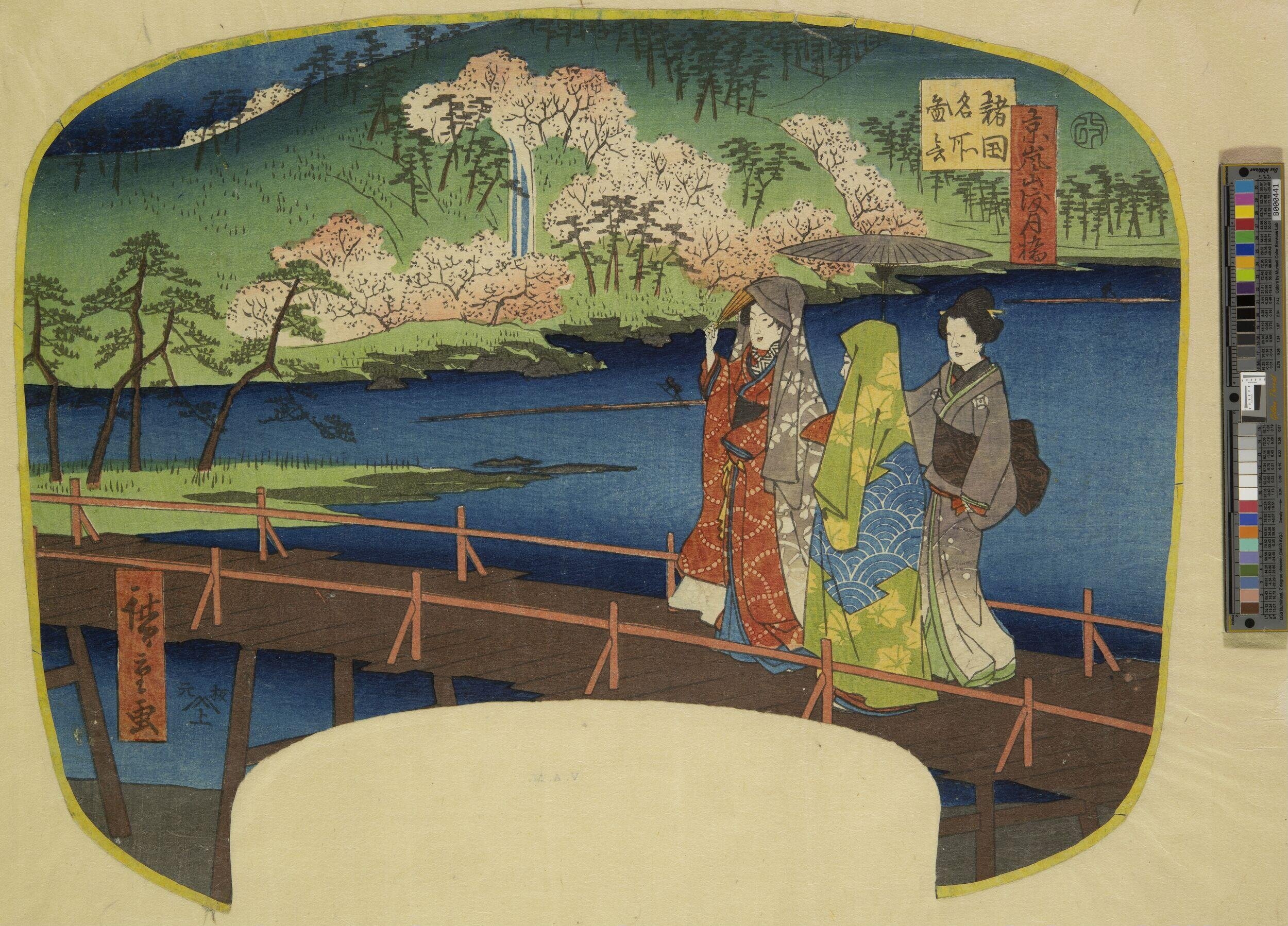
The Togetsu Bridge at Arashiyama in Kyoto
1853-1857
Akashi, from the series Fashionable Genji (Furyū Genji)
1853
Woodblock print (nishiki-e) triptych; ink and color on paper
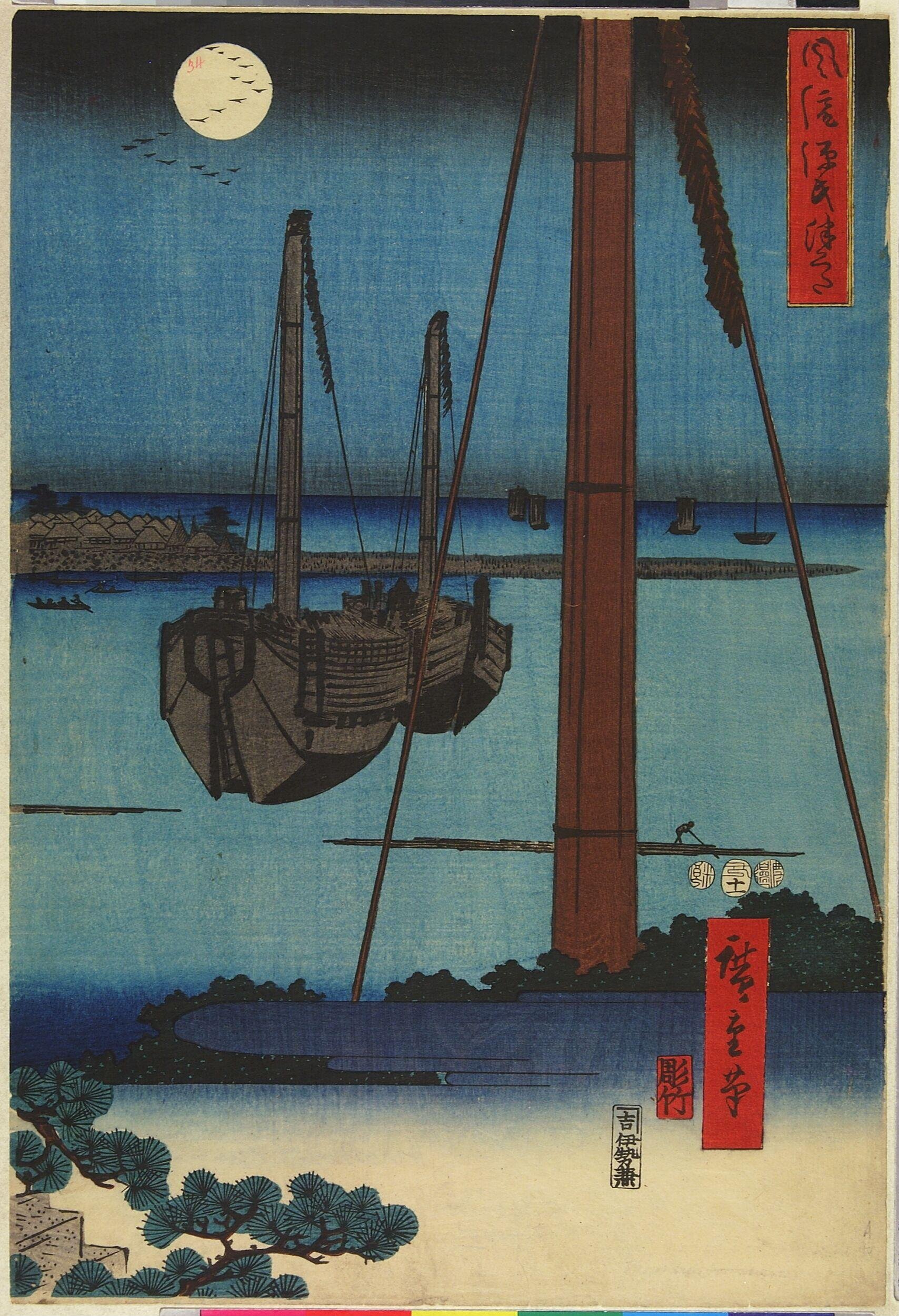
Tsukuda
1853
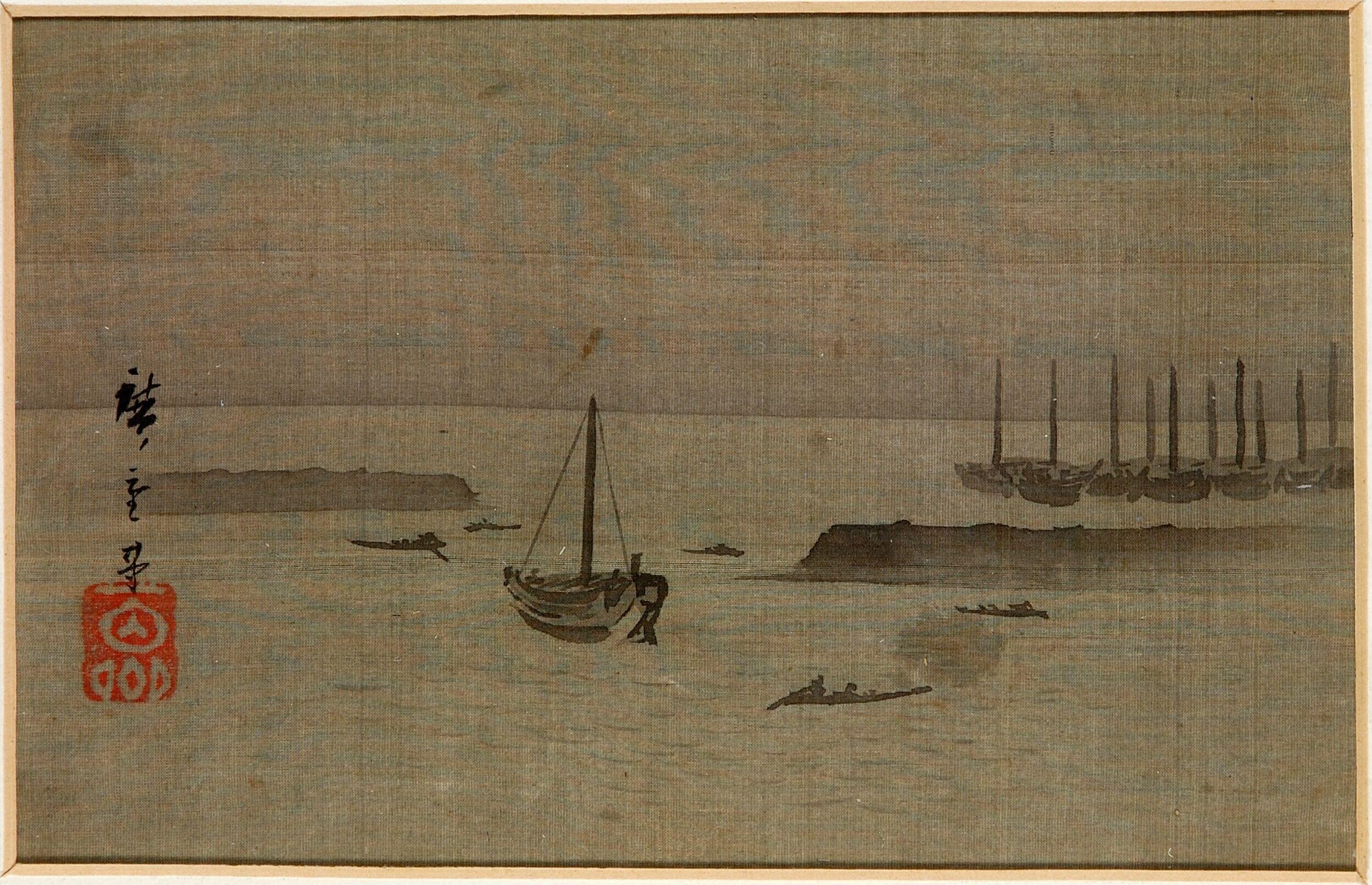
Sea Fortifications
ca.1853 - ca.1855

Awa Province: Inner Bay at Kominato (Awa, Kominato uchiura), from the series "Famous Places in the Sixty-odd Provinces (Rokujuyoshu meisho zue)"
1853
Color woodblock print; oban

Harima Province: Maiko Beach (Harima, Maiko no hama), from the series "Famous Places in the Sixty-odd Provinces (Rokujuyoshu meisho zue)"
1853
Color woodblock print; oban

Omi Province: Lake Biwa and Ishiyama Temple (Omi, Biwako Ishiyamadera), from the series "Famous Places in the Sixty-odd Provinces (Rokujuyoshu meisho zue)"
1853
Color woodblock print; oban

Kingfisher above a Yellow-flowered Water Plant
1853, third month
Color woodblock print; aitanzaku
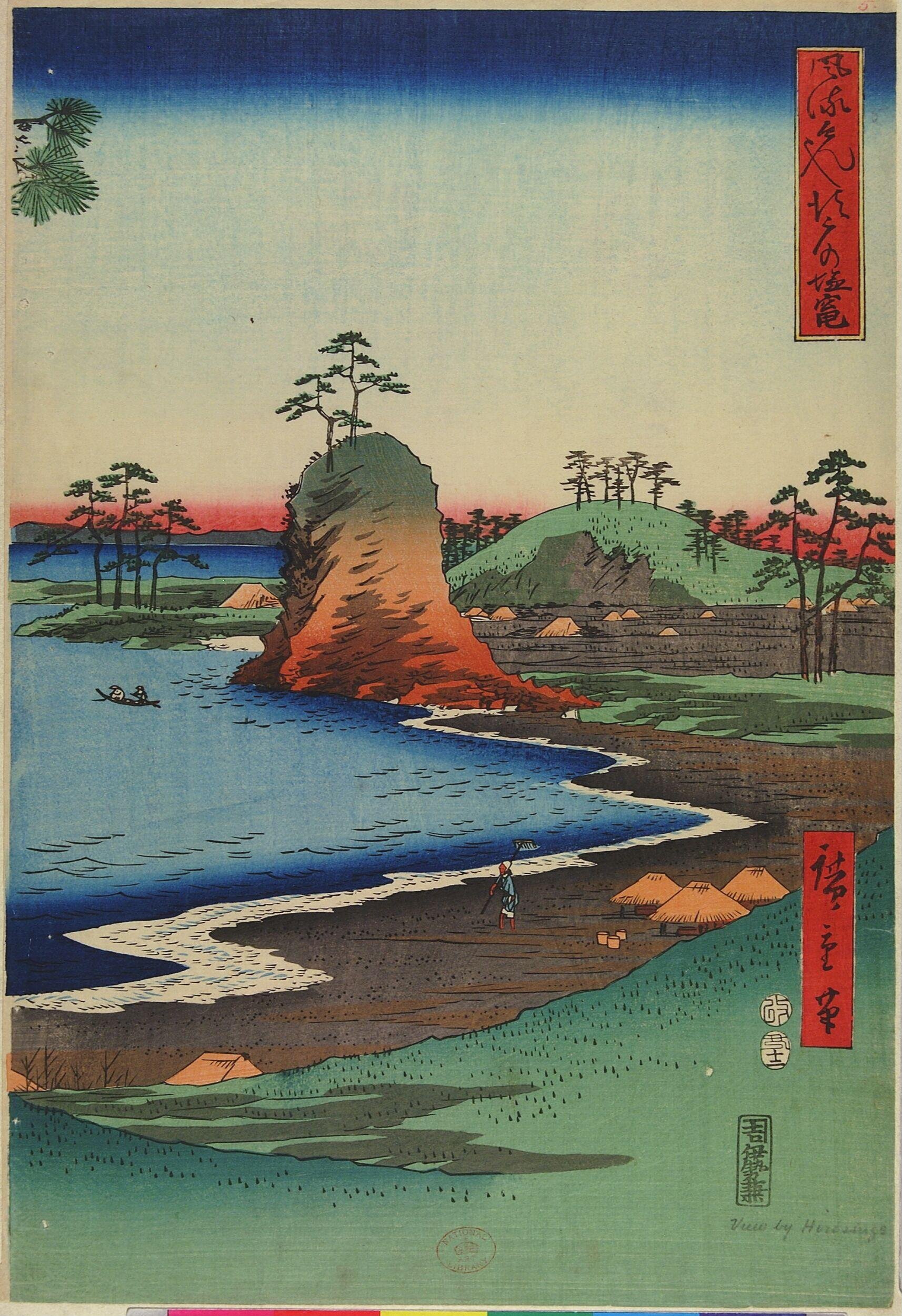
Elegant Genji at the Salt Kilns at Suma (Fūryū Genji Suma no Shiogama)
1853
Owaji Island, from the series Famous Places in the Sixty-odd Provinces [of Japan] ([Dai Nihon] Rokujūyoshū meisho zue)
Edo period, 1853-1856
Ukiyo-e woodblock print in "ōban" format; ink and color on paper, with printed signature reading "Hiroshige hitsu"

Shinano Province: The Moon Reflected in the Sarashina Rice Fields near Mount Kyôdai (Shinano, Sarashina tagoto no tsuki, Kyōdaisan), from the series Famous Places in the Sixty-Odd Provinces (Rokujūyoshū meisho zue)
1853
Color woodblock print; ōban

Shimosa Province: Choshi Beach on the Outer Bay (Shimosa, Choshi no hama Toura), from the series "Famous Places in the Sixty-odd Provinces (Rokujuyoshu meisho zue)"
1853
Color woodblock print; oban

Izu Province: Hot Springs of the Shuzen Temple (Izu, Shuzenji tojiba), from the series "Famous Places in the Sixty-odd Provinces (Rokujuyoshu meisho zue)"
1853
Color woodblock print; oban

Bingo Province: Kannon Temple at Abuto (Bingo, Abuto, Kannondo), from the series "Famous Places in the Sixty-odd Provinces (Rokujuyoshu meisho zue)"
1853
Color woodblock print; oban

Sketch for Autumn Moon at Ishiyama Temple (Ishiyama no shugetsu), from the series "Eight Views in Omi Province (Omi hakkei)"
c. 1859
Ink on paper
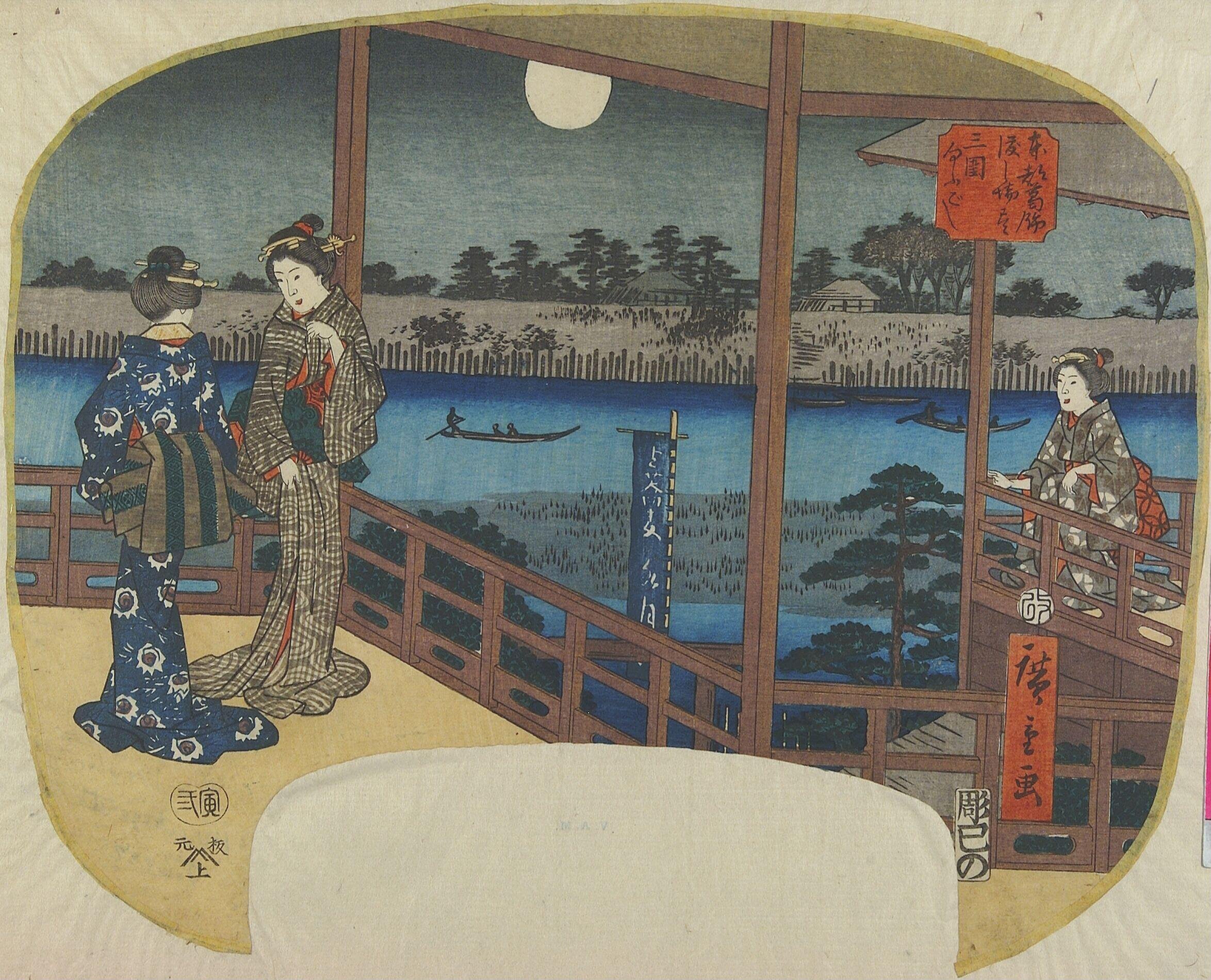
The Mimeguri Shrine from the Opposite Side of the Crossing
1854
The Snowy Garden
1854
Triptych of color woodblock prints, ink and color on paper
Signature Techniques
Mokuhanga techniques most associated with Utagawa Hiroshige.
Compare With
Hiroshige's atmospheric meisho-e tradition extends through Hasui's twentieth-century shin-hanga revival of the same genre.