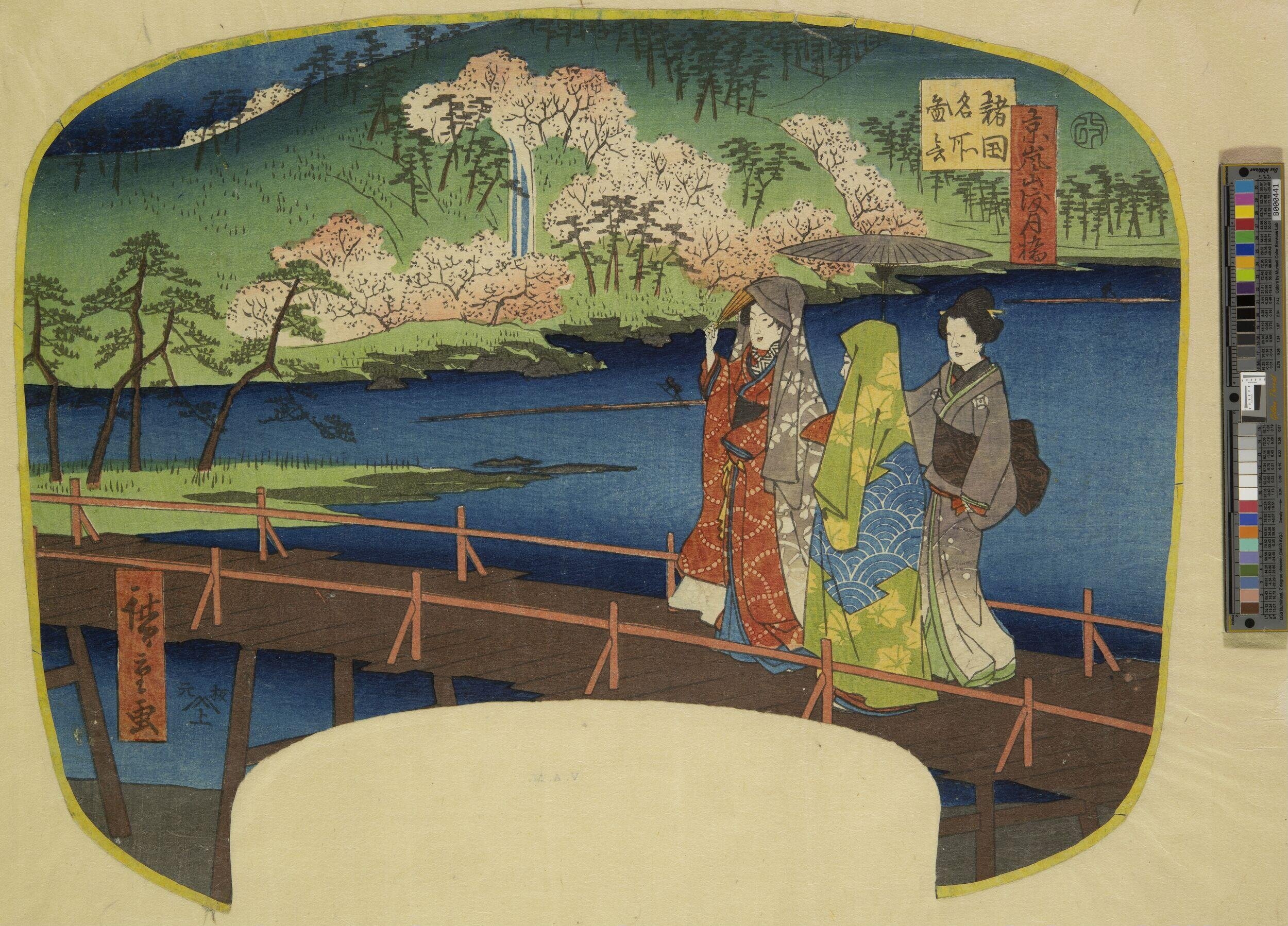
The Togetsu Bridge at Arashiyama in Kyoto
- Date:
- 1853-1857
- Medium:
- Source:
- Victoria and Albert Museum
Description
Dated 1853 and held in the Victoria and Albert Museum, The Togetsu Bridge at Arashiyama in Kyoto is one of Utagawa Hiroshige's Edo ukiyo-e treatments of a celebrated scenic site outside the shogunal capital. Arashiyama, on the western edge of Kyoto along the Katsura River, had been a famous place since classical times for its cherry blossoms, autumn foliage, and the long timber bridge of Togetsukyō ("Moon-Crossing Bridge") that connects the riverbanks. Hiroshige takes a high vantage, allowing the bridge to span the picture diagonally from one side to the other; small figures on its boards establish scale, while boats on the river below indicate the local pleasure traffic associated with the spot. Behind the bridge the wooded slopes of Arashiyama rise in soft layers, and depending on the seasonal cue—pink for cherry, red and ochre for maple—the print becomes either a spring or autumn view. The palette is dominated by mid-range greens and blue-greys, with warmer accents reserved for the foliage and the bridge timbers. As a landscape print, the design situates a specific architectural feature within a famous natural setting, in keeping with Hiroshige's lifelong practice of pairing recognizable structures—a bridge, a torii, a pavilion—with broader scenic backdrops. The Victoria and Albert impression preserves the careful registration and the layered atmospheric perspective for which the artist's mature work was admired.
More Prints by Utagawa Hiroshige


More Landscapes Prints

Lake Kugushi in Wakasa Province (Wakasa Kugushiko), from the series Souvenirs of Travel I (Tabi miyage dai isshu)"
Wakasa Kugushiko
1920
Color woodblock print; oban
Autumn Maple Leaves at Takao, from the album Eight Views of Kyoto (Kyôto hakkei)
Woodblock print

The Beach at Kaiganji in Sanuki Province (Sanuki Kaiganji no hama), from the series "Collection of Views of Japan II, Kansai Edition (Nihon fukei shu II Kansai hen)"
1934
Color woodblock print; oban

Tea Kettle, section of a sheet from the series "Mirror of Stone Rubbings of Views of the Provinces" (Kohon meihitsu ishizuri kagami)
n.d.
Woodblock print; ishizuri-e, section of harimaze sheet
Featured in Collections
Curated cross-cuts that include this print.
Frequently Asked Questions
The Togetsu Bridge at Arashiyama in Kyoto was created by Utagawa Hiroshige (歌川広重) in 1853-1857.
The Togetsu Bridge at Arashiyama in Kyoto depicts landscapes and bridges.