Biography
Utagawa Yoshiharu (歌川芳春, 1828-1888) was a mid-nineteenth-century Edo woodblock print designer of the Utagawa school, best remembered today as a pupil of the great Utagawa Kuniyoshi and as a prolific designer of actor prints, warrior prints, comic compositions, and the new Yokohama-e and kaika-e genres that emerged at the end of the Edo period and into the early Meiji era. He belonged to the densely populated second generation of Kuniyoshi pupils who carried that master's style into the upheavals of the Bakumatsu and Restoration years, and his career documents the transformation of Edo print culture from samurai-era yakusha-e and musha-e into the more topical, news-oriented commercial imagery that defined Japanese prints in the 1860s and 1870s.
Yoshiharu was born in Edo in 1828 and entered the studio of Utagawa Kuniyoshi (1797-1861) as a young man, taking the gō Yoshiharu in keeping with the Utagawa school convention by which pupils received a character from the master's name. Kuniyoshi's studio was one of the most productive in Edo at mid-century, and Yoshiharu worked in the same milieu as the other, better-known Yoshi-pupils, including Yoshitoshi, Yoshiiku, Yoshikazu, Yoshifuji, and Yoshitora.
From the mid-1850s, Yoshiharu produced a steady output of single-sheet prints and series in the established Utagawa idioms. He designed musha-e (warrior prints), including work drawn from the Suikoden (Water Margin) tradition of Chinese and Japanese military romance that Kuniyoshi had transformed into one of the most commercially successful print genres of the 1840s and 1850s. He also produced yakusha-e (actor prints) for the Edo kabuki stage, mitate (visual parodies), and bijinga (pictures of beautiful women). A group of 1857 prints documents the Osaka acrobat Hayatake Torakichi, who toured Edo and became a popular subject; Yoshiharu's images of Torakichi spinning tops at Ryōgoku and performing balancing feats beneath cherry trees, today held in the Metropolitan Museum of Art and the Museum of Fine Arts, Boston, are among his most recognizable works and exemplify the close engagement of Utagawa-school designers with the celebrity entertainments of late-Edo Edo.
During the 1860s, Yoshiharu's practice expanded into the new commercial genres that emerged in response to the opening of Japan to the West. He produced Yokohama-e (Yokohama pictures) documenting the foreigners, ships, and exotic novelties that arrived at the treaty port from 1859 onward, and contributed to the boom in topical news prints that accompanied the political turbulence of the Bakumatsu years. His 1863 triptych "The Great Elephant from a Foreign Land" (Ikoku watari dai zō no zu), today held by the Art Institute of Chicago, is a striking example of this genre: it depicts a live elephant brought to Japan as a foreign curiosity, the kind of imported spectacle that fed Edo's appetite for sensational news. He also designed kaika-e ("enlightenment pictures") in the early Meiji period, prints celebrating the new institutions, fashions, and technologies of Westernizing Japan.
After the Meiji Restoration of 1868, Yoshiharu continued to design prints into the 1870s and 1880s, including prints documenting the foreign circus troupes that toured Japan in the early Meiji years, an early example of Japanese woodblock prints absorbing the global entertainment industries of the modern era. He died in 1888, his late work overlapping with the broader decline of the woodblock medium under pressure from photography and lithography.
Yoshiharu's prints are held today by the Metropolitan Museum of Art, the Art Institute of Chicago, the Museum of Fine Arts, Boston, and other major public collections. He is a minor figure relative to the dominant Kuniyoshi pupils such as Yoshitoshi and Yoshitora, but his work is valued by collectors and scholars of late-Edo and early-Meiji ukiyo-e for its range of subjects, its documentation of the rapid social transformations of the 1860s and 1870s, and the particular charm of his acrobat, warrior, and Yokohama-e compositions in the late Utagawa idiom.
Key Facts
- Active Period
- 1828–1888
- Nationality
- 🇯🇵Japan
- Movements
- Meiji/Taishō PrintsUkiyo-e
- Works Indexed
- 8
Frequently Asked Questions
Utagawa Yoshiharu (歌川芳春, 1828-1888) was a mid-nineteenth-century Edo woodblock print designer of the Utagawa school, best remembered today as a pupil of the great Utagawa Kuniyoshi and as a prolific designer of actor prints, warrior prints, comic compositions, and the new Yokohama-e and kaika-e genres that emerged at the end of the Edo period and into the early Meiji era. He belonged to the densely populated second generation of Kuniyoshi pupils who carried that master's style into the upheavals of the Bakumatsu and Restoration years, and his career documents the transformation of Edo print culture from samurai-era yakusha-e and musha-e into the more topical, news-oriented commercial imagery that defined Japanese prints in the 1860s and 1870s.
Utagawa Yoshiharu was active from 1828 to 1888. They were associated with the Meiji/Taishō Prints and Ukiyo-e movements.
Utagawa Yoshiharu's work was shaped by the Meiji/Taishō Prints and Ukiyo-e traditions in Japanese woodblock printmaking. Meiji/Taishō Prints: Meiji and Taishō era prints (1868–1926) bridge the transition from traditional ukiyo-e to the modern shin-hanga and sosaku-hanga movements. Ukiyo-e: ## What is ukiyo-e? Ukiyo-e ([浮世絵](/glossary/ukiyo-e)) — literally "pictures of the floating world" — is the Edo-period Japanese print and painting tradition that flourished from roughly 1660 to 1868, depicting the pleasures of urban life in Edo (modern Tokyo): courtesans, kabuki actors, sumo wrestlers, famous landscapes, and seasonal beauties.
Original prints by Utagawa Yoshiharu can be found in collections including Metropolitan Museum of Art, Museum of Fine Arts, Boston, Art Institute of Chicago.
Woodblock Prints by Utagawa Yoshiharu (8)

The Brave Woman Tomoe Gozen and Takezo Saburoemon, from the series Famous Warriors in Combat
1856
Woodblock print (nishiki-e); ink and color on paper
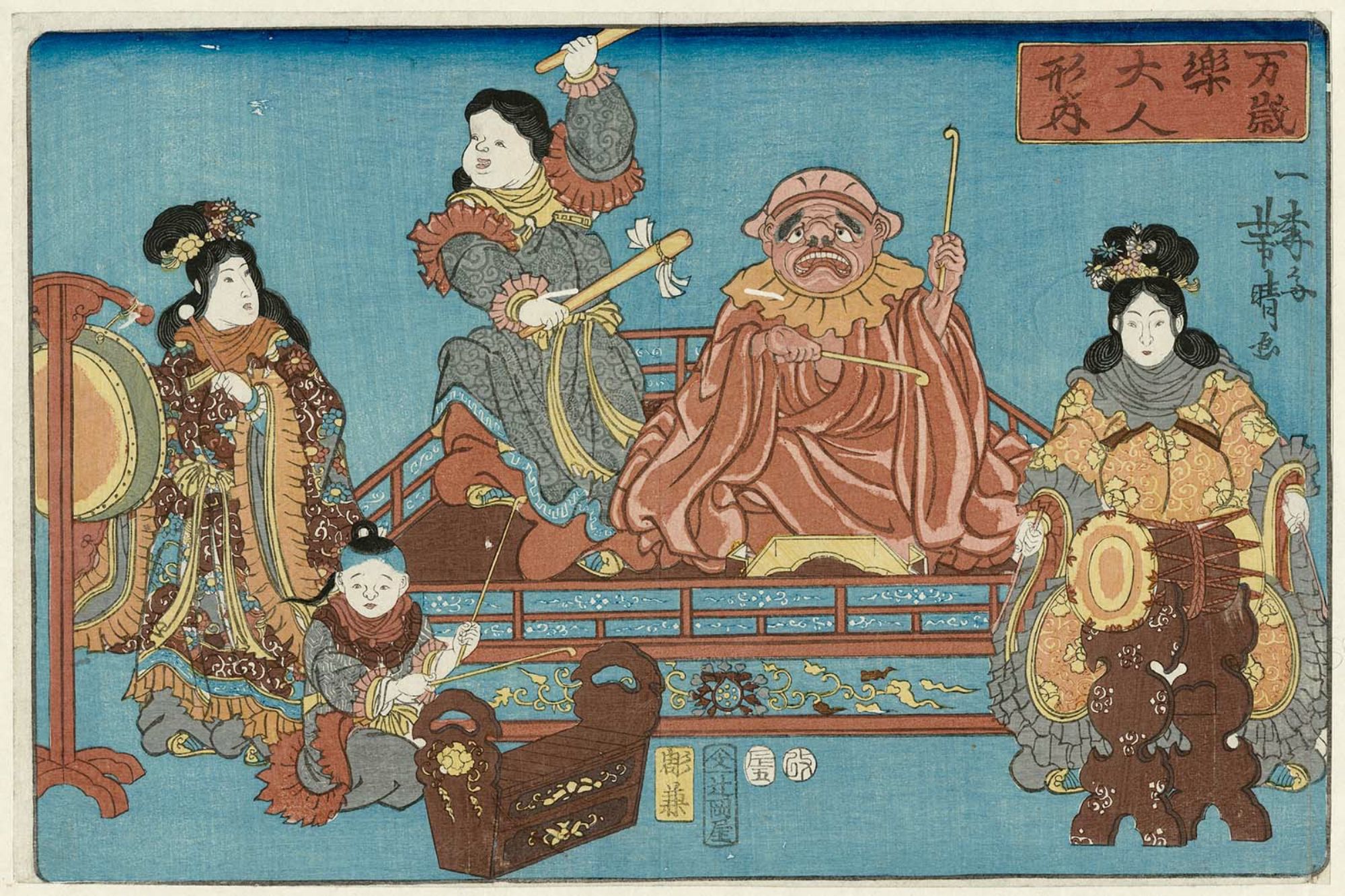
Comic Music (Manzaigaku), from the series Large Dolls
1856
Woodblock print (nishiki-e); ink and color on paper

The Plum Blossom that Flew on Lightning from Chikushino
1857
Woodblock print (nishiki-e); ink and color on paper
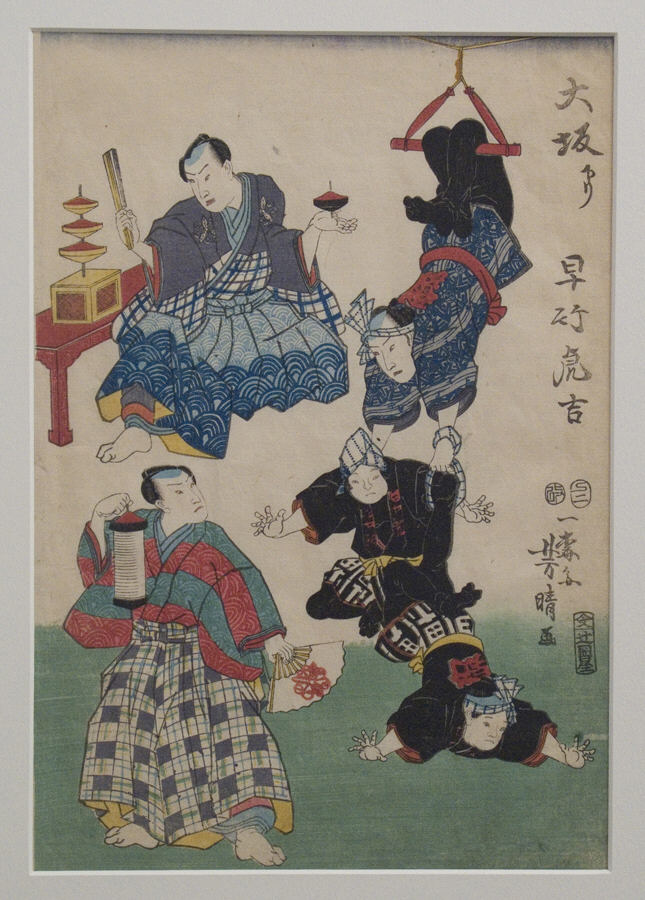
Hayatake Torakichi from Osaka
1857
Woodblock print (nishiki-e); ink and color on paper
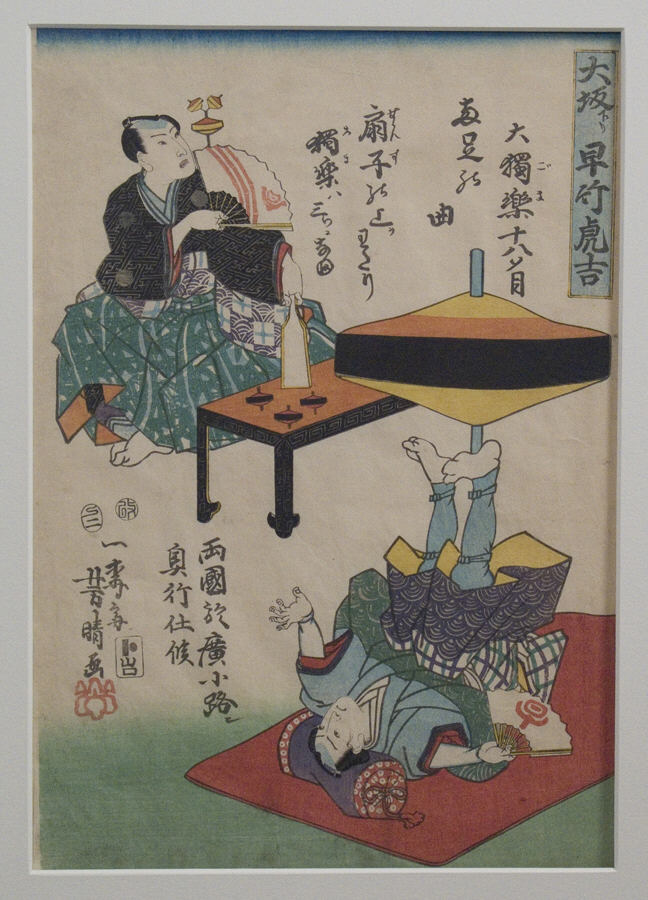
Hayatake Torakichi from Osaka: Spinning Tops in Ryogoku
1857
Woodblock print (nishiki-e); ink and color on paper
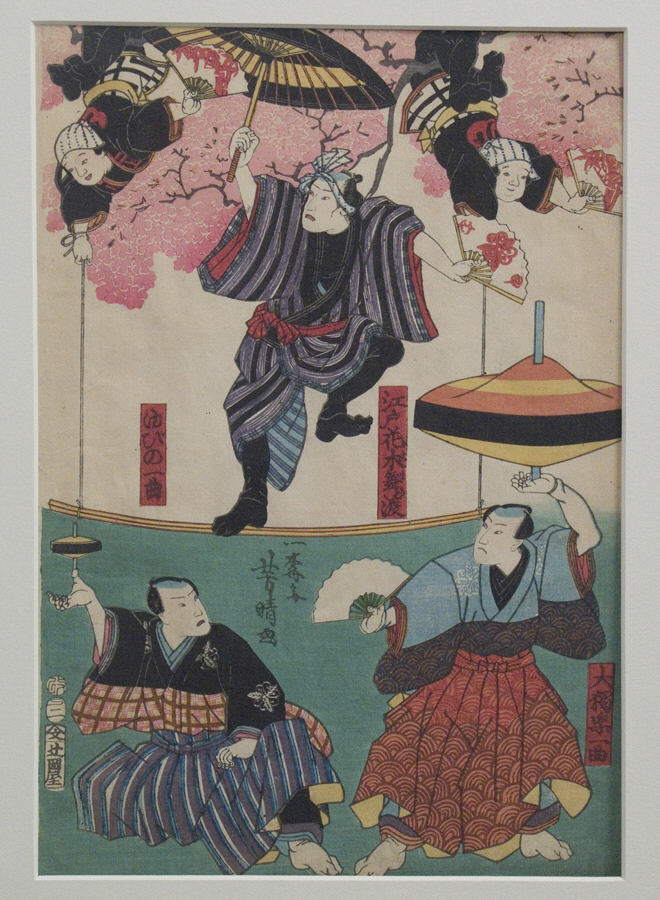
Acrobats Beneath Cherry Trees: Spinning Tops and Balancing
1857
Woodblock print (nishiki-e); ink and color on paper

The Great Elephant from a Foreign Land (Ikoku watari dai zo no zu)
異国渡大象之図
1863
Color woodblock print (nishiki-e), oban triptych
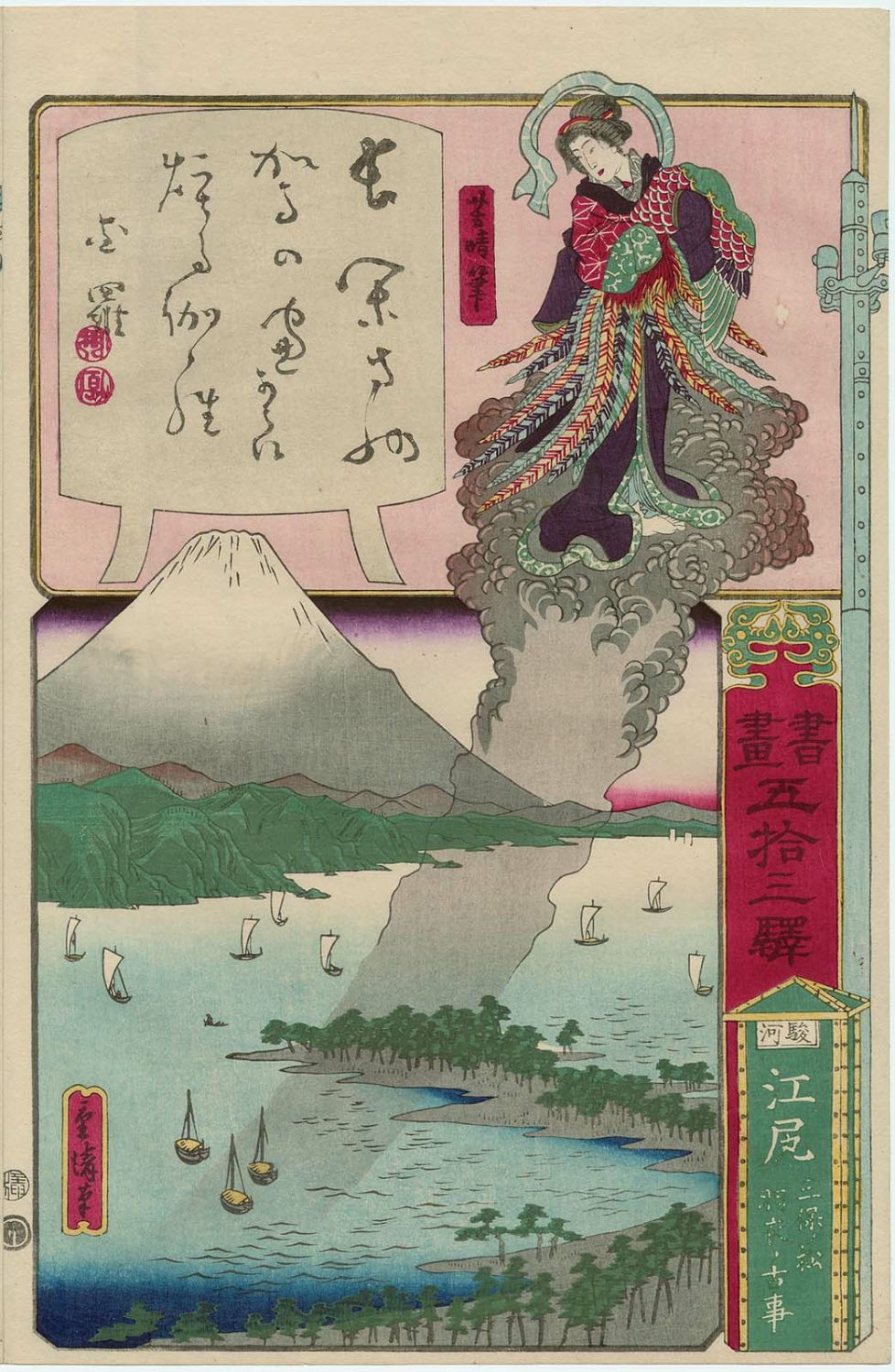
Ejiri in Suruga Province: The Old Story of the Pine of Miho and the Feather Robe
1872
Woodblock print (nishiki-e); ink and color on paper