
Biography
Utagawa Yoshimune I (歌川芳宗, 1817–1880), who worked under the art name Isshōsai (一笑齋), was a Japanese woodblock print designer of the late Edo and early Meiji eras and one of the senior pupils of Utagawa Kuniyoshi (1798–1861). He trained in Kuniyoshi's Edo studio while still a young man, absorbing the boisterous, narratively driven idiom that had made his teacher the most popular print designer of the second quarter of the nineteenth century. He worked alongside the other senior "Yoshi"-named pupils — Yoshitora, Yoshikazu, Yoshifuji, Yoshiiku and the precocious Yoshitoshi — who together carried the Kuniyoshi tradition into the rapidly transforming visual culture of Bakumatsu and early Meiji Japan.
Yoshimune's output is documented across several genres of Edo-period and early Meiji print publishing. He produced musha-e (warrior prints) and ōzumō (sumo) compositions in the dramatic Kuniyoshi manner, including the early-1850s "Procession of Wrestlers for a Fundraising Match" (Kanjin ōzumō dohyō-iri no zu) now held by the Art Institute of Chicago, a vigorous record of the ceremonial entrance of wrestlers into the ring during the charitable kanjin tournaments that were a major event in the Edo sporting calendar. His work is also well represented at the Victoria and Albert Museum, which holds more than two dozen of his sheets — among them a topical 1862 print on how to ease the symptoms of measles — that entered the collection through the museum's landmark 1886 purchase from the London dealer S. M. Franck & Co.
Yoshimune worked through the years when the opening of Yokohama to foreign trade in 1859 was transforming the print industry, as Edo publishers began issuing Yokohama-e depicting the European and American merchants, sailors, and consular families newly settled in the treaty port. That genre was dominated by his fellow Kuniyoshi pupils, with Yoshitora, Yoshikazu, and Utagawa Sadahide producing the largest numbers of Yokohama sheets, documenting Western dress, ships, animals, and architecture for an Edo audience hungry for information about the outside world.
Yoshimune also produced more intimate works for connoisseurs and bibliophiles. The Metropolitan Museum of Art holds a set of his hanshita-e — the preparatory drawings a print designer made for transfer onto the block by the carver — dated to circa 1860 and catalogued as "Chaps. 4, 5 of Legends of the Dog Warriors (Hakkenden)." The Hakkenden, Kyokutei Bakin's epic serialized romance of eight dog warriors descended from a princess and a magical dog, was the most popular long-form novel of the late Edo period and a major source of subjects for warrior prints. Yoshimune's hanshita-e — drawn in ink and light colors on paper, each leaf around 17 by 12 centimeters — give a rare and intimate view of the process by which a Utagawa-school designer translated literary narrative into the disciplined linework that printmakers required.
Yoshimune lived through the upheavals of the Meiji Restoration of 1868 and continued to design prints into the 1870s, though by then the traditional ukiyo-e print trade was in steady decline under pressure from photography, lithography, and Western-style illustrated newspapers. He died in 1880. His eleventh and youngest son, Arai Yoshimune (1863–1941), known as Utagawa Yoshimune II, succeeded to his father's art name in 1882 and went on to become a designer of early twentieth-century shin-hanga prints, sometimes confused with his father in the Western literature. The elder Yoshimune is represented today in the collections of the Metropolitan Museum of Art, the Art Institute of Chicago, and the Victoria and Albert Museum, among other major repositories of Japanese prints — a useful figure for understanding Kuniyoshi's large workshop and the passage of ukiyo-e from the dense urban culture of Edo into the early Meiji era.
Key Facts
- Active Period
- 1817–1880
- Nationality
- 🇯🇵Japan
- Movements
- Meiji/Taishō PrintsUkiyo-e
- Works Indexed
- 5
Frequently Asked Questions
Utagawa Yoshimune I (歌川芳宗, 1817–1880), who worked under the art name Isshōsai (一笑齋), was a Japanese woodblock print designer of the late Edo and early Meiji eras and one of the senior pupils of Utagawa Kuniyoshi (1798–1861). He trained in Kuniyoshi's Edo studio while still a young man, absorbing the boisterous, narratively driven idiom that had made his teacher the most popular print designer of the second quarter of the nineteenth century. He worked alongside the other senior "Yoshi"-named pupils — Yoshitora, Yoshikazu, Yoshifuji, Yoshiiku and the precocious Yoshitoshi — who together carried the Kuniyoshi tradition into the rapidly transforming visual culture of Bakumatsu and early Meiji Japan.
Utagawa Yoshimune was active from 1817 to 1880. They were associated with the Meiji/Taishō Prints and Ukiyo-e movements.
Utagawa Yoshimune's work was shaped by the Meiji/Taishō Prints and Ukiyo-e traditions in Japanese woodblock printmaking. Meiji/Taishō Prints: Meiji and Taishō era prints (1868–1926) bridge the transition from traditional ukiyo-e to the modern shin-hanga and sosaku-hanga movements. Ukiyo-e: ## What is ukiyo-e? Ukiyo-e ([浮世絵](/glossary/ukiyo-e)) — literally "pictures of the floating world" — is the Edo-period Japanese print and painting tradition that flourished from roughly 1660 to 1868, depicting the pleasures of urban life in Edo (modern Tokyo): courtesans, kabuki actors, sumo wrestlers, famous landscapes, and seasonal beauties.
Original prints by Utagawa Yoshimune can be found in collections including Victoria and Albert Museum, Art Institute of Chicago.
Woodblock Prints by Utagawa Yoshimune (5)
Procession of Wrestlers for a Fundraising Match (Kanjin ozumo dohyo-iri no zu)
early 1850s
Color woodblock print; oban triptych

Figure on Plain Ground
19th century
Woodblock print on paper (nishiki-e), chūban format

Aiban Landscape from a Series
19th century
Woodblock print on paper (nishiki-e), aiban format
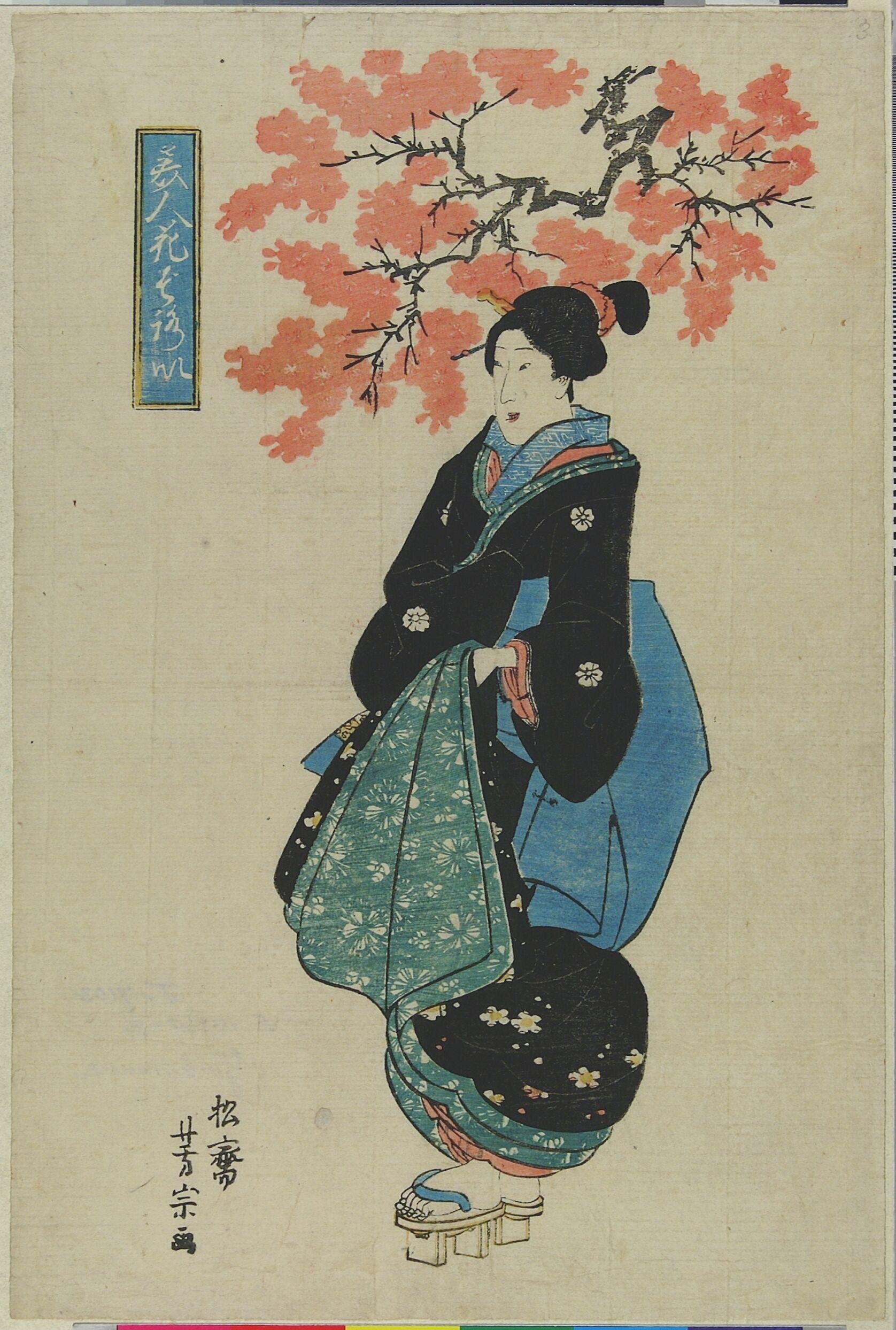
Figure on Plain Ground with Blossoms
19th century
Woodblock print on paper (nishiki-e), aiban format

Figures in Sea-scene (triptych)
19th century
Woodblock print on paper (nishiki-e), ōban triptych