Biography
Walter Joseph Phillips (1884–1963) was a British-born Canadian artist celebrated for his exquisite color woodcut prints of the Canadian landscape, from the lakes and forests of the West to the peaks of the Rocky Mountains. While not strictly a shin-hanga artist, Phillips was profoundly influenced by Japanese woodblock printing techniques, and his masterful synthesis of Japanese printmaking methods with Canadian subject matter produced some of the finest color woodcuts in the history of Canadian art.
Born on October 25, 1884, in Barton-upon-Humber, Lincolnshire, England, Phillips studied at the Birmingham Municipal School of Art before emigrating to Canada in 1913. He settled first in Winnipeg, Manitoba, where he taught art and began developing the printmaking practice that would define his career. He first took up etching after arriving in Canada, but his encounter with the classical Japanese color woodblock print transformed his artistic direction.
Phillips taught himself the Japanese woodblock technique by studying published sources and examining original Japanese prints. He adopted the traditional Japanese method of printing from multiple hand-carved cherry wood blocks, using water-based pigments applied to dampened paper with a baren — the circular rubbing pad used in Japanese printing. This commitment to Japanese methods rather than Western oil-based printing techniques gave his prints a luminosity, transparency, and subtlety of color gradation that set them apart from the work of other Canadian printmakers.
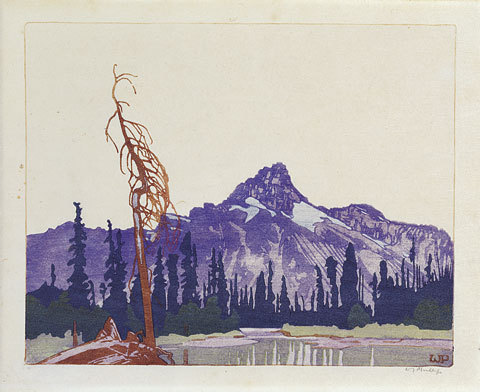
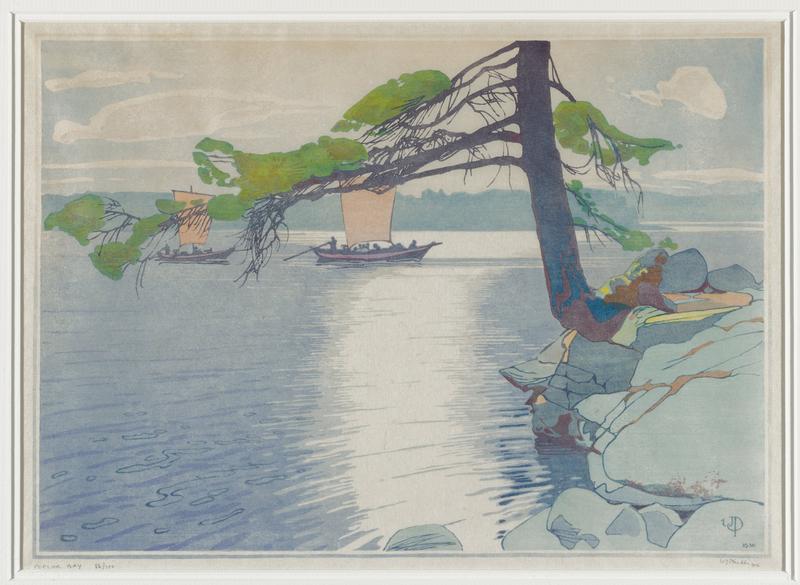
The Canadian landscape became Phillips's great subject — the lakes and forests he came to know during his years in the West, and later the mountains. Works such as "Lake of the Woods," "Lake Louise," "Karlukwees," and "York Boat on Lake Winnipeg" capture the grandeur, clarity, and atmospheric beauty of the Canadian wilderness with a sensitivity that reflects both his Japanese technical training and his deep personal response to the landscape. His prints of the Rockies, depicting emerald lakes ringed by snow-capped peaks under luminous skies, required extraordinary technical skill, the complex gradations of sky, water, and mountain built up from multiple separately carved color blocks.
Phillips's technical mastery of the color woodcut was exceptional. He employed bokashi (graduated color printing) with great skill, creating seamless transitions from one color to another that evoke the atmospheric effects of light on water, snow, and sky. His registration — the precise alignment of multiple color blocks — was remarkably accurate, even when working with large numbers of blocks. He carved his own blocks and printed each impression by hand, maintaining complete control over every stage of the process.
Throughout his career, Phillips exhibited widely in Canada, the United States, and England, establishing himself as one of Canada's foremost printmakers. He was elected a member of the Royal Canadian Academy of Arts and the Canadian Society of Painter-Etchers and Engravers. He also taught at the Banff School of Fine Arts, where he served as a resident artist from 1940 and influenced generations of Canadian printmakers.
Phillips was also an articulate writer on art, publishing "The Technique of the Color Wood-Cut" in 1926, a practical guide that drew extensively on Japanese methods and helped disseminate knowledge of the technique among Western artists. This book remains a valuable reference for printmakers interested in the Japanese-influenced approach to color woodcut.
Phillips died on July 5, 1963, in Victoria, British Columbia. His prints are held in major Canadian collections, including the National Gallery of Canada, the Glenbow Museum, and the Winnipeg Art Gallery, as well as other public collections in Canada and abroad. His work represents one of the most successful and artistically distinguished examples of the Japanese woodblock technique adapted to Western subject matter, demonstrating that Japanese printing methods could serve as a vehicle for expressing artistic visions rooted in entirely different landscapes and cultural traditions.
Key Facts
- Active Period
- 1884–1963
- Nationality
- 🇬🇧United Kingdom
- Movement
- Shin-hanga
- Works Indexed
- 11
Frequently Asked Questions
Walter Joseph Phillips (1884–1963) was a British-born Canadian artist celebrated for his exquisite color woodcut prints of the Canadian landscape, from the lakes and forests of the West to the peaks of the Rocky Mountains. While not strictly a shin-hanga artist, Phillips was profoundly influenced by Japanese woodblock printing techniques, and his masterful synthesis of Japanese printmaking methods with Canadian subject matter produced some of the finest color woodcuts in the history of Canadian art.
Walter J. Phillips was active from 1884 to 1963. They were associated with the Shin-hanga movement.
Walter J. Phillips's work was shaped by the Shin-hanga tradition in Japanese woodblock printmaking. Shin-hanga: ## What is Shin-hanga? Shin-hanga (新版画), literally "new prints," is the early twentieth-century revival of the collaborative Japanese woodblock workshop, organized between roughly 1915 and 1960 by the Tokyo publisher Watanabe Shōzaburō (1885–1962) and a handful of competing houses.
Walter J. Phillips's prints frequently feature landscapes, rivers & lakes, seascapes, travel scenes, winter, snow scenes.
Original prints by Walter J. Phillips can be found in collections including Victoria and Albert Museum, Scholten Japanese Art.