
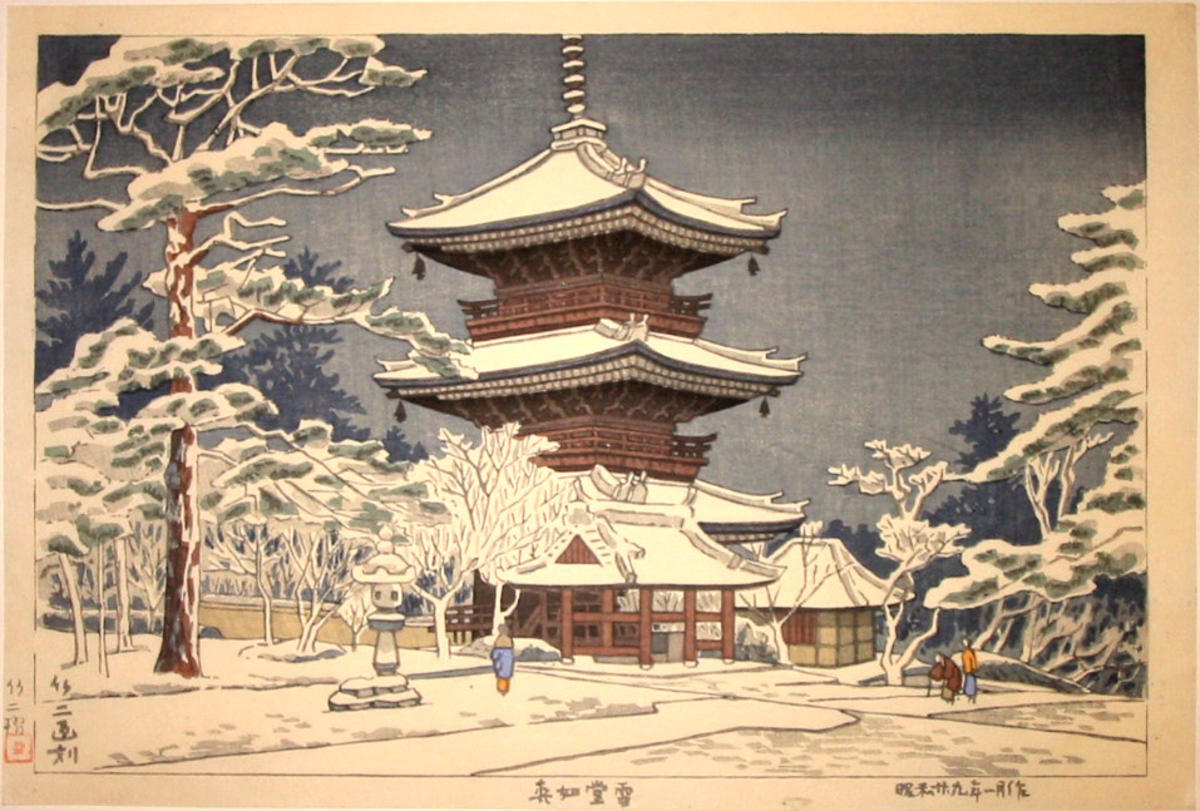
Five Storey Pagoda
by Asada Benji
- Source:
- ukiyo-e.org
Description
Five Storey Pagoda is a Japanese woodblock print associated with Asada Benji, an artist who worked within the shin-hanga tradition of architectural and landscape printmaking that flourished in twentieth-century Japan. The composition takes as its subject one of the most enduring forms in Japanese sacred architecture: the five-storey pagoda, a wooden tower whose tiered roofs descend in measured intervals from a slender spire at the apex. Such pagodas, descendants of Indian stupas adapted through centuries of Chinese and Japanese refinement, mark the precincts of major Buddhist temples and serve as visual anchors in the historic cities of Kyoto, Nara, and the temple complexes around Tokyo. As a shin-hanga subject, the pagoda offered the artist a rich opportunity to balance architectural precision with the atmospheric effects for which the movement is known, working closely with carvers and printers in the traditional collaborative system that distinguished shin-hanga from earlier ukiyo-e workshops. The Japanese woodblock medium suits the subject particularly well: the carved lines render the bracketing systems, eaves, and railings of the tower with clarity, while successive impressions of color blocks allow for graded skies and the soft tonalities of surrounding foliage. Shin-hanga prints of this kind were created during a period when Japanese artists, publishers such as Watanabe Shozaburo and Uchida, and an international audience were rediscovering classical motifs through a modernized lens, blending Western perspective and naturalistic shading with the line-driven sensibility inherited from the floating world tradition. This impression is documented through ukiyo-e.org, which preserves a digitized record of the print and situates it within the broader corpus of twentieth-century Japanese landscape and architectural woodblock prints. For collectors of Japanese woodblock prints, Asada Benji's pagoda compositions represent the meditative, place-centered strand of shin-hanga that emphasized cultural continuity, seasonal mood, and the enduring presence of religious architecture within Japan's evolving modern landscape.
More Prints by Asada Benji


More Pagodas Prints

Featured in Collections
Curated cross-cuts that include this print.
Frequently Asked Questions
Five Storey Pagoda was created by Asada Benji (浅田弁治).
Five Storey Pagoda depicts pagodas.