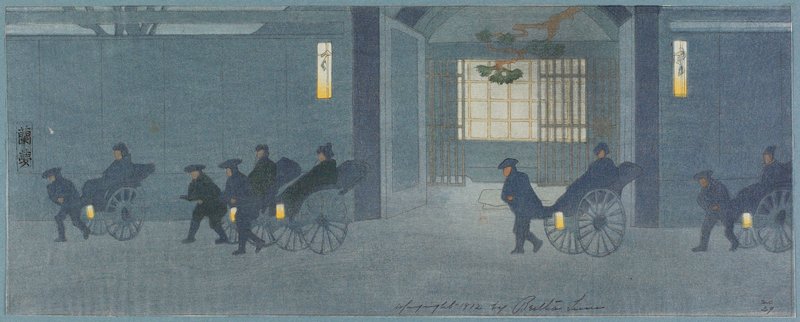
Through the Night
by Bertha Lum
- Date:
- 1912
- Medium:
- Color woodcut
- Dimensions:
- 14.3 × 36 cm
- Source:
- Minneapolis Institute of Art
Description
Figures and landscape merge in darkness in this 1912 color woodcut, where the night becomes an active presence rather than mere absence of light. Lum tackles the technical problem of the nocturnal print — maintaining visual interest and legibility within a predominantly dark palette — by strategically placing light sources or light-toned elements against the enveloping blackness. The "through" of the title suggests passage and movement, a journey undertaken after sundown when familiar terrain becomes mysterious and distances feel amplified. Printing dark areas in water-based woodblock technique requires building up pigment through multiple impressions or using concentrated applications, and the paper must be carefully dampened to accept dense color without blotching. Lum's control of this process allows the night scene to read as velvety rather than muddy.
More Prints by Bertha Lum


More Night Scenes Prints
Evening in East Africa
Woodblock print

Evening Shower at Teradomari (Teradomari no yau), from the series "Souvenirs of Travel, Second Series (Tabi miyage dai nishu)"
Teradomari no yau
1921
Color woodblock print; oban
![Mount Fuji on a Moonlit Night, Kawai Bridge (Tsukiyo no Fuji [Kawaibashi]), from the series "Selection of Views of the Tokaido (Tokaido fukei senshu)" by Kawase Hasui](https://www.artic.edu/iiif/2/d0960668-1e73-339a-b182-fb995a54bff0/full/843,/0/default.jpg)
Mount Fuji on a Moonlit Night, Kawai Bridge (Tsukiyo no Fuji [Kawaibashi]), from the series "Selection of Views of the Tokaido (Tokaido fukei senshu)"
1947
Color woodblock print; oban

Evening Moon at Nakanoshima, Sapporo (Sapporo Nakanoshima no yuzuki), from the series "Collection of Views of Japan, Eastern Japan Edition (Nihon fukei shu higashi Nihon hen)"
March 1933
Color woodblock print; oban
Featured in Collections
Curated cross-cuts that include this print.
Frequently Asked Questions
Through the Night was created by Bertha Lum in 1912.
Through the Night depicts night scenes.
Through the Night measures 14.3 × 36 cm.