
Moon crossing bridge
by Fumio Fujita
- Medium:
- Mokuhanga (Japanese woodblock)
- Image courtesy of
- Saru Gallery
Description
The title refers to Togetsukyo, the wooden bridge spanning the Katsura River at Arashiyama in western Kyoto—a site whose name ("Moon Crossing") derives from a thirteenth-century imperial observation that the moon appeared to traverse the bridge's arc. Fujita's interpretation likely sets the bridge against a low horizon with the moon as a circular form above, rendered through bokashi gradation to suggest atmospheric depth. The composition reduces the structural elements to horizontal and vertical bands, a strategy consistent with his approach to landscape since adopting the sosaku-hanga method around 1963. Where Edo-period meisho-e of the same site emphasised seasonal cherry or maple foliage, Fujita's treatment isolates the geometry of bridge and water, allowing the wood-grain of the cherry block and the absorbency of the washi to register as part of the image. The printing typically employs a limited palette of indigos and umbers.
More Prints by Fumio Fujita

More Bridges Prints
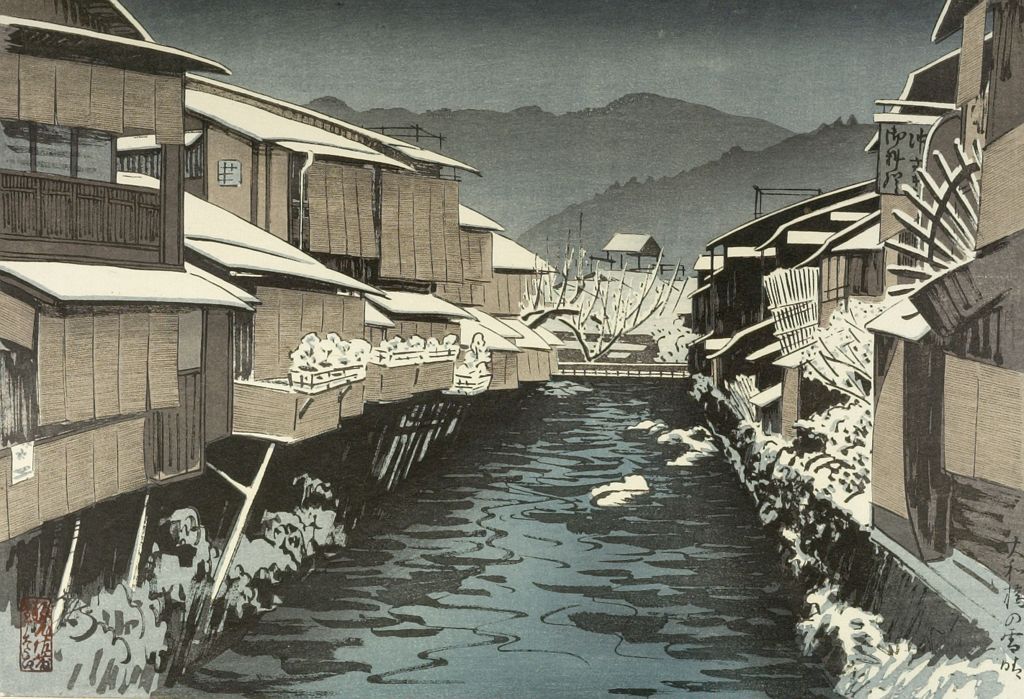
Fair Weather After Snow at Yamato Bridge, Kyoto (Yamato bashi no yukibare), Taishô period, dated 1924
Woodblock print
![Mount Fuji on a Moonlit Night, Kawai Bridge (Tsukiyo no Fuji [Kawaibashi]), from the series "Selection of Views of the Tokaido (Tokaido fukei senshu)" by Kawase Hasui](https://www.artic.edu/iiif/2/d0960668-1e73-339a-b182-fb995a54bff0/full/843,/0/default.jpg)
Mount Fuji on a Moonlit Night, Kawai Bridge (Tsukiyo no Fuji [Kawaibashi]), from the series "Selection of Views of the Tokaido (Tokaido fukei senshu)"
1947
Color woodblock print; oban

Shin Ohashi Bridge (Shin Ohashi), from the series "Twenty View of Tokyo (Tokyu nijukkei)"
1926
Color woodblock print; oban

Sacred Bridge in Nikko (Nikko Shinkyo)
1930
Color woodblock print; oban
Frequently Asked Questions
Moon crossing bridge was created by Fumio Fujita (藤田不美夫).
Moon crossing bridge depicts bridges and moonlight.