Biography
Fumio Fujita (藤田不美夫, born 1933) is a Japanese sosaku-hanga printmaker widely regarded as one of the most accomplished practitioners of contemporary mokuhanga, known for his contemplative landscapes of forests and trees rendered in a style that distills natural forms to their essential geometry. Born in Handa City, Aichi Prefecture, he studied oil painting at Musashino Art School (now Musashino Art University), completing his degree in 1956. He also trained as an art teacher and worked in Tokyo as a graphic designer from approximately 1958 to 1965 before committing fully to printmaking.
Around 1963, Fujita adopted the sosaku-hanga approach of self-drawn, self-carved, and self-printed work, taking complete control over every stage of production. He settled in Atsugi, west of Tokyo, and established his own studio. His earliest prints explored architectural subjects --- the geometric patterns of Japanese latticed screens, the repetitive rhythms of roof tiles, the interplay of shadow and structure --- but he soon gravitated toward the forest landscapes that would become his signature theme.
Fujita's mature work is dominated by his depictions of birch and tree groves, simplified to near-abstraction yet retaining the unmistakable character of specific species and seasons. He reduces tree trunks to vertical columns, branches to angular patterns, and foliage to interlocking planes of color, creating compositions that hover between landscape painting and geometric design. The wood grain of the blocks contributes its own organic texture, and the layered printing of water-based pigments on washi paper produces effects of depth and translucency that distinguish his prints from the flatter graphic work of many contemporaries. His limited editions, typically numbering one hundred or two hundred impressions, are printed with a consistency that reflects decades of technical refinement.
Beyond forest subjects, Fujita's catalog includes abstract compositions and prints combining organic forms with representational elements --- birds among branches, geometric shapes layered over natural textures. Throughout his work, he maintains an emphasis on pattern, texture, and the reduction of visual complexity to essential structures. His approach to printmaking is intensely physical and deliberate: each image requires multiple woodblocks, carefully carved and printed in sequence to build up the complex surfaces and layered atmospheres that characterize his best work.
Fujita exhibited his prints in Japan and internationally throughout his career. His work is held in the collection of the Los Angeles County Museum of Art as well as other institutions in Japan and abroad. He continued producing prints for more than five decades, refining his distinctive fusion of natural observation and modernist abstraction.
Key Facts
- Active Period
- 1933–2020
- Nationality
- 🇯🇵Japan
- Movement
- Contemporary Mokuhanga
- Works Indexed
- 70
Frequently Asked Questions
Fumio Fujita (藤田不美夫, born 1933) is a Japanese sosaku-hanga printmaker widely regarded as one of the most accomplished practitioners of contemporary mokuhanga, known for his contemplative landscapes of forests and trees rendered in a style that distills natural forms to their essential geometry. Born in Handa City, Aichi Prefecture, he studied oil painting at Musashino Art School (now Musashino Art University), completing his degree in 1956. He also trained as an art teacher and worked in Tokyo as a graphic designer from approximately 1958 to 1965 before committing fully to printmaking.
Fumio Fujita was active from 1933 to 2020. They were associated with the Contemporary Mokuhanga movement.
Fumio Fujita's work was shaped by the Contemporary Mokuhanga tradition in Japanese woodblock printmaking. Contemporary Mokuhanga: Contemporary mokuhanga (literally "wood-block print") encompasses artists working from approximately 1970 to the present who continue or reinvent traditional Japanese woodblock printing techniques.
Fumio Fujita's prints frequently feature landscapes, abstract, trees, mountains, spring, night scenes.
Original prints by Fumio Fujita can be found in collections including Japanese Art Open Database, Art Gallery of Greater Victoria, Asian Collection Internet Auction, wbp.
Woodblock Prints by Fumio Fujita (70)
Surface of the Earth A
1967
Woodblock print, ink and color on paper
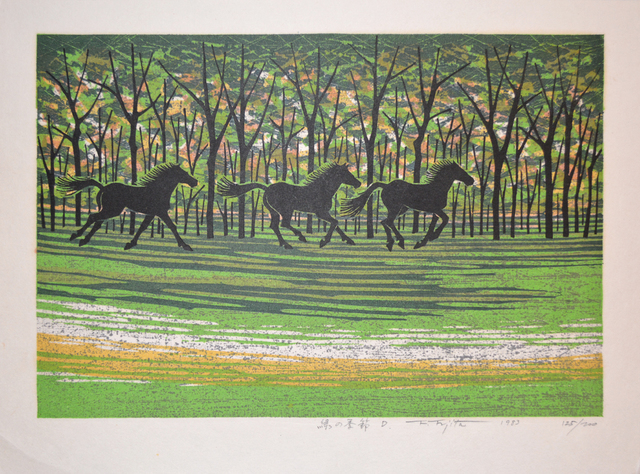
Midori no Kisetsu
1983
Woodblock Print
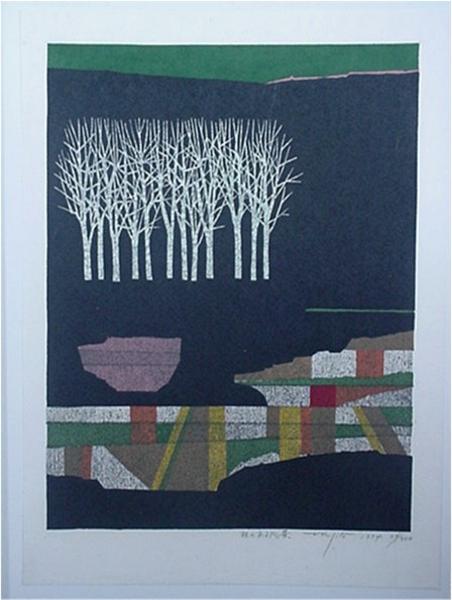
Trees
Woodblock print
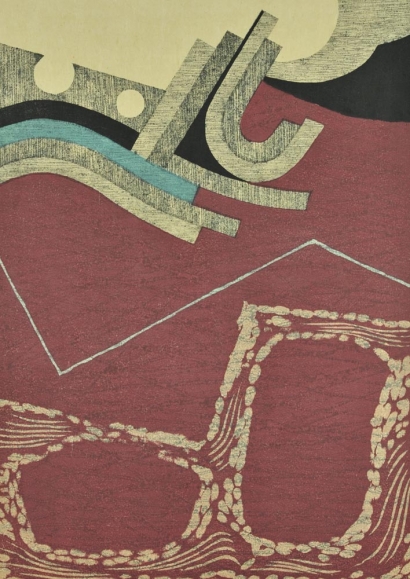
Earth's Surface
Woodblock print
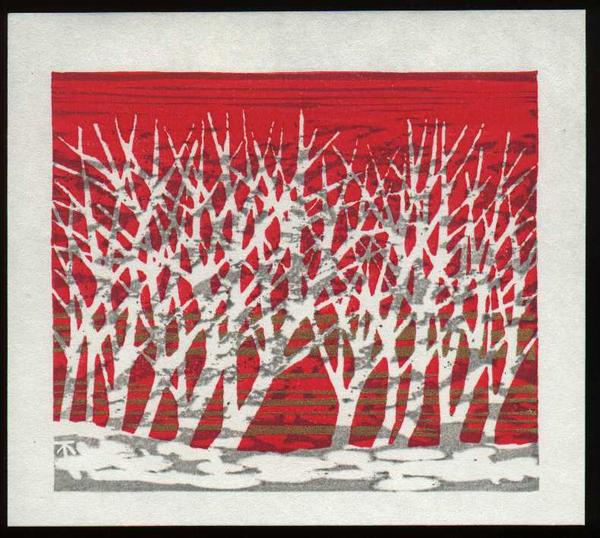
Akebono (Dawn)
Woodblock print

SHIRAKABARIN B (white birch B)
Woodblock print
A Mountain Path in Autumn
Woodblock print
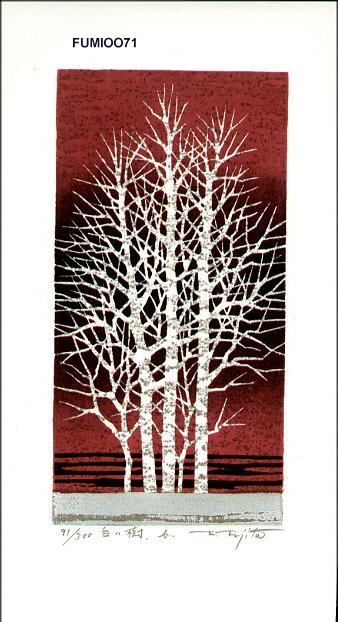
White Tree B
Woodblock print
Spring of a Village among the Hills
Woodblock print
ENOSHIMA YUKEI (Evening Scene at Enoshima)
Woodblock print
DAICHI (earth)
Woodblock print
HAYASHINOMICHI B (path to the forest B)
Woodblock print
Work B
Woodblock print

Seashells
Mokuhanga (Japanese woodblock)

Landscape
Mokuhanga (Japanese woodblock)
A Mountain Path C
Woodblock print
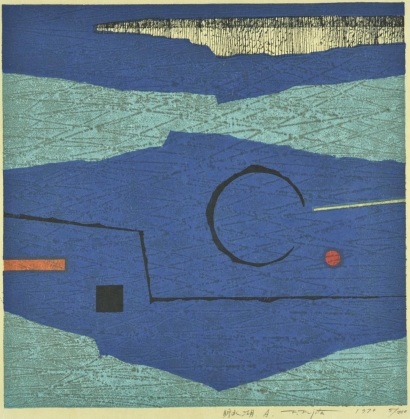
Reservoir
Woodblock print
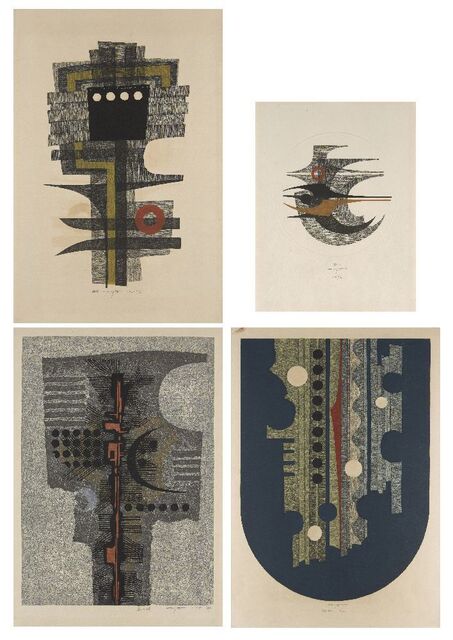
Bird Monument, Mask, Bird C, and Work 68-E
Four woodcut prints in colours on wove
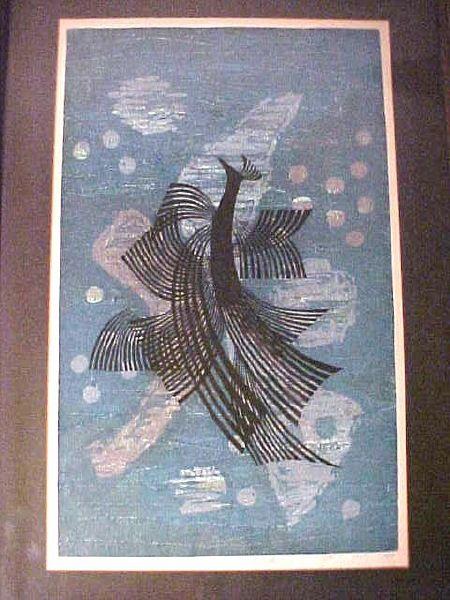
Birds Dance
Woodblock print
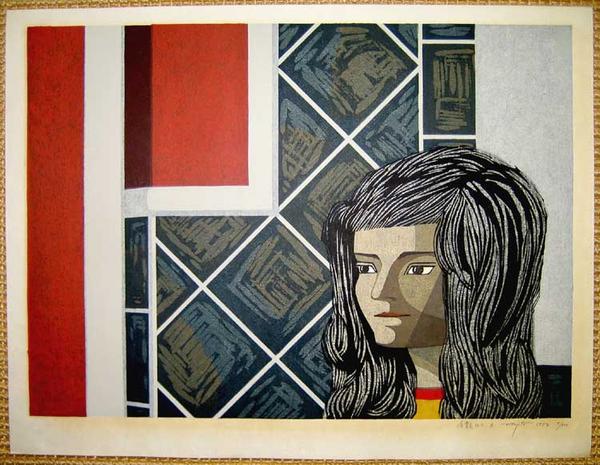
Girl 122 - A
Woodblock print

Shadow of the Sunset
Woodblock print

Pagoda in Itakura
Mokuhanga (Japanese woodblock)

Bamboo grove
Mokuhanga (Japanese woodblock)

White cliff
Mokuhanga (Japanese woodblock)