
View of Mt.Fuji
by Fumio Fujita
- Medium:
- Mokuhanga (Japanese woodblock)
- Image courtesy of
- Saru Gallery
Description
View of Mt.Fuji shows Fujita engaging the most heavily depicted motif in Japanese print history — a subject treated by Hokusai, Hiroshige, and later shin-hanga masters such as Hasui and Yoshida — and reframing it through his contemplative, reductive sosaku-hanga vocabulary. Rather than the dramatic weather effects or topographical specificity of the meisho-e tradition, Fujita's Fuji is likely rendered as a simplified silhouette: a single conical mass set against horizontal bands of foreground and sky, with color held to a few flat fields keyed by the natural tone of the washi. The sharpness of edge typical of his cutting would be tempered by deliberate bokashi along the mountain's slope or at the horizon, registering atmosphere without modeling. Self-drawn, self-carved, and self-printed in keeping with sosaku-hanga principles, the print situates Fuji within Fujita's broader project of distilling Japanese landscape — forests, fields, coast, and mountain — to essential geometry, treating an iconic subject as another form to be reduced rather than monumentalized.
More Prints by Fumio Fujita


More Mount Fuji Prints
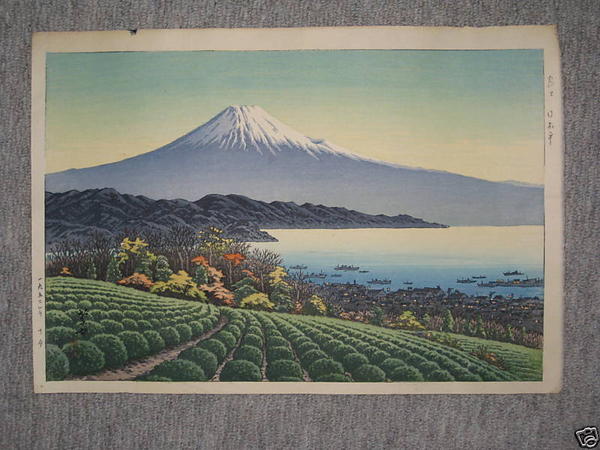
Fuji from tea farm
Woodblock print

Akasaka, Fujikawa, Okazaki, Chiryu, and Narumi, from the series "Famous Places on the Fifty-three Stations of the Tokaido, Five Stations (Tokaido gojusan eki goshuku meisho)"
c. 1830/35
Color woodblock print; oban
![Mount Fuji on a Moonlit Night, Kawai Bridge (Tsukiyo no Fuji [Kawaibashi]), from the series "Selection of Views of the Tokaido (Tokaido fukei senshu)" by Kawase Hasui](https://www.artic.edu/iiif/2/d0960668-1e73-339a-b182-fb995a54bff0/full/843,/0/default.jpg)
Mount Fuji on a Moonlit Night, Kawai Bridge (Tsukiyo no Fuji [Kawaibashi]), from the series "Selection of Views of the Tokaido (Tokaido fukei senshu)"
1947
Color woodblock print; oban

Mt. Fuji in Rain (Ame no Fuji)
n.d.
Color woodblock print
Featured in Collections
Curated cross-cuts that include this print.
Frequently Asked Questions
View of Mt.Fuji was created by Fumio Fujita (藤田不美夫).
View of Mt.Fuji depicts mount fuji and mountains.